
Richmond homeowners usually call about floor tile repairs for the same reason, a crack showed up where the floor used to look fine, or a hollow spot started sounding worse every time someone walked over it. The important part is that tile damage is rarely just a cosmetic issue, and the right fix depends on what's happening under the surface, not just what you can see on top.
In real homes, that means the repair decision starts with diagnosis. A cracked tile in a hallway, a loose edge near a tub, or a grout line that keeps opening back up can point to moisture, movement, or a bonding failure that needs to be handled the right way, especially in Richmond VA homes where older floors, humid summers, and mixed subfloor construction all show up on the job.
Why a Cracked Tile Is Usually a Symptom, Not the Problem
A cracked tile usually shows up last. The floor has already been moving, the bond has already weakened, or moisture has already been working through the assembly, and the tile face is the piece that finally gives you a visible warning. On Richmond jobs, I treat that crack as a diagnostic clue first, because fixing the surface without finding the cause just buys you another failure later.
One tile can crack because of a dropped object. That happens. But a crack that returns, a hollow sound underfoot, or a tile that starts to lift after a damp stretch points to a problem under the finish, not a bad piece of tile. In older homes, that usually means the substrate moved, the thinset let go, or moisture changed the conditions under the floor enough to break the bond.
Practical rule: if a tile failed once, ask why before you spend time on the surface fix.
That approach matters because tile repairs live or die on what is happening below the tile. If the substrate is flexing, if water has reached the setting bed, or if movement joints were left out, a replacement tile can fail in the same spot. The National Park Service notes that moisture intrusion should be addressed before tile repairs, and missing movement joints should be installed before remedial work on ceramic tile floors, which is the kind of detail many consumer guides skip. National Park Service preservation guidance
Richmond homes make that call harder because many floors blend older framing, newer renovations, and mixed subfloors. A bathroom tile that looks like a simple crack can trace back to a moisture issue at the shower, a soft spot in the underlayment, or a previous repair that never bonded well. If you are trying to sort out whether the problem started with water, read this guide on water damage flooring before you choose a patch, because water changes both the repair method and the odds that the fix will hold.
The same judgment applies in bathrooms where the walls and floor are both part of the moisture problem. If you are comparing finishes during a remodel, bathroom wall ideas for remodeling can help you think through how tile, wall materials, and water exposure have to work together in a finished space.
Four Common Floor Tile Problems Homeowners Face
A cracked tile usually gives away more than the crack itself. On a Richmond job, I look at the shape of the break, the grout around it, and whether the tile sounds different from the rest of the floor before I decide on a repair. That quick check tells you whether you're dealing with one bad tile or a floor that is starting to move underneath it. If the cause is movement, moisture, or bond failure, a patch can look fine for a while and still fail again.
Hairline cracks and split tiles
These show up as a visible line across the face of the tile. Sometimes the line is clean and sharp, and sometimes it spreads out from a point of impact, like a dropped pan or a heavy object. If the crack stays in one tile and does not run into the grout joints, replacement is usually the cleaner option.
Chips and small gouges
Chips are a different repair because the tile is still mostly intact. They usually appear at edges, near appliance corners, or in the path of regular foot traffic where shoes and grit keep hitting the same spot. If the damage is shallow, a filler repair can work, but once the chip breaks deeper into the body of the tile, replacement is usually the better finish.
Loose or hollow tiles
These are the ones homeowners notice before they even look closely. Tap the tile with a knuckle or a coin, and a hollow sound usually means the tile has separated from the substrate. I hear that most often in entries, kitchen routes, and bathroom transitions, where moisture and foot traffic both work on the floor.
Failing grout and caulk joints
A lot of people call these tile cracks, but the tile itself may still be fine while the joint system is opening up. Grout that crumbles, caulk that pulls away, and darkened joints at transitions all point to a maintenance problem that can let water through. If the joint is the actual failure, patching the tile won't solve it. In some rooms, it makes more sense to look at a larger finish update, and tile floor refinishing can be part of that conversation when the surface damage is widespread.
A tile floor can look minor from standing height and still be telling you the joint system is starting to fail.
What Causes Floor Tiles to Fail in the First Place
A tile usually fails because something below it changed. The surface can still look fine while the bond underneath is already weak, which is why the repair question starts with diagnosis, not patching. If the thinset never grabbed the substrate properly, the tile may sound hollow and stay in place for a while before it finally lets go. If the floor moves, the tile can crack even when the installation looked solid on day one.
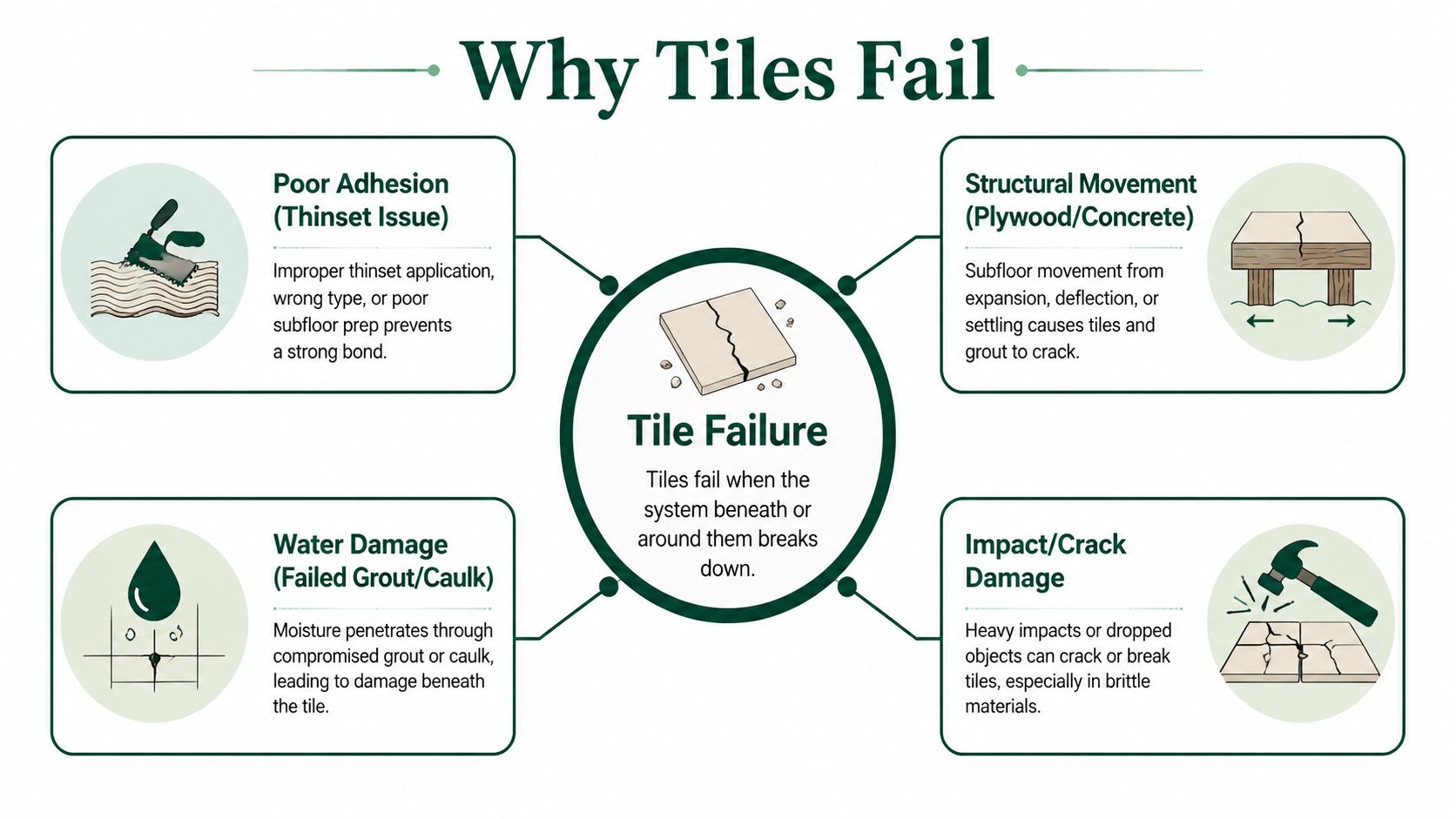
Concrete and plywood fail in different ways, so the same crack does not mean the same fix. A crack on a stable slab may stay isolated, while a crack over a plywood subfloor that flexes under load can point to movement across a wider area. The eGyanKosh floor repair reference makes that distinction clear, and I use that kind of check before I decide whether a floor needs a local repair or a bigger correction. eGyanKosh floor repair reference
Movement, moisture, and bonding loss
Moisture is a common culprit, especially when it reaches the setting bed or the floor structure itself. The National Park Service ceramic tile repair guidance says moisture intrusion should be addressed before repair, and it also points out that shrinkage cracks may need a cleavage membrane, while missing movement joints should be installed before remedial work begins. National Park Service ceramic tile repair guidance
Bond failure often shows up in rooms that get repeated stress. Kitchen paths, bath entries, and laundry areas take more movement, more spill exposure, and more impact from dropped items, so the tile and grout there can fail faster than in a quieter room. In Richmond homes, older framing, patched subfloors, and mixed-age remodels make that diagnosis matter even more because the visible crack is often just the place where a broader problem finally showed itself.
Garage and utility spaces have their own trade-offs. If you are comparing repair options in a tougher setting, Firm Foundations garage tile advice is a useful reference because the same bonding and movement problems show up there, only with more abuse from traffic, temperature swings, and heavier loads.
Effective Repair Methods for Floor Tiles
Loose or hollow tile
Start with the tap-test, because a hollow sound tells you the tile has lost bond somewhere under it. Drill small access holes through the grout line, vacuum out the dust, and inject a bonding adhesive into the void. Then load the tile with weight, usually 20 to 40 lb, for at least 24 hours so the adhesive cures under pressure. Fix A Floor repair method shows that workflow clearly, and it is meant for intact tiles that have debonded, not for tiles that have split or broken apart.
Cracked or broken tile
A clean replacement starts with the grout. Remove the grout around the tile first, then break and lift the tile from the center outward so the fracture does not travel into the neighboring pieces. Scrape the old adhesive back to a clean, level substrate, dry-fit the replacement to confirm the opening, then reset it with fresh adhesive before grouting.
The trade-off is simple. If the surrounding field is sound, a single-tile replacement holds up well. If the crack came from movement, the new tile can fail the same way unless the underlying problem is corrected first.
Grout and caulk problems
Grout repair is about restoring the joint system, not just packing a crack with filler. Check the whole floor for loose tiles, remove damaged mortar by hand, wet the joints or apply a bonding agent, then regrout with material matched to the existing grout in color and consistency. That same approach applies when perimeter caulk has opened up and the joint needs to move again without tearing the tile loose.
If the floor has repeated grout loss in the same area, the joint is usually reacting to movement, not just age. In those cases, a fresh fill helps for a while, but it does not solve a substrate or expansion problem below the surface.
When a repair is more than a patch
A small repair makes sense when the damage is local and the rest of the floor is stable. Once the trouble spreads across several tiles, or the failure keeps returning in the same zone, surface work stops being a smart use of time.
For tile floor refinishing and larger surface restoration decisions, compare the visible damage with the rest of the room before you choose a fix. If you are deciding whether a spot repair is enough or whether the whole area needs attention, this tile floor refinishing guide is a useful companion read.
What Floor Tile Repairs Really Cost
A cracked tile can look like a small cosmetic problem, but the price depends on what caused the failure and how far it has spread. If the bond underneath is sound and the damage is isolated, the repair stays straightforward. If the tile is breaking because the substrate moves, the thinset let go, or moisture is working through the floor, the bill rises because the fix has to address more than the visible surface.
HomeAdvisor's repair data puts typical grout-and-tile repair costs at $466, with many jobs landing between $280 and $662 and a broader range from $140 to $1,150. For floor repairs specifically, the same source shows a spread of $50 to $700. Those numbers align with the situation on Richmond jobs, where a single cracked tile is one price, and a repair that turns into demo, prep, and matching work is another. HomeAdvisor tile and grout repair cost data
The part homeowners do not see is what drives the job above a basic patch. Substrate repair, water-damage mitigation, and discontinued-tile sourcing can push a repair up quickly, especially when the replacement tile has to be tracked down or fabricated to fit what is already there. On older homes, the tile search can take as much time as the installation itself. That is usually the point where a repair stops being a simple surface fix and becomes a diagnostic job.
| Repair Type | Typical Cost Range | Typical DIY Time | Typical Pro Time |
|---|---|---|---|
| Small chip or cosmetic crack repair | Qualitative, usually lower than full replacement | One afternoon | Often same day |
| Single cracked tile replacement | $130 to $500 | Half day to a full day | Often one visit plus cure time |
| Regrouting | $100 to $700 | One day | One visit plus cure time |
| Floor repair with broader damage | $50 to $700 or more depending on scope | Varies by condition | Varies by condition |
A wide repair range also reflects labor skill. The U.S. Bureau of Labor Statistics reports a median annual wage of $52,000 in May 2024 for flooring installers and tile-and-stone setters, with employment projected to grow 6% from 2024 to 2034 and about 8,400 openings per year on average. That matters because tile repair is not just hand work, it is layout, removal, substrate judgment, and finish matching. For many Richmond homeowners, that makes a professional repair more practical than trying to force a cheap fix onto a floor that already failed once. BLS occupational outlook for flooring installers and tile-and-stone setters
If the repair is part of a bigger renovation, it helps to browse rehab mortgage programs and see how flooring work fits into the overall budget.
When to DIY and When to Call a Professional
A chipped tile on a floor that still feels solid is a reasonable DIY repair for many homeowners. A loose tile can also be handled at home if there is no sign of water staining, the adhesive choice is right, and you are willing to wait for proper cure time. Once the tile starts breaking in more than one spot, the question is no longer just how to patch it.
The decision points that matter
- Extent of damage: One tile is a different job from a cluster, and a cluster usually means the problem reaches beyond the visible surface.
- Substrate condition: Flex, movement, soft spots, or a recurring hollow sound point to a problem under the tile, not just on top of it.
- Water evidence: Staining, damp grout, or damage near a tub, shower, or exterior entry deserves a closer look before any repair starts.
- Tile matching: If the tile line is discontinued, finding a close match can take more effort than the replacement itself.
- Removal risk: Older tile can chip the neighbors during extraction, especially when part of the bond is strong and part of it has already failed.
If the repair means opening more than two tiles, or moisture is already part of the picture, it is time for a professional look.
That matching issue comes up often in Richmond's older homes. A tile that looks close in the showroom can read very differently in natural daylight once it is installed, which is why the better call is sometimes a targeted repair instead of forcing a near-match. For homeowners comparing service types and trying to figure out where repair ends and a larger project begins, tile installation companies can help set that boundary before the work starts.
Buff & Coat Hardwood Floor Refinishing can also look at related floor issues when tile repair is part of a broader flooring decision in Richmond VA.
Preventing the Next Repair
The joint system is what keeps most tile floors stable. Grout and caulk need attention before water gets a path into the floor assembly, and a clean, intact joint line does more for longevity than a cosmetic patch ever will. In real homes, the simplest habit is to look closely at the bathroom, kitchen, and entry transitions a few times a year, especially after seasonal changes.
What to watch for
- Hairline cracks that keep widening: Seasonal change can make a weak area easier to spot.
- Hollow sounds underfoot: A tile that starts sounding different deserves attention before it becomes a full break.
- Caulk pulling away: Separations around tubs, thresholds, and backsplashes are small warning signs with big consequences.
- Grout that keeps darkening or crumbling: That often means moisture is getting in or the joint is aging out.
Richmond weather adds its own stress. Freeze-thaw cycles can be hard on exterior and entryway tile, and older homes in places like the Fan, Church Hill, and Bon Air often have tile over plywood subfloors that are long past their easiest years. That doesn't mean every tile floor is a problem, but it does mean the floor deserves a closer look when a crack shows up.
For homeowners weighing repair against broader hardwood work, Buff & Coat Hardwood Floor Refinishing also handles floor installation Richmond, hardwood floor refinishing, dustless sanding, buff and coat service, and wood floor recoating when tile work is only one part of the update. If you're still deciding whether the floor needs a spot repair or a bigger reset, the right move is a quick inspection, not guessing.
Why Richmond Homeowners Choose Buff & Coat
- 15 years in business
- Dustless sanding systems
- Local, owner-operated
- High-quality finishes
- Clear pricing and honest advice
- 5-star customer service
Ready to restore your floors with a repair that lasts? If you're in Richmond, Midlothian, Chesterfield, Henrico, Glen Allen, Short Pump, or Mechanicsville, Buff & Coat can look at the damage and give you a straight answer about whether the fix should be local or part of a bigger floor plan.
Richmond homeowners dealing with cracked, loose, or hollow tile don't need a sales pitch, they need a clear diagnosis and a repair that holds up. If you want honest guidance on floor tile repairs and related flooring work, visit Buff & Coat Hardwood Floor Refinishing and request a free estimate.