Richmond homeowners finishing a basement usually start with the wrong question. They ask which floor looks best, then find out the issue is whether it can survive moisture, cold concrete, and a slab that's never perfectly flat. If you want the best flooring for basement space in Richmond VA, the smart answer is simple, pick a floor that handles failure first, style second.
| Flooring Type | Moisture Tolerance | Best Basement Use | Verdict |
|---|---|---|---|
| SPC Luxury Vinyl Plank | Excellent, 100% waterproof | Finished living space, rec room, family room | Best all-around choice for most homes |
| Porcelain Tile | Excellent, 100% waterproof | Flood-prone basements, upscale finishes | Strongest long-term pick if cold floors don't bother you |
| Engineered Hardwood | Moderate, moisture-sensitive | Dry, climate-controlled finished spaces | Use carefully, only with a tested slab |
| Water-Resistant Laminate | Limited | Budget-only projects | Cheaper up front, riskier below grade |
| Polished Concrete | Excellent once sealed | Utility rooms, modern minimal spaces | Tough and low-maintenance, but not warm |
| Epoxy Coating | Excellent | Workshops, mechanical rooms | Practical, not cozy |
| Rubber Flooring | Good | Gyms, play zones | Niche choice that works where comfort matters more than looks |
| Carpet Tiles | Low to moderate | Dry bonus rooms, temporary finishes | Comfortable, but the first to suffer when moisture shows up |
Why Basement Flooring Is a Different Decision
A homeowner can walk into a showroom in Richmond VA and fall in love with a wood look, then get home and realize the basement slab changes the rules. Below grade, the floor has to deal with moisture vapor, colder temperatures, and less natural drying than the main level. That's why a floor that performs beautifully upstairs can fail fast downstairs.
The basement doesn't play by upstairs rules
Concrete looks solid, but it still moves moisture. In Richmond, seasonal humidity and clay-heavy soils can keep pushing vapor through a slab even when it feels dry to the touch. That's why basement flooring is less about style samples and more about whether the material can tolerate a damp environment without swelling, warping, or growing mold.
The whole point of this guide is to help you avoid the expensive mistake of installing a floor that looks great for a year and then starts cupping, smelling musty, or breaking at the seams. A lot of people want carpet because it feels warmer, or hardwood because it matches the rest of the house. In a basement, those instincts need to get checked fast.
Practical rule: if a floor can't handle moisture from below, it doesn't belong in a basement, no matter how nice it looks in a brochure.
That's why the conversation in Richmond VA keeps coming back to waterproof resilient surfaces, especially SPC luxury vinyl plank and porcelain tile. Consumer guidance consistently puts vinyl at the top of the room-by-room list for moisture-prone spaces, and basement-specific guides single out SPC as the best overall basement option because it is built for damp conditions, not just decoration Consumer Reports.
If you're trying to decide what belongs in a finished basement, don't start with the prettiest sample. Start with the slab. That one decision controls whether the room still looks good five years from now.
What Actually Kills Basement Floors
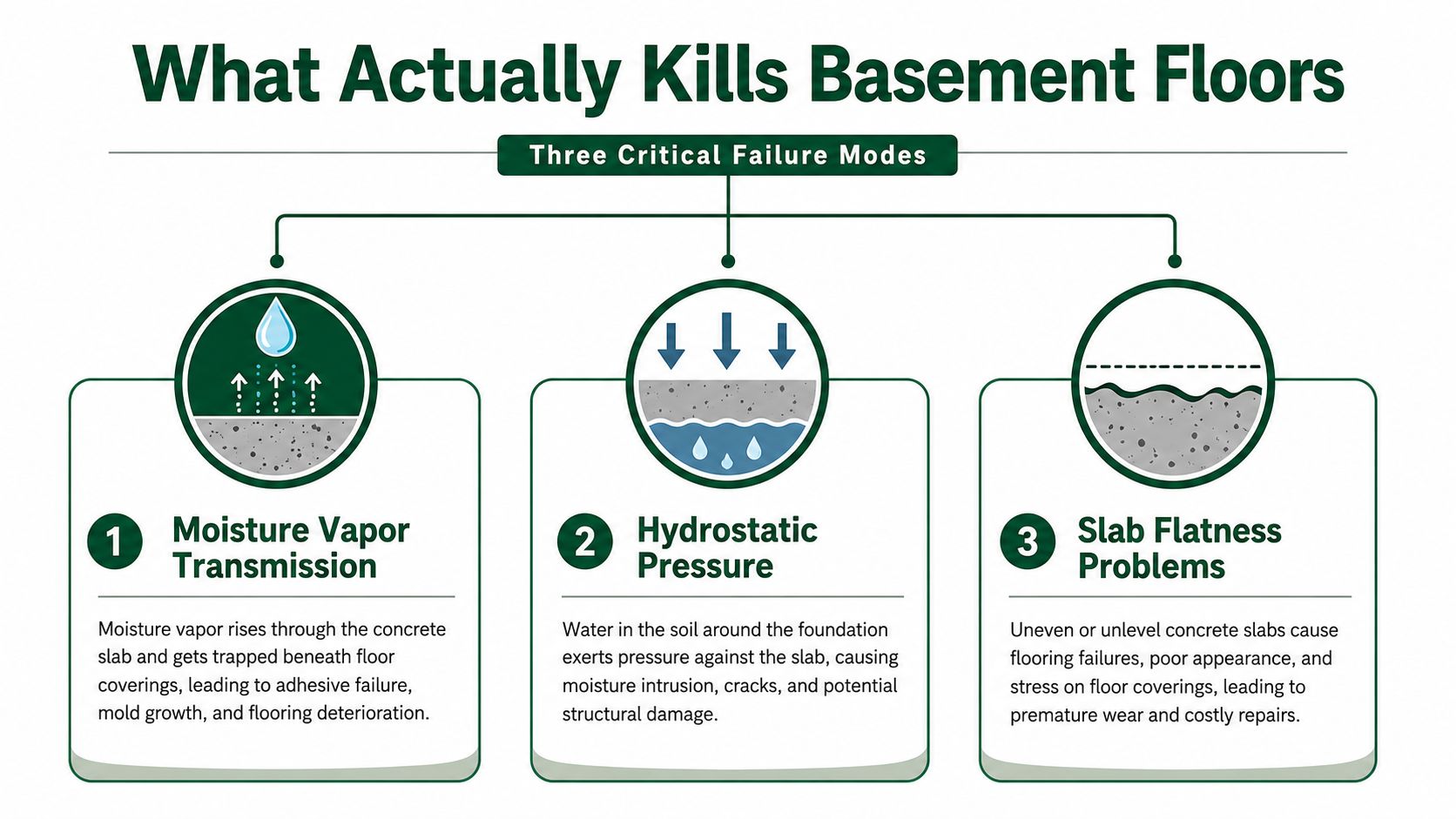
Most basement flooring failures come from three things, and homeowners usually only notice one of them after the damage is done. The first is moisture vapor transmission through the concrete. The second is hydrostatic pressure during wet seasons. The third is flatness problems in the slab itself.
Moisture can come through a slab that looks dry
A basement slab can feel fine and still move enough vapor to ruin the wrong flooring. That matters because moisture-sensitive products, especially wood-based or fiberboard-core materials, don't forgive hidden dampness. They swell, separate, or buckle after the fact, which is why a moisture test matters more than a visual inspection.
If you want a broader checklist for tracking down where water is entering a home, browse Covenant Aire Solutions' leak guide. It's useful when you're trying to figure out whether the issue is the basement slab, the foundation, or another source feeding the problem.
Cold concrete creates another trap
Basements also deal with a temperature mismatch. The slab stays cool while the air above it turns warm and humid, especially in summer. That combination can create condensation under flooring that doesn't breathe well. Once moisture gets trapped, it doesn't take long for seams to telegraph, adhesives to fail, or organic materials to start smelling off.
Uneven slabs punish the wrong products
Flatness is the other big killer. Some floors tolerate a little imperfection, others don't. SPC floating floors are more forgiving than tile or engineered hardwood, but even those still need a slab that meets the installation standard. The concrete guide in the source set points to ASTM F710 and a flatness requirement of no more than 3/16 inch per 10 feet for SPC over concrete FloorCasa.
A slab that's “mostly flat” in a basement is still a problem if you're installing tile or wood. The floor doesn't care what it looks like before the install, it cares what it feels like after.
For homeowners in Richmond VA, the takeaway is blunt. If the basement has ever been damp, if the slab isn't flat, or if humidity is a regular issue, the floor choice has to be built around those realities. If water has reached the room before, that's a warning, not a footnote.
The Eight Basement Flooring Contenders Compared
A basement floor has to earn its keep. It needs to survive moisture, slab movement, and the kind of wear that comes from a room below grade doing real work, not just looking good in photos. In Richmond VA, I judge every option by the same standard, how likely it is to fail, what it costs installed, and how much slab prep it needs before the first board or tile goes down.
SPC luxury vinyl plank
For most finished basements, SPC luxury vinyl plank is the first floor I'd put on the table. It is rigid, 100% waterproof, and far more forgiving of minor slab flaws than wood or tile. If you want a straight answer from a contractor's point of view, this is the basement-friendly floating floor that makes the most sense when the concrete is dry enough to cover and the room still needs some margin for error. For homeowners who want to understand the product more closely, learn more about SPC luxury vinyl plank installation.
Porcelain tile
Porcelain tile is the toughest surface in the group. It is also 100% waterproof, and the comparison source gives it the highest durability rating in the set The Basement Guide. I recommend it when the basement is going to see heavy use and the homeowner is willing to live with a harder, colder floor. That trade-off matters. Tile is unforgiving under bare feet, and it makes the slab prep and install work more demanding, which pushes total cost up fast.
Engineered hardwood
Engineered hardwood is the one people want for appearance, then regret if the basement is not dry. It gives you a wood look, but it still needs a stable environment and a slab that is not trying to push moisture into the floor system. Guidance from the moisture-meter side of the trade is clear that solid hardwood is the wrong call below grade, and engineered wood only improves the odds, it does not erase the moisture risk Wagner Meters. In a Richmond basement, I only consider it after moisture testing and only when the space has been controlled like the rest of the house.
Water-resistant laminate
Water-resistant laminate is the budget option that sounds safer than it usually is. The phrase “water-resistant” buys you some short-term tolerance, but it does not make the floor basement-proof. The basement comparison source rates it below SPC for durability and gives it a 6/10 score The Basement Guide. That is enough to tell you where it belongs, dry basements only, light-duty use, and no room for wishful thinking if the slab has a history of moisture.
Polished concrete
Polished concrete is the no-nonsense answer for homeowners who care more about permanence than softness. It handles water well, cleans easily, and skips the extra layers that can fail later. You do not get warmth underfoot, and you do not get the comfort of a finished floor system, but you do get a surface that fits utility spaces, modern basements, and rooms where long-term durability matters more than polish.
Epoxy coating
Epoxy coating belongs where the basement is doing hard work. It seals the slab, stands up to abuse, and makes cleanup simple. I like it for workshops, storage, and mechanical areas where the goal is protection, not a residential feel. If the room is meant for heavy traffic, tools, or messy projects, epoxy makes more sense than trying to force a softer flooring choice into a space that does not need one.
Rubber flooring
Rubber flooring is a specialty pick, and that is exactly how it should be treated. It works well in gyms and play areas because it cushions impact and handles spills better than carpet or wood products. It is practical, not pretty. If the basement is going to take pounding from weights, kids, or constant movement, rubber has a real place. If the room is supposed to feel like a living area, I would pass.
Carpet tiles
Carpet tiles are the comfort-first option, and that comfort comes with a clear limit. They are easy to like on paper because they are affordable and softer than hard surfaces, but moisture makes them the first floor to backfire in a basement. The comparison source gives them a 5/10 durability score The Basement Guide. That is why I only recommend them in dry basements where the homeowner understands that one moisture event can turn a cheap install into a replacement job.
The short version is simple. If you want the best mix of failure resistance, comfort, and total installed cost in Richmond VA, SPC luxury vinyl plank is the safest bet. If you want maximum toughness and can live with a hard, cold surface, porcelain tile is the strongest long-term play. The rest work only when the basement conditions line up with the product, not when the homeowner hopes they will.
Installed Cost and Lifespan Compared
Homeowners usually ask what the floor costs first, then they ask how long it lasts. That is the right order. A cheap floor that fails early becomes the expensive choice, especially in a basement where moisture is always waiting for a weak install. In Richmond VA, you should judge every option by failure resistance and total installed cost, not by how it looks in a showroom.
Where the money goes
Installed cost varies a lot by material and by how much prep the slab needs before the first piece goes down. The comparison chart shows SPC luxury vinyl near the middle of the pack, porcelain tile at the top end, water-resistant laminate and carpet tiles lower on the invoice, engineered hardwood and polished concrete in the mid-to-upper range, with rubber flooring and epoxy coating often landing in the middle depending on the job The Basement Guide. That spread matters because basement prep is never just material cost. A slab that needs patching, leveling, vapor control, or better transitions can move the final number fast.
Durability tells the rest of the story. The same comparison puts SPC and porcelain tile at the top for lifespan, while carpet tiles and water-resistant laminate sit much lower. In plain English, the floor with the smallest ticket price can still be the worst value if it fails early and has to be ripped out.
If you are set on wood, read proper hardwood installation on concrete before you spend a dollar. Hardwood in a basement is a special-case choice, and the install details decide whether it survives or becomes a repair bill.
The value sweet spot in Richmond VA
For most homeowners, SPC luxury vinyl plank is the smart buy. It gives you a strong mix of moisture resistance, installed cost, and day-to-day comfort, and it does not demand the kind of coddling that wood or carpet does. Porcelain tile is the harder, pricier choice when you want the longest service life and you can live with a colder floor underfoot. That is the honest trade-off.
Best value rule: if the basement is meant for everyday living, pick the floor you can trust through damp weather and occasional slab issues, not the one with the prettiest sample.
Richmond labor usually tracks close enough to national-style pricing that the ranking holds up locally. Final cost still swings with slab prep, room size, and transitions, and a tired concrete slab can change the job fast. I have seen plenty of concrete work that needed attention first, the same way a contractor handles fixing driveways and walkways in Atlanta before finishing over it. SPC still gives most finished basements the best value, and porcelain tile stays the toughest premium option when you want the floor to outlast the room.
Subfloor Prep That Determines Whether the Floor Lasts
A basement floor is usually won or lost before the first plank or tile goes down. Skip prep, and you are gambling with your money, while the slab usually wins that bet. In Richmond VA, where moisture and slab conditions vary from house to house, prep is the difference between a floor that lasts and a floor that starts failing early.
Moisture testing comes first
Pros do not guess. They test. That usually means checking the slab with a calcium chloride test and an in-slab relative humidity probe so you know whether vapor movement is low enough for the flooring system you want. If the readings come back too high, the floor choice changes or the prep gets upgraded. That is the truth homeowners need before spending money on material.
Flatness matters more than people think
A floating floor over concrete needs a slab that is flat, not just “close enough.” The floor has to sit within a tight tolerance, or the planks will telegraph every hump and dip, click underfoot, and wear out faster at the joints. That is why a basement floating floor should be planned around the slab you have, not the slab you wish you had, and a good guide to basement floating floors will tell you the same thing.
If the slab is out of spec, self-leveling underlayment or patching can bring it back into tolerance. Without that correction, even a waterproof floor can feel hollow and fail earlier than it should.
Vapor barriers and subfloor systems are not one-size-fits-all
A 6 mil polyethylene vapor barrier is a baseline tool for moisture control in some basement installs, especially with rigid vinyl products. In other situations, a better membrane is worth the upgrade because the basement is not just fighting today's moisture, it is fighting long-term vapor movement.
For warmer, drier-feeling floors, the options change by material. A cork or foam underlayment can help vinyl feel less cold. A dimpled plastic membrane creates an air gap beneath certain floor systems. A sleeper system with plywood is what you use when nail-down engineered hardwood is on the table. For a closer look at how that kind of preparation works in practice, FloorCasa covers the basics of concrete subfloor prep for finished basements.
The video below shows the kind of prep sequence homeowners rarely see but absolutely pay for if it is done wrong.
For a related example of how surface prep affects the final result, fixing driveways and walkways in Atlanta shows the same principle at work on exterior concrete. The surface has to be right before the finish can succeed.
Know when to DIY and when to hand it off
A handy homeowner can handle cleanup, basic layout, and some underlayment work. Moisture testing and leveling are different. If the slab has staining, obvious low spots, or any history of water intrusion, bring in a pro before you buy materials. That is especially true in Richmond VA basements where one bad install can cost more to fix than the original job.
Matching the Right Floor to the Way You Use the Basement
The right floor depends on the room's job. A finished basement that serves as a rec room has different needs than a workshop, and Richmond homeowners should think in terms of use first, material second.
Rec room or family hangout
Go with SPC luxury vinyl plank and a quality underlayment. It gives you the wood look people want without turning the room into a moisture headache. Maintenance is easy, a vacuum and damp mop are enough, and the surface holds up well to daily traffic in a Richmond VA home.
Home gym or kids' play zone
Choose rubber tiles or rolled rubber over a vapor barrier. That setup handles sweat, dropped weights, and hard play better than most flooring types. The trade-off is appearance, but in a gym or play space, performance matters more than pretending it's a living room.
Rental unit or in-law suite
Use SPC vinyl or porcelain tile if you want the lowest maintenance and longest useful life. Renters are hard on floors, and basement moisture leaves no room for fragile materials. Tile is the harder, colder answer. SPC is the more comfortable one.
Workshop or utility area
Go with sealed concrete or epoxy-coated concrete. It's the cheapest route to a clean, durable surface that doesn't care much about spills, storage, or utility traffic. This is not where you spend money on softness.
Finished living space where wood look really matters
If you want the look of real wood, engineered hardwood is the only version I'd even discuss for a basement, and only after a passing moisture test plus a sleeper or plywood subfloor. Maintenance is more involved, and climate control matters if you want the floor to stay stable. If the slab is questionable, skip it and choose SPC.
Richmond VA basements run the gamut from casual family dens to serious finished suites, so don't let one material choice try to serve every purpose. Match the floor to the room, then let the slab decide whether the plan is realistic.
The Verdict and When to Call a Pro
My straight answer for most Richmond homeowners is this. If you're finishing a basement for everyday living, waterproof SPC luxury vinyl plank is the best balance of moisture resistance, comfort, installed cost, and lifespan. It's the floor I'd put in first when the basement is going to be used like real living space.
If your budget stretches farther and you can live with cold floors, porcelain tile is the upgrade pick. It's the hardest surface in the group, and the durability numbers back that up The Basement Guide. For utility rooms and workshops, sealed concrete or epoxy is the right call. Don't overbuild a space that doesn't need a decorative finish.
Quick maintenance and lifespan snapshot
- SPC vinyl: easy to clean with a damp mop, and the source set places it around 15 to 25 years in service life FloorCasa.
- Porcelain tile: can last a lifetime with proper care and occasional regrouting.
- Engineered hardwood: needs climate control and a dry slab to reach the upper end of its life.
- Epoxy and sealed concrete: stay practical because they're simple to maintain, not because they feel luxurious.
Call a Richmond flooring contractor any time the slab hasn't been moisture tested, the room is more complicated than a simple rectangle, you want tile or epoxy, or a sleeper subfloor is being considered. Those are the jobs where experience saves money.
If you want honest guidance on basement flooring in Richmond VA, Buff & Coat Hardwood Floor Refinishing can help you sort through the options and give you a clear estimate without the runaround. The right floor starts with the right prep, and that's where a careful local pro makes the difference.
Why Richmond Homeowners Choose Buff & Coat
- 15 years in business
- Dustless sanding systems
- Local, owner-operated
- High-quality finishes
- Clear pricing and honest advice
- 5-star customer service
Ready to restore your hardwood floors? Buff & Coat makes the process fast, clean, and stress-free. Call 804-392-1114 or request your free estimate at Buff & Coat Hardwood Floor Refinishing.