

Home Blog Hardwood Heartbreak or Happy Home? Understanding Replacement Costs
Hardwood Heartbreak or Happy Home? Understanding Replacement Costs

When Hardwood Heartbreak Strikes: Understanding Your Investment
The cost of replacing wood floor planks ranges from $6 to $25 per square foot, but many factors influence the final price. Whether you’re dealing with water damage, deep scratches, or warped boards, understanding these costs upfront helps you budget effectively and make the right decision for your home.
Quick Cost Breakdown:
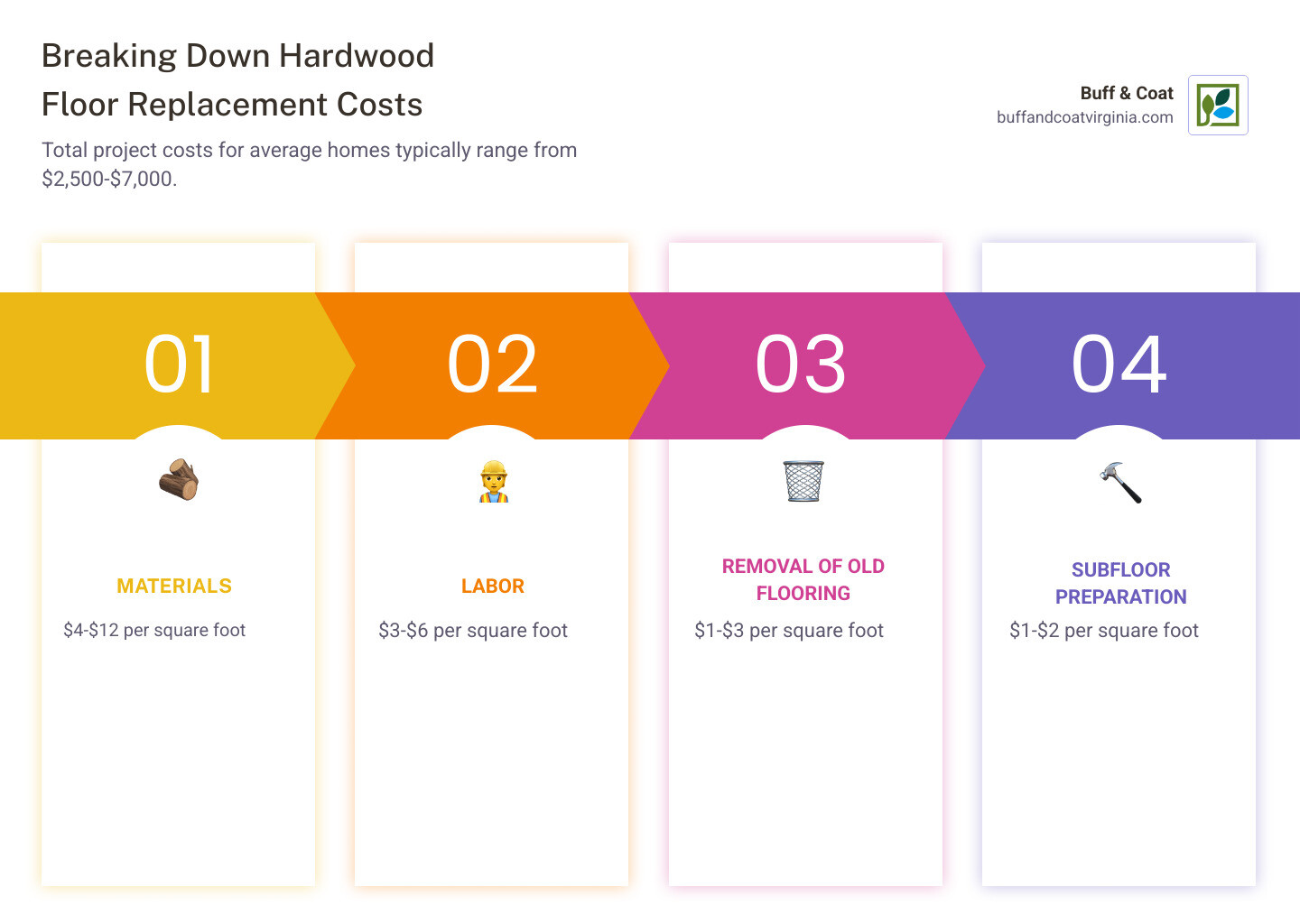
- Materials: $4-$12 per square foot
- Labor: $3-$6 per square foot
- Removal of old flooring: $1-$3 per square foot
- Subfloor preparation: $1-$2 per square foot
- Total project cost: $2,500-$7,000 for average homes
Your floors take more abuse than any other surface in your home. When damage becomes too extensive for simple repairs, replacement becomes necessary. However, not all floor damage requires a complete overhaul—sometimes working with a professional hardwood flooring company can save you thousands while delivering beautiful results.
The decision between repair, refinishing, and replacement depends on your floor’s condition, your budget, and your long-term goals. While replacement costs more upfront, it can provide up to 118% return on investment according to the National Association of Realtors.
I’m David Emmerling, and I’ve spent over 20 years helping Richmond homeowners steer decisions about the cost of replacing wood floor planks through my company Buff & Coat. My experience has shown me that understanding all your options – from dustless refinishing to complete replacement – helps homeowners make the most cost-effective choice for their situation.
Basic cost of replacing wood floor planks vocab:
The Bottom Line: Average Cost of Replacing Wood Floor Planks
The cost of replacing wood floor planks is a significant investment, with the national average for installing new hardwood flooring sitting between $6 and $12 per square foot for labor and materials. For a complete replacement that includes tearing out old floors, costs can climb to $25 per square foot or more.
For perspective, a typical 1,000-square-foot project could run anywhere from $6,000 to $25,000. This wide range is due to several factors that influence the final price.
Cost Per Square Foot Breakdown
Here’s how the cost of replacing wood floor planks breaks down per square foot:
Materials are the foundation of your investment. Standard wood planks cost $4 to $12 per square foot, while exotic species or wide planks can cost $13 to $25 per square foot. Your choice of wood significantly impacts the final bill.
Labor costs represent 50% to 70% of the total project expense. Professional installation typically runs $3 to $6 per square foot. Quality installation is critical for your floors’ longevity and is not an area to cut corners.
Removal costs for old flooring are $1 to $3 per square foot for standard removal. Glued-down flooring or removal over concrete can increase this to $5 per square foot due to the intensive labor required.
Subfloor preparation adds $1 to $2 per square foot and includes leveling, moisture barriers, and repairs. If your project involves extensive hardwood floor damage repair that extends to the subfloor, these costs can increase substantially.
The average total cost ranges from $6 to $25 per square foot, including all labor and materials.
Estimating the cost of replacing wood floor planks per project
Real project costs paint a clearer picture. Here’s what you can expect for common room sizes:
- 200 sq ft (bedroom or home office): $1,200 – $5,000
- 500 sq ft (large living room or open area): $3,000 – $12,500
- 1,000 sq ft (entire floor or multiple rooms): $6,000 – $25,000
Project scope matters tremendously. Most average homes see total investments between $2,500 and $7,000, but luxury materials and complex layouts can push projects as high as $69,000. Understanding these cost drivers helps you make informed decisions.
Key Factors That Influence Replacement Costs
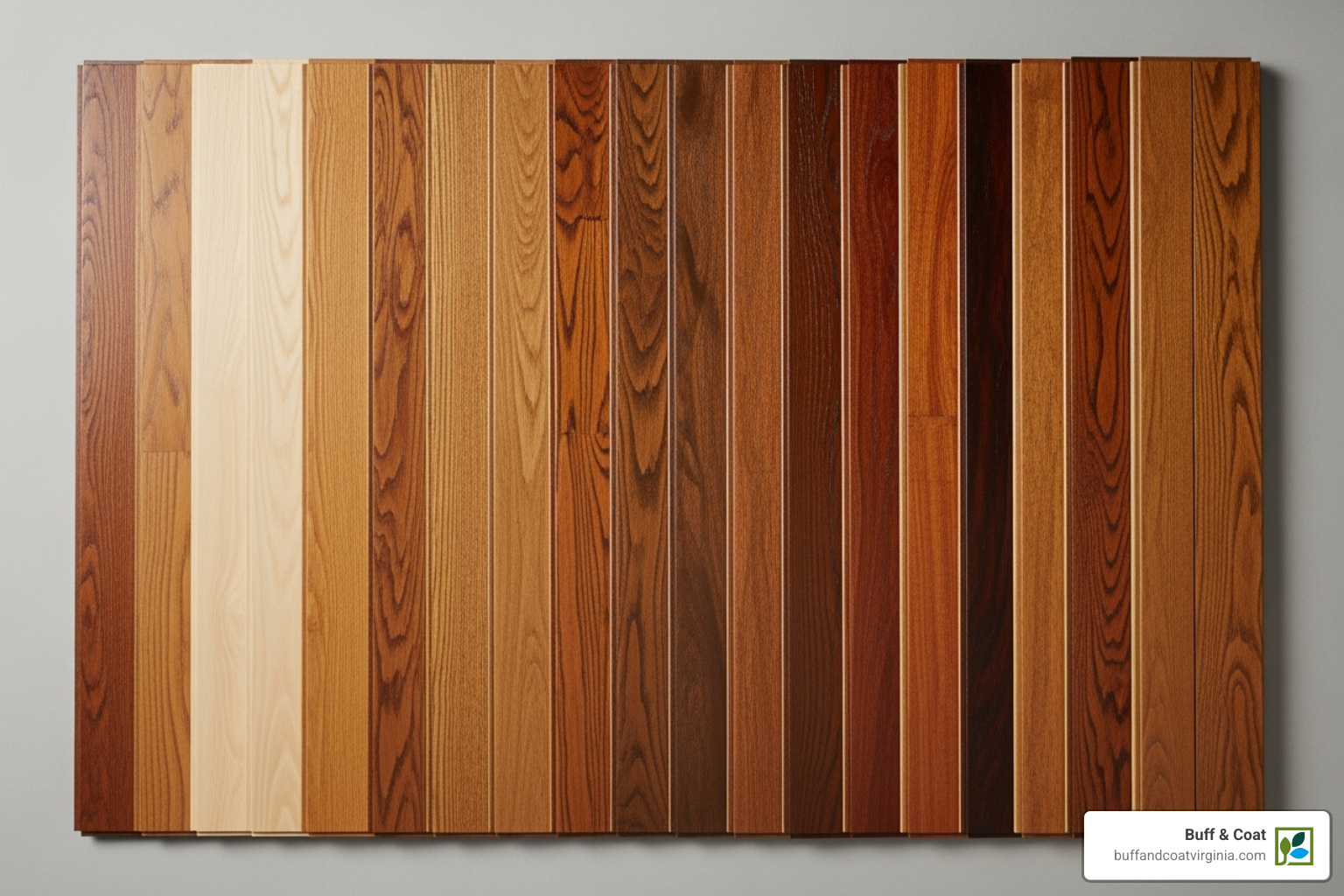
The beauty of hardwood flooring lies in its incredible diversity, but this variety also creates a wide spectrum of pricing options. The type of wood you choose is one of the biggest drivers of your total project cost. From familiar domestic species that have graced American homes for generations to exotic imports that make a bold statement, understanding these differences helps you make the right choice for your budget and lifestyle.
Wood Species, Grade, and Hardness
Think of wood selection like choosing a car – you can get from point A to point B with any option, but the ride quality, features, and price tag vary dramatically.
Domestic woods offer the perfect blend of beauty, durability, and value. Oak remains America’s sweetheart for good reason, with red oak materials typically costing $5 to $11 per square foot and white oak ranging from $5 to $12. Its distinctive grain patterns and proven track record make it a safe bet for any home. Maple delivers a cleaner, more contemporary look with materials costing $4 to $15 per square foot – perfect if you prefer subtle grain patterns. For homes with active families or pets, hickory stands as one of the hardest domestic options, with materials ranging from $6 to $14 per square foot.
Exotic woods command premium prices but deliver show-stopping results. Brazilian walnut (Ipe) ranks among the world’s hardest woods, with materials costing $9 to $15 per square foot – an investment that pays dividends in durability. Teak brings natural water resistance and rich color variations at $9 to $13 per square foot, while mahogany offers luxurious warmth typically priced at $10 to $14 per square foot.
Wood grade significantly impacts both appearance and the cost of replacing wood floor planks. Select grade represents the premium tier, featuring minimal imperfections and uniform color at $8 to $23 per square foot for materials. Common grade accepts natural character marks, knots, and color variations, creating rustic charm at $6 to $18 per square foot.
The Janka hardness scale measures wood’s resistance to denting and wear. Higher ratings mean greater durability but often higher costs – crucial information for high-traffic areas or homes with children and pets.
Plank Dimensions: Thickness and Width
Size matters when it comes to hardwood planks, affecting both material costs and installation complexity.
Plank thickness directly correlates with longevity and refinishing potential. 3/8-inch planks, commonly used for engineered wood, cost $3 to $8 per square foot but offer limited refinishing options. 3/4-inch planks represent the gold standard for solid hardwood at $5 to $16 per square foot, providing maximum durability and the ability to be refinished multiple times over decades.
Plank width creates different visual impacts and cost considerations. Standard widths under 5 inches remain more economical and easier to install. Wide planks over 5 inches create expansive, modern aesthetics at $4.50 to $18 per square foot, though they sometimes reduce labor costs since fewer pieces cover the same area.
Installation complexity increases with wider and thicker planks, potentially affecting labor time and overall project costs.
Solid vs. Engineered Hardwood
The choice between solid and engineered hardwood represents one of the most important decisions in your flooring journey, each offering distinct advantages and cost implications.
| Feature | Solid Hardwood | Engineered Hardwood |
|---|---|---|
| Cost Difference | $5-$28 per square foot (materials) | $4.50-$16 per square foot (materials) |
| Lifespan | 30-100 years, can last longer with proper care | 20-30 years, depending on wear layer thickness |
| Refinishing | Can be refinished multiple times (up to 10-12 times) | Can be refinished 1-2 times, depending on wear layer |
| Installation | Nail-down or staple-down over plywood subfloor | Nail-down, glue-down, or floating; can be installed below grade |
| Moisture | Sensitive to moisture, not recommended for basements | More stable, better resistance to humidity fluctuations |
| Durability | Very durable, but can expand/contract with humidity | Stable, less prone to gapping or warping |
Solid hardwood delivers best longevity and refinishing potential, making it ideal for families planning to stay in their homes long-term. Engineered hardwood offers greater stability and installation flexibility at a lower initial investment, perfect for moisture-prone areas or budget-conscious projects.
Understanding these factors helps you balance your vision with your budget. For comprehensive guidance on making the right choice for your specific situation, explore our detailed guide on replacing old hardwood floors.
Beyond the Planks: Uncovering Additional Project Costs
While material prices are a major focus, the cost of replacing wood floor planks includes several other significant expenses. Labor, demolition, and subfloor preparation can substantially increase your budget, with labor alone accounting for 50% to 70% of the total project cost. Proper preparation and expert installation are essential for a durable, beautiful result.
Labor and Installation Method
The skill of your installation team is critical for long-term performance.
Labor costs typically range from $3 to $6 per square foot. This covers site preparation, installation, and finishing details. Skilled professionals use specialized tools and experience to protect your warranty and ensure quality.
The installation method also impacts cost and longevity. Nail-down installation is the standard for solid hardwood on wooden subfloors, creating a highly durable floor. Glue-down installation is effective for engineered wood over concrete but can increase material and labor costs, with more expensive future removal. Floating installation, common for engineered planks that click together, is the most budget-friendly labor option due to its speed.
Choosing professional floor installation ensures proper technique and delivers the lasting results you expect.
Demolition and Subfloor Issues
Before new planks are installed, the old flooring must be removed and the subfloor perfected.
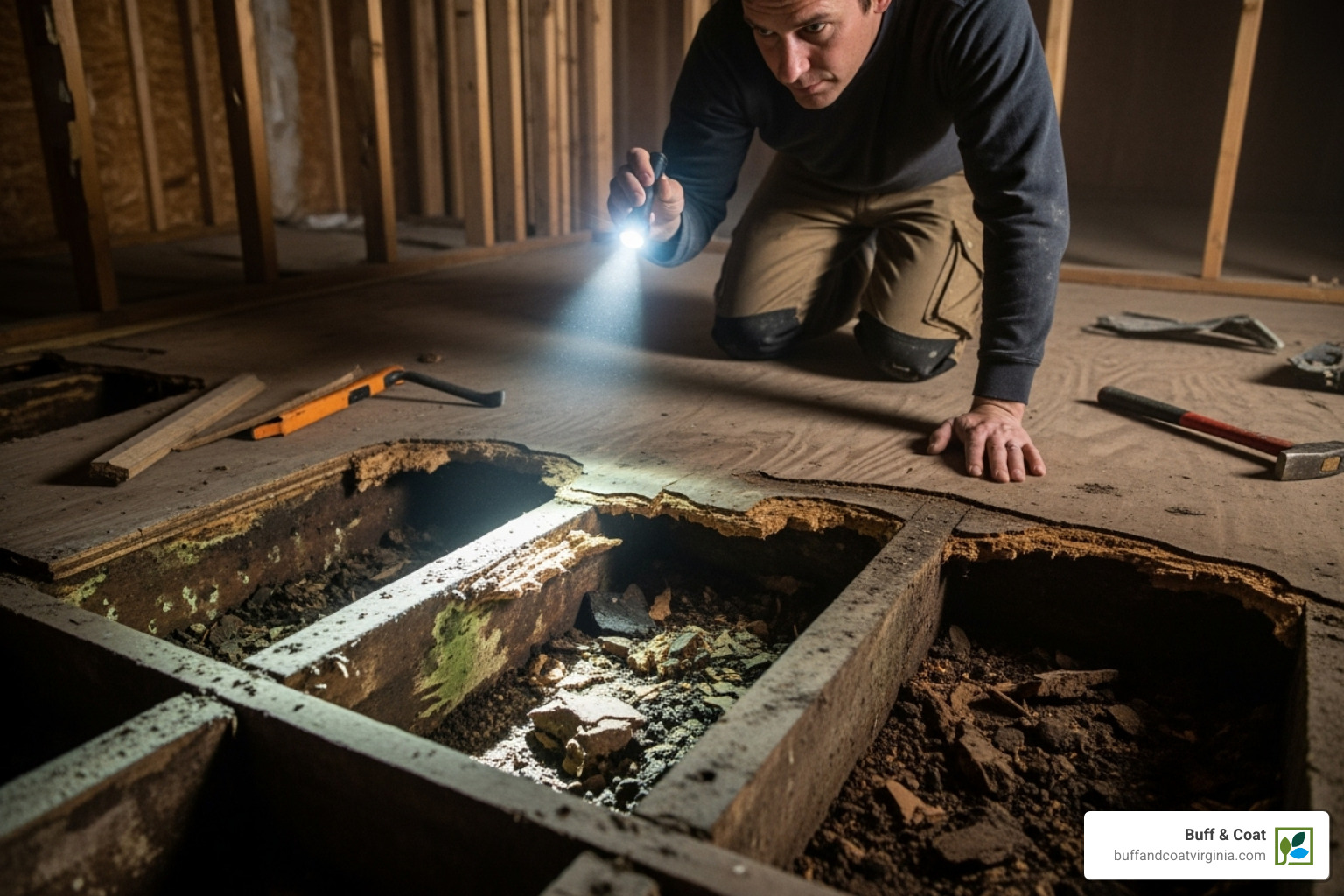
Removal of existing flooring costs $1 to $5 per square foot. Carpet is relatively easy to remove, but old tile or glued-down hardwood is more time-consuming and costly.
Subfloor repair is critical for a level, dry, and sound foundation, typically adding $1 to $2 per square foot for minor leveling or patching.
Floor joist repair is needed for structural issues like sagging or excessive squeaking and costs $40 to $60 per square foot of the affected area. Our squeaky floor repair guide can help identify these problems early.
Water damage can cause rot and mold, often requiring subfloor replacement ranging from $1,000 to $3,000 for affected areas.
Hidden factors in the cost of replacing wood floor planks
Be aware of these additional costs to budget accurately:
Moving furniture: Professionals charge $60 to $120 per hour.
Finishing and coating: On-site sanding, staining, and sealing unfinished hardwood adds $2 to $7 per square foot. Prefinished planks avoid this cost.
Complex layouts: Rooms with many angles or built-ins can increase installation costs by 15-25% due to added labor and material waste.
Herringbone patterns: These intricate designs add about 30% to installation costs (roughly $12 per square foot extra).
Trim and molding: New baseboards and transition strips are essential for a polished look and add to material and labor costs.
Repair, Refinish, or Replace? Making the Most Cost-Effective Choice
Deciding whether to undertake a full replacement isn’t always straightforward. Sometimes your floors are like that favorite sweater with a few snags – they just need some TLC, not a complete replacement. For floors with surface-level damage, hardwood floor refinishing is a much more affordable option that offers a significant return on investment.
The key is knowing when to stop throwing good money after bad and when a simple refresh will do the trick.
When to Repair or Refinish
Many homeowners are surprised to learn that their “ruined” floors can actually be saved with the right approach. Minor damage like isolated scratches, dents, or small gouges often don’t require starting from scratch. If you’re dealing with just a few problem boards, targeted hardwood floor board replacement can seamlessly blend new planks with your existing floor.
Scratches are probably the most common complaint I hear from homeowners. The good news? Most scratches that haven’t gone through the protective finish layer can be buffed out or addressed with professional refinishing. Dents from dropped furniture or high heels usually respond well to steam treatment and refinishing.
If your floors look faded or have lost their original luster from years of foot traffic and sun exposure, refinishing can bring them back to life. Sun bleaching, minor water marks, and that general “tired” look are all perfect candidates for refinishing rather than replacement.
Cost to refinish hardwood floors averages $3 to $8 per square foot, which includes sanding, optional staining, and applying fresh protective coats. Most homeowners spend between $1,100 and $2,700 for refinishing, making it dramatically more budget-friendly than the cost of replacing wood floor planks. For detailed pricing breakdowns, our hardwood refinishing cost guide covers everything you need to know.
When Replacement is Necessary
Unfortunately, not every floor can be saved. Some damage goes beyond what even the most skilled craftsman can repair, making replacement the only sensible choice.
Extensive water damage is usually the death knell for hardwood floors. When water causes widespread buckling, severe cupping, or warping across large areas, especially if mold has developed or the subfloor is compromised, replacement becomes unavoidable. Water doesn’t just damage the surface – it can destroy the structural integrity of both the planks and the subfloor beneath.
Warping or cupping that affects most of the floor area typically indicates ongoing moisture problems that refinishing can’t fix. While minor cupping might be sanded out, severe warping where boards are pulling away from each other or crowning in the middle usually means the wood has been permanently damaged.
Widespread structural issues like loose planks, excessive squeaking throughout the room, or floors that feel bouncy underfoot often signal problems that go deeper than the surface. These issues usually require addressing the subfloor, making replacement more cost-effective than trying to patch things up.
For engineered hardwood with a thin wear layer, replacement becomes necessary when the top layer of real wood is too thin to sand again. Most engineered floors can only be refinished once or twice before the veneer layer is compromised.
Pest infestation damage from termites or other wood-boring insects compromises the structural integrity of your floors. Safety concerns make replacement the only responsible choice in these situations.
Return on Investment (ROI)
Here’s where the numbers get really interesting. Investing in your hardwood floors isn’t just about making your home look beautiful – it’s one of the smartest financial moves you can make.
New wood floors deliver an ROI of up to 118%, according to the National Association of Realtors. This means you’re likely to recoup more than every dollar you spend when you sell your home. But here’s the real surprise: refinished floors offer an even better ROI of up to 147%!
This data from the 2022 Remodeling Impact Report shows just how much buyers value well-maintained hardwood floors. The home value increase from either refinishing or replacing hardwood floors consistently ranks among the top home improvement investments you can make.
These impressive returns make the decision between repair and replacement much clearer – even if you’re planning to sell within a few years, investing in your floors pays dividends.
Frequently Asked Questions about Wood Floor Replacement Costs
When it comes to understanding the cost of replacing wood floor planks, homeowners naturally have plenty of questions. After two decades in the flooring business, I’ve heard them all! Let’s tackle the most common concerns that come up during our free consultations.
How can I save money when replacing hardwood floor planks?
Smart homeowners know there are several ways to reduce the cost of replacing wood floor planks without sacrificing quality. Choose common wood species like oak or maple instead of exotic imports – you’ll save significantly on materials while still getting beautiful, durable floors. Brazilian walnut might catch your eye, but domestic oak delivers lasting beauty at a fraction of the cost.
Handle your own prep work if you’re physically able. Removing furniture and tackling demolition yourself can save $1 to $5 per square foot in labor costs. Just be ready for some serious elbow grease and dust!
Timing matters too. Schedule your project during contractors’ slower seasons – typically late winter or early spring – when many offer better rates to keep their crews busy.
Prefinished planks are another smart choice. While the material cost runs slightly higher upfront, you’ll eliminate on-site sanding, staining, and multiple finish coats. This cuts labor time dramatically and gets you back in your rooms faster.
Shop around for materials at suppliers like Lowe’s, Home Depot, or online retailers. Look for sales, remnants, or contractor lots that can deliver premium materials at reduced prices.
What is the cost difference between replacing and refinishing hardwood floors?
This question hits at the heart of smart home improvement decisions, and the difference is dramatic.
Replacing hardwood floors typically costs $6 to $25 per square foot, with average projects running around $4,700. This makes sense when you’re dealing with extensive damage, structural issues, or want to completely change your wood type.
Refinishing costs significantly less at $3 to $8 per square foot, with typical projects averaging around $1,900. That’s less than half the cost of replacement in most cases! If your floors are structurally sound but just look tired, scratched, or faded, refinishing delivers incredible value.
The return on investment tells the whole story. New floors offer up to 118% ROI, but refinished floors can deliver up to 147% ROI according to the National Association of Realtors. That’s why our professional hardwood floor restoration services often make more financial sense than complete replacement.
How long does it take to replace hardwood floors?
Timeline expectations are crucial for planning your life around a flooring project. For a standard room of 200-300 square feet, expect the full process to take 3 to 7 days from start to finish.
Larger projects covering 1,000 square feet or more typically require 1 to 3 weeks, depending on complexity. Several factors influence your timeline significantly.
Demolition time varies wildly based on your existing flooring. Carpet comes up quickly, but old glued-down hardwood or tile can be stubborn and time-consuming to remove.
Subfloor preparation can add days if we find damage that needs repair. Water damage or structural issues require careful attention that can’t be rushed.
Wood acclimation is non-negotiable – new planks must adjust to your home’s humidity for several days before installation to prevent future warping.
Finishing work adds the most time if you choose unfinished hardwood. The sanding, staining, and multiple polyurethane coats require several days with drying time between each application. During this period, the floors can’t be walked on. Prefinished floors eliminate this entire step, cutting your project timeline significantly.
Complex patterns like herringbone or rooms with many obstacles naturally extend the timeline, but the stunning results justify the extra time investment.
Get a Precise Quote for Your Richmond Home
Understanding the cost of replacing wood floor planks involves more than just plugging numbers into a calculator. While those national averages we’ve discussed give you a solid starting point, every home tells its own story. Your subfloor might have hidden surprises, your room layout could present unique challenges, or you might fall in love with a particular wood species that changes everything.
That’s where professional assessment becomes invaluable. A skilled contractor can spot potential issues before they become expensive surprises, recommend the most cost-effective solutions for your specific situation, and help you understand exactly what you’re investing in.
For over two decades, the team at Buff & Coat has been Richmond’s trusted partner for hardwood flooring solutions. We’ve seen it all – from Victorian homes in the Fan District with original heart pine floors to modern builds in Short Pump needing their first replacement. Our experience serving Richmond, VA and surrounding communities like Chesterfield and Midlothian has taught us that no two projects are exactly alike.
What sets us apart is our commitment to dust-free processes. Whether you’re looking at a full replacement or wondering if our signature “buff and coat” refinishing might save you thousands, we use advanced techniques that keep your home clean throughout the project. Many of our clients are amazed when they find that refinishing can deliver stunning results at a fraction of replacement costs.
We believe in complete transparency – no hidden fees, no surprise charges, no pushy sales tactics. That’s why we offer free, no-obligation estimates that give you all the information you need to make the best decision for your home and budget. During our inspection, we’ll assess your current floors, discuss your goals and timeline, and provide you with detailed options and pricing.
Ready to turn your flooring concerns into excitement about your home’s potential? Contact us today or call us at (804) 298-4242 to schedule your free inspection. Let’s explore whether your floors need a complete replacement or if our proven refinishing process can bring back their original beauty – either way, you’ll have the information you need to move forward with confidence.


