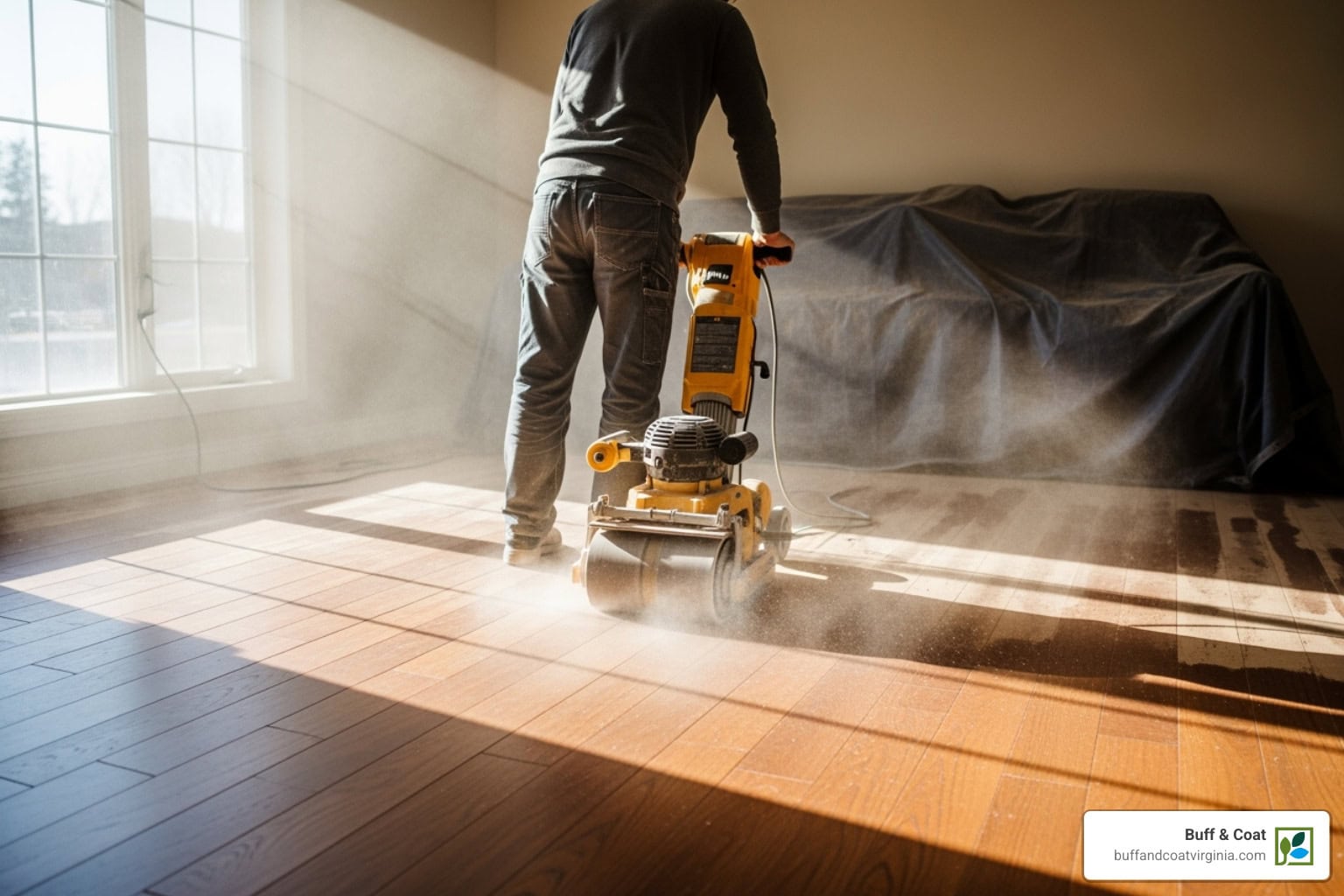
Why Professional Floor Sanding Makes Financial Sense
When you hire someone to sand floors, you’re choosing between a challenging DIY project and professional expertise that delivers lasting results. The decision impacts not just your floors’ appearance, but your home’s value, your time, and potentially your wallet if mistakes happen. If you’re comparing options, start with our trusted hardwood floor refinishing experts in Virginia to understand the best approach for your home.
Quick Decision Guide:
- Hire a Pro If: You have valuable hardwood, large areas (500+ sq ft), engineered wood, or want guaranteed results
- Consider DIY If: You have unlimited time, a small room (under 200 sq ft), solid wood floors, and extensive DIY experience
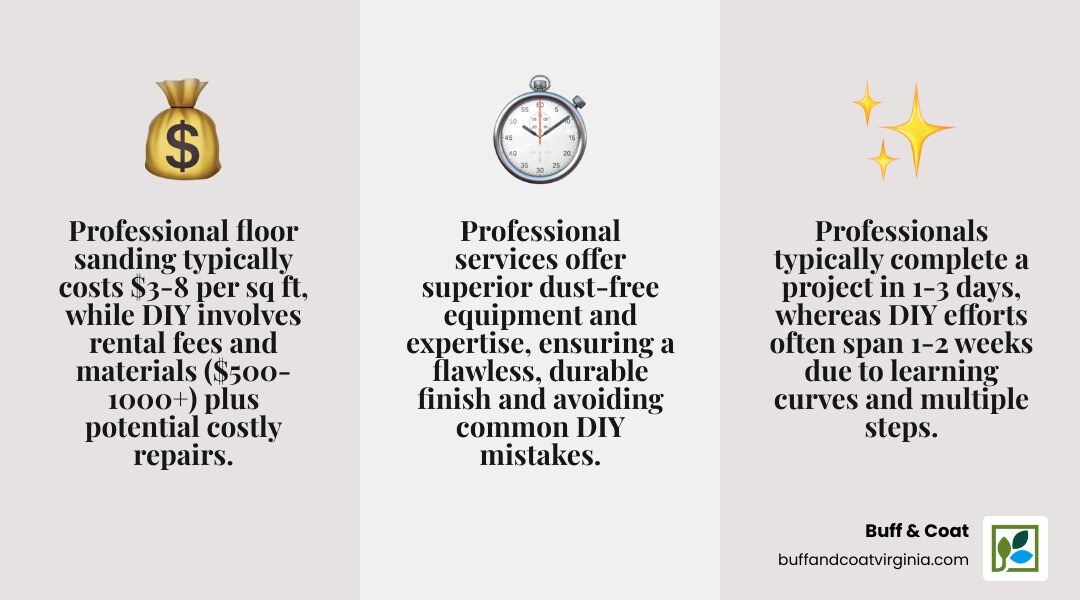
- Professional Cost: $3-8 per square foot vs DIY materials/rental: $500-1,000 plus significant time investment
- Timeline: Professionals complete most projects in 1-3 days vs 1-2 weeks for DIYers
The allure of saving money by sanding your own floors is strong. After all, rental equipment costs just $50-80 per day, and how hard can it be? But as one experienced flooring professional noted: “It usually takes around 2 years for a professional to refine their floor sanding skills” – and that’s with daily practice and proper training.
For Richmond area homeowners seeking professional floor sanding, the stakes are particularly high given the beautiful historic hardwood floors common in our region. One wrong move with a drum sander can create permanent gouges that require expensive board replacement. If you’re in the Richmond, Chesterfield, or Midlothian areas, our team at Buff & Coat Virginia is ready to help. You can learn more about our local services for floor sanding in Richmond.
I’m David Emmerling, owner of Buff & Coat Hardwood Floor Refinishing with over 20 years of experience helping homeowners decide whether to hire someone to sand floors or explore alternatives. Through countless consultations, I’ve seen both the spectacular failures of DIY attempts and the relief on homeowners’ faces when they choose professional restoration instead.
Hire someone to sand floors vocab explained:
- cost of professional floor sanding services
- book dust-free floor sanding service
- floor sanding contractors
The DIY Challenge: What It Really Takes to Sand Your Own Floors
Picture this: you’re standing in your local Home Depot, looking at that drum sander rental, thinking “How hard could this be?” Trust me, I’ve had countless homeowners call me after finding the answer to that question the hard way. What seems like a straightforward weekend project quickly becomes a lesson in why you should hire someone to sand floors instead of tackling this beast yourself.
Floor sanding isn’t just pushing a machine around your room like you’re vacuuming. It’s more like learning to tame a wild animal that’s eager to destroy your floors if you let your guard down for even a second. One flooring expert perfectly described using a drum sander as “like learning to drive a stick shift instead of an automatic, with lots of hill starts, blindfolded and with Metallica blasting on volume 12.”
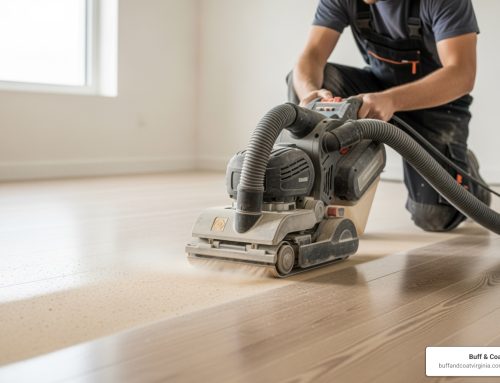
The equipment alone will test your patience and your muscles. Rental sanders come in different flavors: the aggressive drum sander for large areas, the finicky edger sander for corners and perimeters, and various orbital sanders for finishing touches. Each one has its own personality and potential for disaster.
That drum sander can literally pull your arms out of their sockets if you’re not ready for it. Stop the machine for even a heartbeat while it’s touching your floor, and you’ll have a permanent crater that no amount of wood filler can properly hide. The edger is equally unforgiving – it’s designed to sand right up to your baseboards, but blending those edges seamlessly with the main floor requires skills that take years to develop.
Then there’s the dust contamination issue. We’re talking about clouds of fine wood particles that get into everything – your lungs, your furniture, your neighbor’s house three doors down. If your home was built before 1978, you might be dealing with lead paint mixed into that dust, which creates serious health hazards that go way beyond just wearing a basic dust mask.
The Hidden Costs and Time of a DIY Project
Here’s where the “savings” of DIY start to evaporate faster than water on hot asphalt. Those rental fees might look reasonable at first glance – maybe $50-80 per day for the main sander. But you’ll need multiple machines, and most projects take much longer than expected.
Material costs add up quickly too. You’ll burn through sandpaper like there’s no tomorrow (plan on $10-20 per day just for paper), plus you need wood filler, stain if you want to change the color, and multiple coats of polyurethane. Before you know it, you’re looking at $500-1,000 just in materials for a typical room.
But the real kicker is your time investment. Professional crews can sand and refinish about 1,000 square feet per day. You? Plan on taking 2-4 times longer, especially if you’ve never done this before. What takes us 1-3 days could easily consume your next two weekends, assuming everything goes smoothly (spoiler alert: it rarely does).
The most expensive hidden cost is potential repair costs when things go wrong. I’ve seen DIY disasters that cost more to fix than the original professional job would have cost. Deep gouges might require replacing entire boards. A completely botched finish means stripping everything and starting over. Some mistakes are so severe they require full floor replacement, which can run $1,000-12,000 depending on your space.
When you factor in all these costs, you might save only about half compared to professional work – not the 75% savings most people expect. For a detailed breakdown of what professional services actually cost, check out our guide on the Cost of Professional Floor Sanding Services.
Common (and Costly) DIY Floor Sanding Mistakes
After two decades in this business, I’ve seen every possible DIY mistake you can imagine. Here are the big ones that turn dream floors into expensive nightmares:
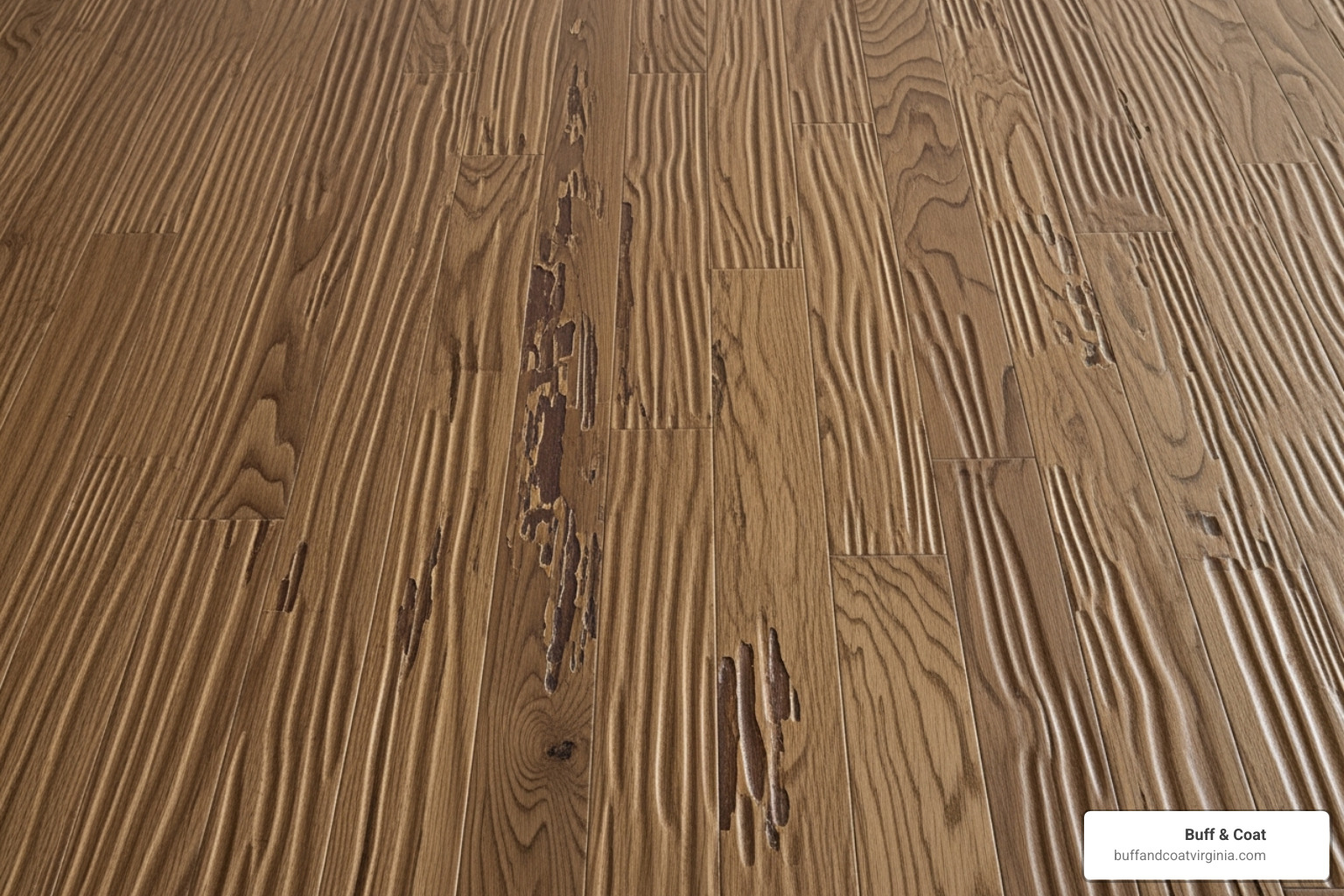
Wrong grit sequence is probably the most common error. Floor sanding follows a specific progression from coarse grits (36-40) to remove old finish, through medium grits (60-80), to fine grits (100-120) for smoothness. Skip a step or don’t sand thoroughly with each grit, and you’ll see every scratch magnified once you apply stain and finish.
Uneven pressure creates what we call “dishing” – some areas get sanded deeper than others, creating waves across your floor. Rental equipment is often less powerful and harder to control than our professional machines, making consistent pressure nearly impossible for beginners.
Divots and gouges are the stuff of DIY nightmares. Let that drum sander sit still for one second while it’s running, and you’ve just carved a permanent crater in your floor. These are incredibly difficult to repair and often require replacing damaged boards entirely.
Edger blending issues show up as visible lines or “halos” around your room’s perimeter. The edger cuts differently than the drum sander, and blending these two different sanding patterns seamlessly is an art form that takes years to master.
Botched finish application can ruin all your hard work in the final step. Common problems include applying polyurethane too thick (causing bubbles), not stirring properly (uneven sheen), trapping dust between coats, or not allowing proper drying time. A poor finish job means your floor will need refinishing again in 2-4 years instead of lasting the 7-10 years you’d get from professional work.
These mistakes don’t just look bad – they directly impact your floor’s lifespan and your home’s value. Sometimes the smartest move is recognizing when to hire someone to sand floors and avoid these costly pitfalls altogether.
Why You Should Hire Someone to Sand Floors: The Professional Advantage
When you choose to hire someone to sand floors, you’re investing in expertise, efficiency, and a superior result that DIY simply cannot match. Think of it this way: you wouldn’t perform surgery on yourself just because you watched a few medical shows, right? The same logic applies to your beautiful hardwood floors.
Professional floor sanders bring something you simply can’t rent at Home Depot: years of hard-earned experience. It takes about two years of daily practice to truly master floor sanding techniques. These pros understand the unique personality of different wood species—how oak reacts differently than maple, why some boards sand faster than others, and exactly how much pressure to apply without creating damage.
More importantly, they’ve already made all the costly mistakes on someone else’s floors (usually during their apprenticeship), so they won’t be “going to school” on your precious hardwood. When professionals walk into your home, they immediately assess factors like wood type, existing damage, and the best approach for your specific situation.
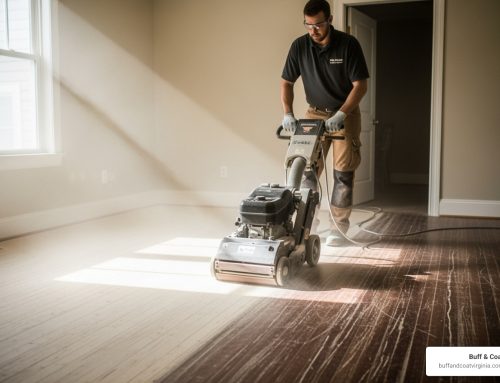
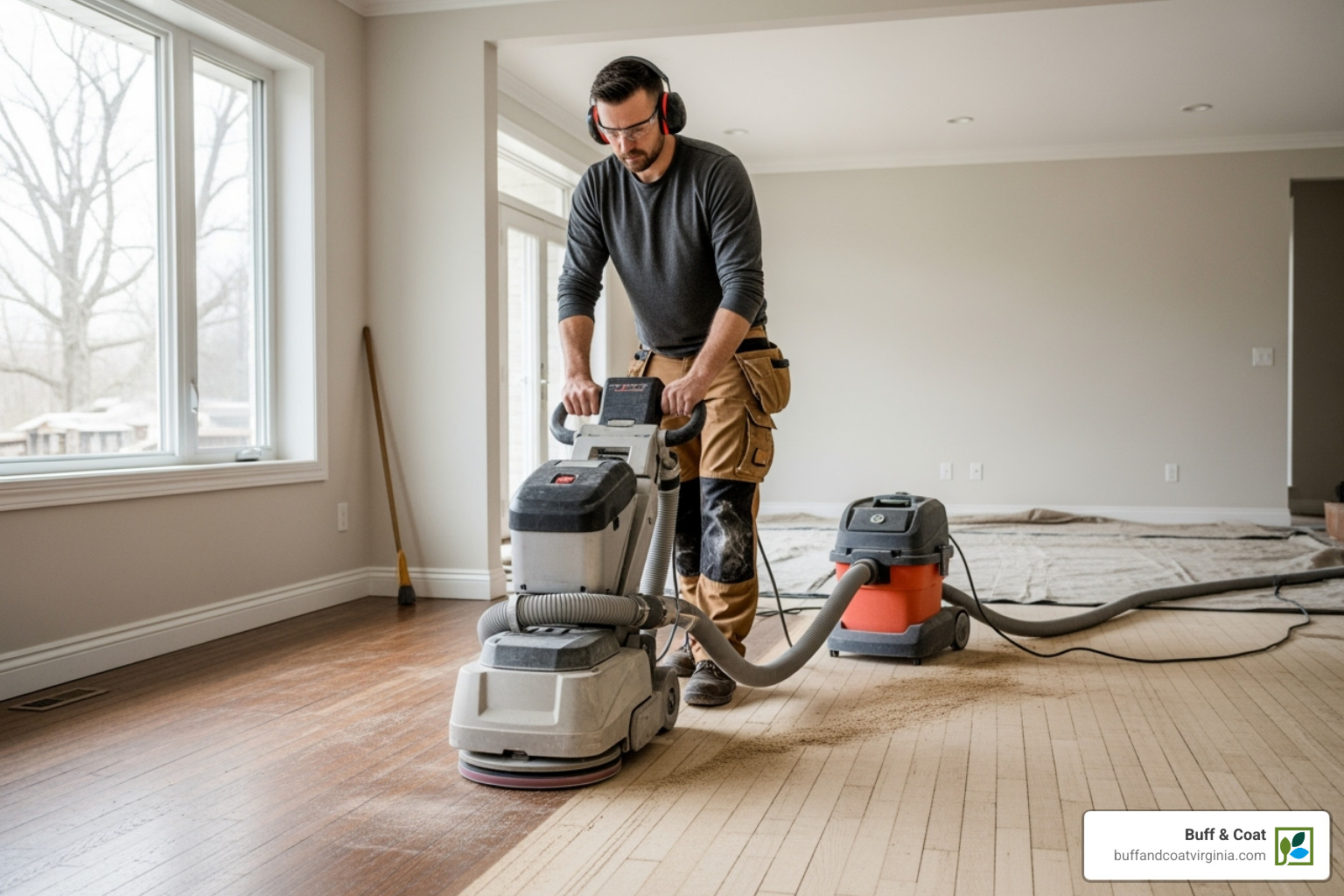
The superior equipment professionals use is perhaps the biggest game-changer. We’re talking about $20,000 sanding machines that operate on 220v power versus the 110v rental units available to homeowners. That power difference isn’t just numbers on a spec sheet—it translates to more consistent, even material removal and a dramatically smoother finish.
Professional sanders also come equipped with advanced dust containment systems. While rental units might have a basic vacuum attachment, professional equipment can capture up to 99% of dust particles, protecting your family’s health and saving you days of cleanup afterward.
The Power of Professional Equipment and Techniques
The difference between professional-grade sanders and rental equipment is like comparing a Formula 1 race car to your daily commuter. Both have wheels and engines, but the performance gap is enormous.
Professional sanders are engineered for even material removal, preventing the dreaded “dishing” effect where some areas get sanded deeper than others. These machines maintain consistent contact with the floor, eliminating the waves and uneven surfaces that plague DIY projects.
Many reputable professionals follow standards established by the National Wood Flooring Association, which provides comprehensive training and certification programs. This means your contractor isn’t winging it—they’re following industry best practices developed over decades of refinement.
Proper floor preparation is where professionals really shine. Before touching a single piece of sandpaper to your floor, they’ll carefully inspect every square inch. They’ll set protruding nail heads below the surface, remove old wax or contaminants, and make necessary repairs. This attention to detail prevents equipment damage and ensures a uniform result across your entire floor.
Professional contractors also know which specific sanders work best for different stages. They might start with an aggressive drum sander for initial finish removal, switch to an orbital sander for smoothing, and finish with a buffer for the final preparation before staining. This isn’t guesswork—it’s a proven system.
At Buff & Coat, our commitment to dustless sanding technology means your family can often remain in the home during the refinishing process. Our advanced systems don’t just make cleanup easier—they create a healthier environment for everyone involved. Learn more about our approach to dustless sanding wood floors.
How Hiring Someone to Sand Floors Saves You Time and Stress
Let’s be honest: your weekends are precious. The thought of spending multiple weekends wrestling with heavy equipment, breathing dust, and worrying about permanent mistakes isn’t exactly relaxing.
When you hire someone to sand floors, most projects wrap up in just 1-3 days instead of the 1-2 weeks a DIY project typically requires. Professional teams arrive with multiple crew members, each specializing in different aspects of the process. While one person handles the main floor sanding, another focuses on edges and detail work, and a third prepares for the finishing stages.
There’s no learning curve when you hire professionals. You won’t spend hours watching YouTube tutorials or practicing on scrap wood in your garage. You won’t experience that sinking feeling when you realize you’ve been using the wrong grit sequence for the past four hours.
The physical demands of floor sanding are brutal. These machines are heavy, the work is repetitive, and you’ll spend considerable time on your hands and knees working edges and corners. Professional crews handle this grueling work while you focus on more enjoyable aspects of your life.
Professional cleanup is another huge advantage. While no sanding process is completely dust-free, professional systems minimize the mess dramatically. What little dust remains gets handled by the crew, not by you spending your evening with a shop vacuum.
Perhaps most importantly, reputable professionals offer workmanship warranties. If something goes wrong with the finish or if you’re not satisfied with the results, they’ll return to make it right. This safety net simply doesn’t exist with DIY projects—if you mess up, you’re on your own to fix it or pay someone else to repair your mistakes.
The peace of mind that comes with professional service is invaluable. Instead of lying awake wondering if you applied the polyurethane correctly or if those scratch marks will show through the stain, you can relax knowing experienced hands are caring for one of your home’s most valuable features.
Ready to skip the stress and get guaranteed results? Our team provides comprehensive floor sanding and polishing services that restore your floors’ beauty while protecting your investment for years to come.
Cost vs. Value: A Head-to-Head Comparison
The decision to hire someone to sand floors versus doing it yourself often boils down to a perceived cost difference. However, we’ve found that when you factor in all variables, the long-term value and peace of mind offered by professionals far outweigh the initial savings of a DIY attempt.
Here’s what the numbers really tell us:
Professional floor sanding typically costs between $3-8 per square foot, depending on your location, the condition of your floors, and whether you choose premium options like dustless sanding. For an average 1,000 square foot project, you’re looking at $3,000-$8,000 total.
DIY costs might seem lower upfront – around $2-4 per square foot in materials and equipment rental. That same 1,000 square foot room could cost $2,000-$4,000 in supplies. But here’s where it gets tricky.
The time investment tells a different story entirely. While professionals complete most projects in 1-3 days, DIYers often spend 1-2 weeks of dedicated effort. If you value your time at even $25 per hour, those extra weeks quickly eat into your supposed savings.
Equipment quality creates another gap. Professional 220v sanders deliver consistent, even results that rental 110v units simply can’t match. It’s like comparing a precision instrument to a basic tool – both might get the job done, but one does it far better.
The skill level difference is perhaps most critical. Professionals bring years of experience and training, while DIYers are learning on their actual floors. This leads to dramatically different finish quality outcomes.
Finish longevity shows where professionals truly shine. A properly executed professional job lasts 7-10 years, while DIY attempts often need redoing in 2-4 years. When you factor in this shortened lifespan, the overall value equation shifts heavily toward professional work.
The most sobering reality? The cost of re-doing a failed DIY job often exceeds what hiring a professional would have cost initially. We’ve seen homeowners spend $15,000+ to repair floors damaged by DIY attempts that went wrong.
Is It Cheaper to Sand Your Own Floors?
The short answer is: not really, once you consider the full picture. The upfront cost analysis might show DIY as cheaper, but this creates what we call the illusion of savings.
When you start factoring in your time’s value – those weekends spent wrestling with rental equipment, the physical exhaustion, the stress of potentially damaging your floors – the savings become questionable. Most homeowners underestimate both the time required and the difficulty involved.
Then there’s the high cost of potential mistakes. A single gouge from a drum sander can require replacing multiple boards. Uneven sanding might mean starting over completely. Poor finish application can leave you with a floor that looks worse than when you started.
The long-term value perspective changes everything. Professional work maintains your home’s value and provides years of beautiful, durable floors. DIY mistakes can actually decrease your home’s value and create ongoing problems.
For Richmond area homeowners considering their options, our comprehensive guide on Floor Sanding and Polishing breaks down the process and helps you understand what’s involved in achieving professional results.
While DIY might save you some money upfront, the combination of time investment, stress, potential mistakes, and shorter finish lifespan often makes professional floor sanding the smarter financial choice. You’re not just paying for the work – you’re investing in expertise, efficiency, and peace of mind.
Ready to move forward? We give free estimates—click our Contact Us page and schedule a free inspection.