

Home Blog Hardwood Floor Refinishing Colorado Springs: 2026 Guide
Hardwood Floor Refinishing Colorado Springs: 2026 Guide

Professional hardwood floor refinishing in Colorado Springs usually runs $3 to $8 per square foot, and that cost often makes sense because a proper refinishing job can deliver a 147% return on investment in the local market. If your floors look dull, scratched, faded by sun, or worn thin in the traffic lanes, refinishing is often the practical middle ground between living with damage and paying for full replacement.
A lot of Colorado Springs homeowners know this feeling. The mountain light is pouring through the windows, the room itself is beautiful, and then your eye drops straight to the floor. The finish looks tired. The boards have opened up a little. The sunny side of the room is a different color than the area under the rug. That's where local conditions matter more than most online guides admit.
Bringing Your Colorado Springs Home's Floors Back to Life
Colorado Springs is hard on hardwood. The views are great, but the same sunlight that makes a living room look spectacular can bleach and age a finish faster than homeowners expect. Add dry indoor air, daily traffic, pets, kids, and snow tracked in from the driveway, and even a good wood floor starts looking older than it really is.
I see the same pattern in homes all over this climate. A formal dining room may still look decent, but the hallway has lost its clarity, the entry has fine scratches, and the boards near south-facing windows show obvious fading. Homeowners often assume the floor is “ruined” when the underlying problem is that the protective finish has been depleted in spots.
That's why hardwood floor refinishing in Colorado Springs is so often a smart move. It restores the wood you already have, corrects wear that cleaning can't fix, and preserves the character of the house.
For homeowners trying to stay ahead of bigger issues, it also helps to treat flooring as part of regular house care. A broader ultimate home maintenance guide is useful because floor problems rarely start with the floor alone. Sun exposure, moisture at entry points, and indoor air conditions all play a part.
Practical rule: If your floor looks dirty even right after cleaning, you're usually not dealing with dirt anymore. You're looking at finish wear.
Renewal or Refinishing What Your Hardwood Floors Need
A lot of Colorado Springs floors look worse than they are. The finish gets baked by high-altitude sun, winter air opens small gaps between boards, and snowmelt at the entry can rough up a few key areas long before the whole floor is ready for a full sanding job. The decision is figuring out whether the wear is sitting on top of the wood or has already reached into it.
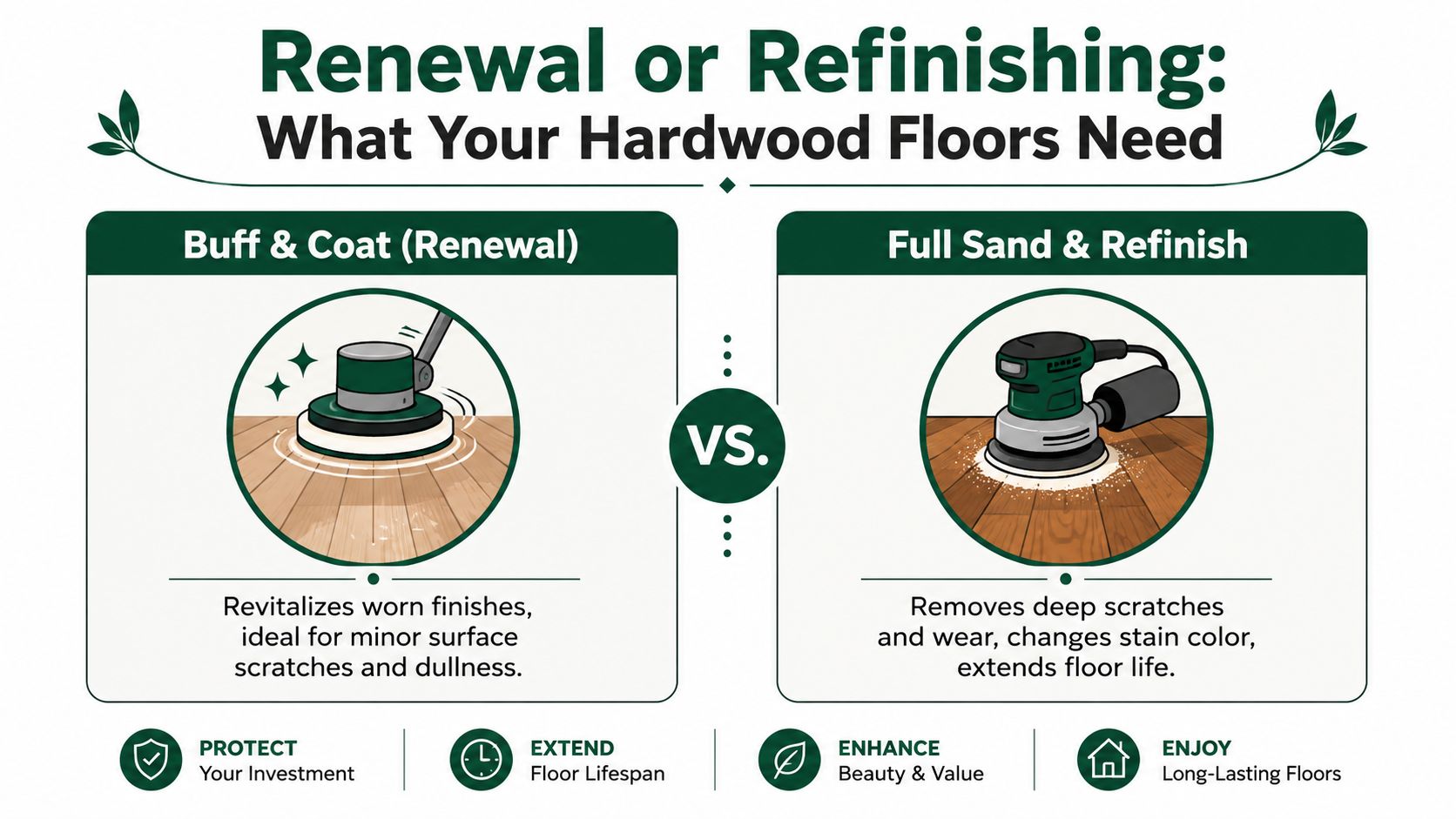
Choose a buff and coat if
A wood floor recoating is the lighter-touch option. The crew cleans the floor, lightly abrades the existing finish, and applies a new topcoat so the surface has protection again. It works best when the finish is tired but still intact enough to bond to a new coat.
This is usually the right fit when you're seeing:
- Dull traffic paths with faded sheen
- Light surface scratches that stay in the finish
- General haze from everyday wear
- Minor scuffing near entries or kitchens without exposed bare wood
In Colorado Springs, this service makes sense for floors that have lost their protective layer faster than expected from sun and dry air, but still have good color and a flat surface. South-facing rooms are a common example. The floor may look worn by the windows while the wood itself is still sound.
If you want to understand how low-dust equipment helps during this kind of maintenance work, this guide on dustless hardwood floor refinishing for a mess-free home update gives a good homeowner-level overview.
Choose a full sand and refinish if
A full refinish goes much deeper. It removes the old finish, cuts out surface damage, and exposes fresh wood so the floor can be stained again or sealed in its natural tone. That's the better choice when the wear has gone past the clear coat.
Choose this if you have:
- Deep scratches
- Sun fading or discoloration
- Finish worn through to bare wood
- Uneven sheen from old spot repairs
- Black water marks, pet stains, or rough grain from moisture exposure
This matters more in our climate than many homeowners realize. Wood moves here. In summer storms it takes on moisture. During winter heating season it shrinks back. That cycle works like a sponge swelling and drying out over and over, and over time it can leave finish lines, edge wear, and exposed seams that a simple recoat will not hide.
A good rule is simple. If the problem is sitting in the top finish layer, renewal may be enough. If you can see color loss, raw wood, stain damage, or uneven board wear, refinishing is usually the honest recommendation.
What this means for hardwood floor repair
Homeowners often search for hardwood floor scratch repair or hardwood floor restoration without knowing which service fits the floor. That's normal. The real question is how deep the damage goes.
Surface wear calls for preservation. Deeper wear calls for sanding and rebuilding the finish system so the floor can handle Colorado Springs conditions again.
The Professional Sanding and Refinishing Process
A refinishing job usually becomes real for homeowners the morning the equipment comes in. Furniture is out. Doorways are sealed. You can hear the first pass of the big machine, and the question is simple: what exactly is happening to my floor?
A good crew follows a clear sequence because hardwood does not forgive shortcuts, especially in Colorado Springs. Our dry winters, summer humidity swings, strong sun, and tracked-in snowmelt all expose weak prep and rushed finish work faster than milder climates do.
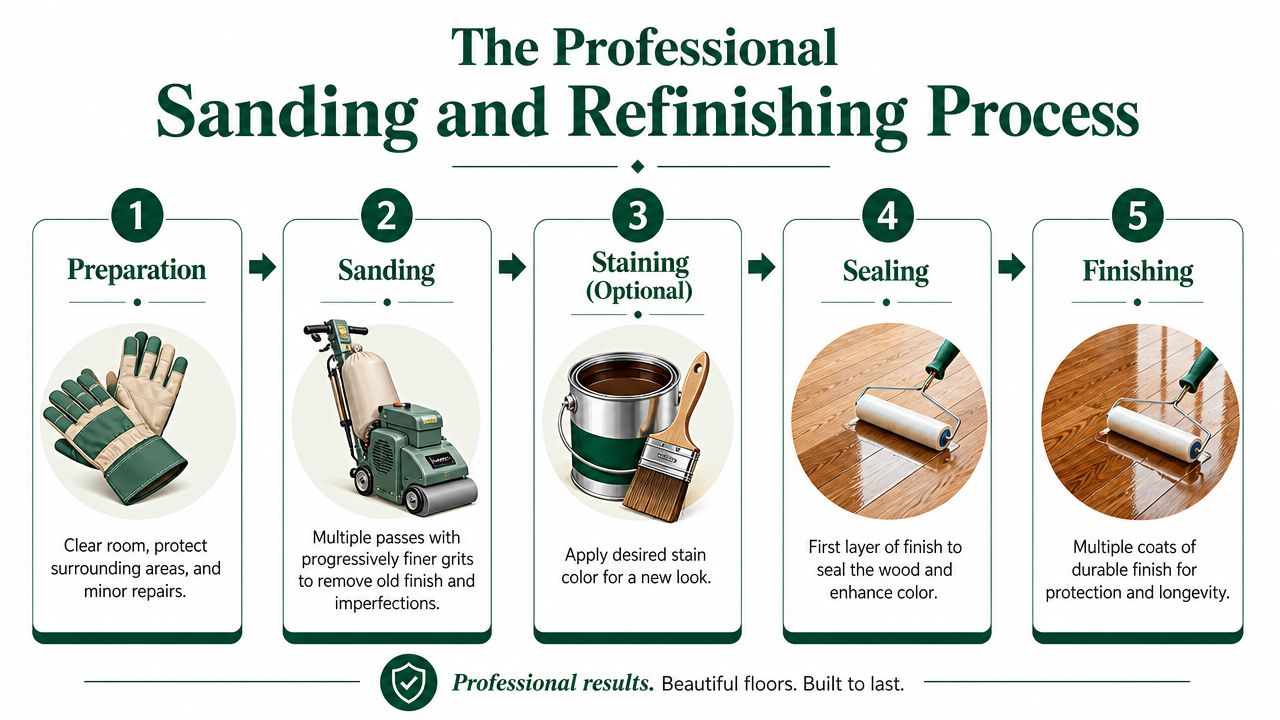
Prep work sets the tone
The job starts before the first sanding pass. The room gets cleared, adjacent spaces get protected, and the floor gets checked for loose boards, minor damage, old patch areas, squeaks, edge wear, and problem spots near entries. In Colorado Springs, I pay special attention to exterior doors, mudroom paths, and sunny south-facing rooms because those areas often show the hardest wear.
Dust control matters too. Modern dustless sanding systems use vacuum-equipped equipment to capture most of the airborne dust during sanding, which makes cleanup easier and keeps fine dust from traveling through the house, as explained in this dustless hardwood refinishing overview. For homeowners comparing cleanup expectations, this article on dustless hardwood floor refinishing and a mess-free home update gives a useful practical picture.
Prep also includes setting expectations. Some gaps that open during our heating season may shrink later. Some black water stains from snowmelt or plant overflows may sand out only partially. A pro should identify those trade-offs before work starts, not after the final coat is down.
Sanding happens in stages for a reason
Professional sanding follows a progressive grit sequence. The floor is cut with a coarse abrasive to remove old finish and flatten wear, then refined with medium and finer grits so the next pass removes the scratch pattern from the one before it. This NWFA-based sanding description outlines that standard progression and the full-coat finish schedule that follows.
Each stage has a job:
- Coarse sanding removes finish, old stain, and surface unevenness.
- Intermediate sanding cleans up the deeper scratch pattern left by the first cut.
- Final sanding leaves the wood ready for stain or sealer so the floor absorbs evenly.
That sequence matters more here than many homeowners expect. Colorado Springs light is harsh. Afternoon sun across a living room will highlight swirl marks, drum stops, edging halos, and chatter that might go unnoticed in dimmer conditions. Dry air also makes board edges and seasonal gaps more visible, so sloppy sanding telegraphs through the finish instead of hiding under it.
Here's a video that shows the workflow homeowners are often trying to picture before they commit:
Stain and finish are where durability is built
After sanding, the floor can stay natural or take a stain. Then it gets sealed and topcoated. Color gets most of the attention, but finish choice is really about how the floor will live in your house.
A busy entry that sees snow, de-icer residue, and wet boots needs a different conversation than a formal dining room. Homes with large west-facing windows may need more focus on UV resistance and maintenance planning because strong high-altitude sun can fade stained wood and age finish faster. Drying time matters too, but cure time matters more. A floor can feel dry and still be vulnerable to rugs, furniture, pet nails, and moisture.
Fresh finish works like concrete that has set but has not fully hardened. It looks done before it is ready for normal traffic.
The best refinishing jobs do not just make the floor look new for a week. They rebuild a finish system that can handle Colorado Springs conditions without failing early at board edges, entry points, and sun-exposed lanes.
Hardwood Floor Refinishing Cost in Colorado Springs
A quote for floor refinishing in Colorado Springs is really a quote for labor, condition, and risk. Two homes with the same square footage can price very differently if one has flat, open rooms and the other has sun-faded boards, pet stains, tight closets, and snowmelt damage near the entry.
According to Angi's Colorado Springs hardwood flooring cost data, the average cost to refinish hardwood floors locally is $1,900, with a typical range of $600 to $4,500. Traditional sanding and refinishing usually falls between $3 and $8 per square foot. The same source places dustless refinishing at $5 to $8 per square foot, a standard 1,000-square-foot home at $3,000 to $7,000, a 500-square-foot condo at $1,500 to $3,500, and homes over 2,000 square feet at $6,000 to $14,000.
Estimated Refinishing Costs in Colorado Springs 2026
| Service Type | Average Cost Per Sq. Ft. | Good For |
|---|---|---|
| Traditional sand and refinish | $3 to $8 | Deep scratches, worn-through finish, discoloration, full restoration |
| Dustless refinishing | $5 to $8 | Homeowners who want stronger dust containment during sanding |
| Commercial refinishing | $2.50 to $6 | Larger spaces with more standardized finishes |
| New hardwood installation | $1.75 to $9 | Floors that can't be saved or full material replacement |
If you want a broader pricing breakdown by scope, finish system, and repair level, this guide to hardwood floor refinishing cost is a useful reference.
What makes one quote higher than another
The biggest price swing usually comes from floor condition. A lightly worn oak floor in a furnished but well-kept home is straightforward. A floor with black water marks, deep gouges, old wax contamination, or cupped boards takes more passes, more edge work, and sometimes more repair time before finish even starts.
Colorado Springs adds a few cost pressures that generic pricing guides usually miss. High-altitude sun can bleach exposed areas and leave darker wood under rugs and furniture, which makes color blending harder. Dry indoor air can open gaps between boards, and those gaps may need to be cleaned out, filled selectively, or left alone depending on season and board movement. Entry areas that see snowmelt often need stain treatment or board replacement because water damage tends to soak in at seams first.
Common quote drivers include:
- Damage level. Deep scratches, pet stains, and uneven wear add sanding time.
- Layout complexity. Hallways, closets, stair landings, and tight transitions slow production.
- Dust containment setup. Dustless systems use specialized equipment and usually cost more.
- Stain work. Color changes take more prep and make sanding quality more visible.
- Repairs before sanding. Board replacement, patching, and subfloor fixes raise the total.
Replacement is still part of the conversation in some homes. Angi's Colorado Springs pricing shows new hardwood installation usually costs $1.75 to $9 per square foot, or $1,500 to $10,000 total. In practice, refinishing is often the better value if the floor still has enough wear layer left and the damage is mostly cosmetic. If boards are badly water-damaged, repeatedly sanded in the past, or moving too much from dryness and moisture exposure, replacement can make more sense long term.
The cheapest bid is not always the lowest real cost. If a contractor skips moisture checks, rushes repairs, or prices the job without accounting for Colorado Springs sun and seasonal movement, the floor may look good for a short time and fail early where the house works it hardest.
The Colorado Climate Challenge High Altitude UV and Humidity
Colorado Springs homeowners don't just need a refinishing contractor. They need someone who understands what this climate does to wood.
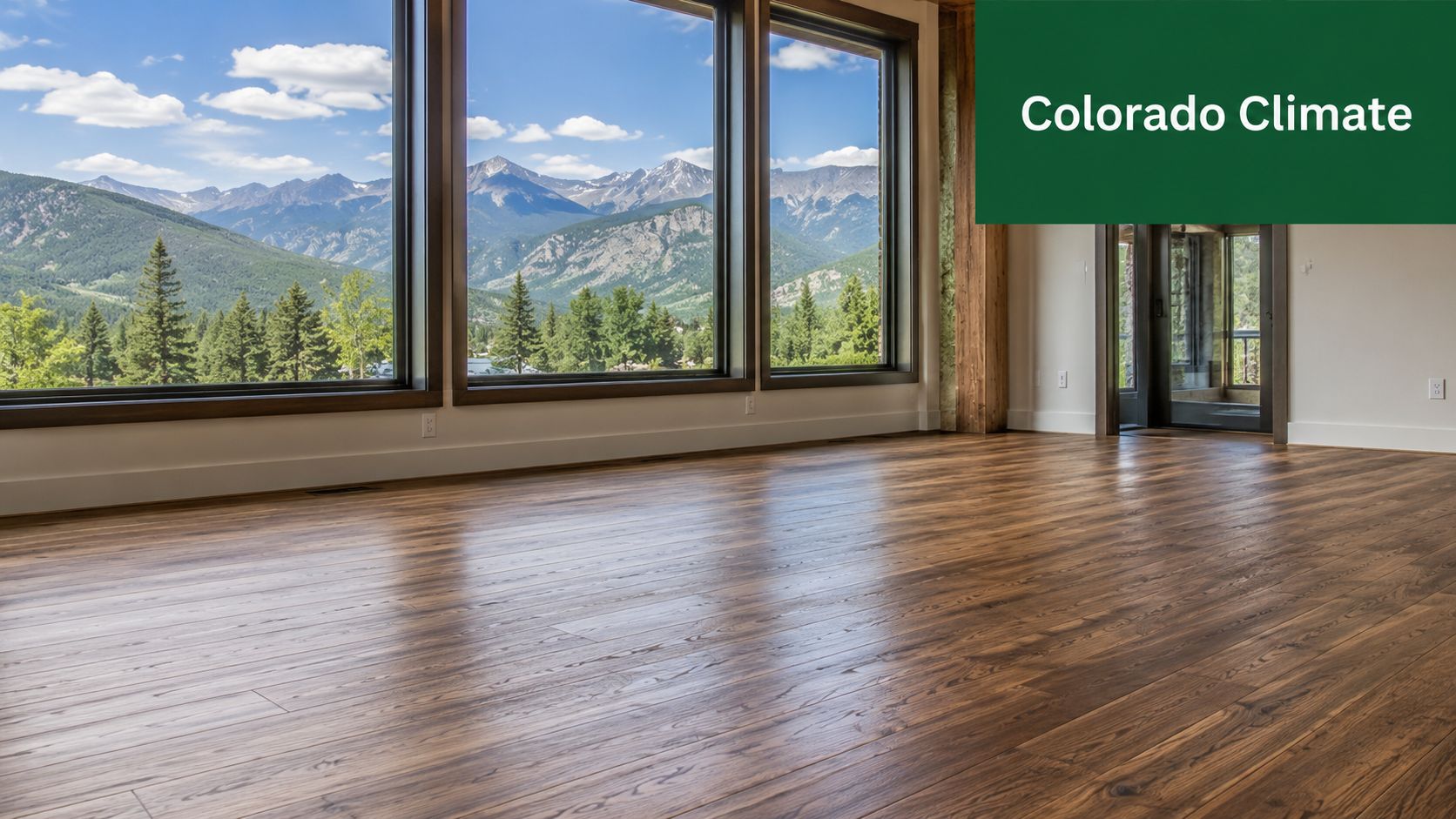
Dry air changes the shape of wood
Colorado Springs' arid climate, with average annual humidity often below 40%, causes wood to shrink, and recommended indoor humidity is 35% to 55% to help prevent gaps and cracking, according to this Colorado hardwood climate guide.
Wood behaves a lot like a sponge with a memory. It takes on moisture and gives it back. When indoor air gets too dry, boards lose moisture and contract. That's when homeowners notice seasonal gaps. In this market, that movement isn't cosmetic trivia. It affects timing, finish performance, and whether the floor is stable enough to sand.
The same source notes that oak can change by about 0.2% in width for every 1% change in humidity, and Colorado Springs can see daily temperature swings that exceed 50°F. That's a lot of movement pressure on a floor system.
Keep indoor humidity steady before and after refinishing. A beautiful finish applied to unstable wood won't stay beautiful for long.
High-altitude sunlight is tougher than most guides admit
Colorado Springs also sits at high altitude, and that stronger light changes the way wood ages. Local guidance points to sun-faded areas from intense high-altitude sunlight as a telltale sign of wear, and identifies a content gap around explaining how roughly 6,000-foot altitude sunlight speeds fading compared with lower-elevation markets in this Colorado Springs hardwood wear discussion.
That matters because homeowners often blame the stain when exposure is the culprit. Move a rug after a few years and the contrast becomes obvious. The floor didn't fail evenly because the room didn't age evenly.
Snowmelt creates a different kind of problem
Moisture damage here often starts at entries, mudrooms, and exterior doors. Snow melts off boots, seeps into seams, and sits where the finish is already under stress. Some floors cup slightly and recover once moisture conditions stabilize. Others don't.
The challenge in Colorado Springs is that homeowners can get both extremes in one year. Very dry interior air can open board seams, and snowmelt can then find those vulnerable spots. That cycle is one reason climate-specific maintenance matters more here than generic national advice suggests.
Hiring a Refinishing Pro 10 Questions to Ask
The easiest way to avoid a bad refinishing job is to ask better questions before the job starts. Price matters, but price without process is a gamble. A floor only gets so many full sandings in its lifetime, so choosing the right contractor is risk management, not just shopping.
Hardwood floors in Colorado Springs typically need refinishing every 7 to 10 years, but that can shorten to 5 to 7 years in high-traffic homes, and a proper refinishing job can deliver a 147% return on investment at resale, according to this Colorado Springs refinishing interval and ROI guide. That's exactly why vetting the contractor matters.
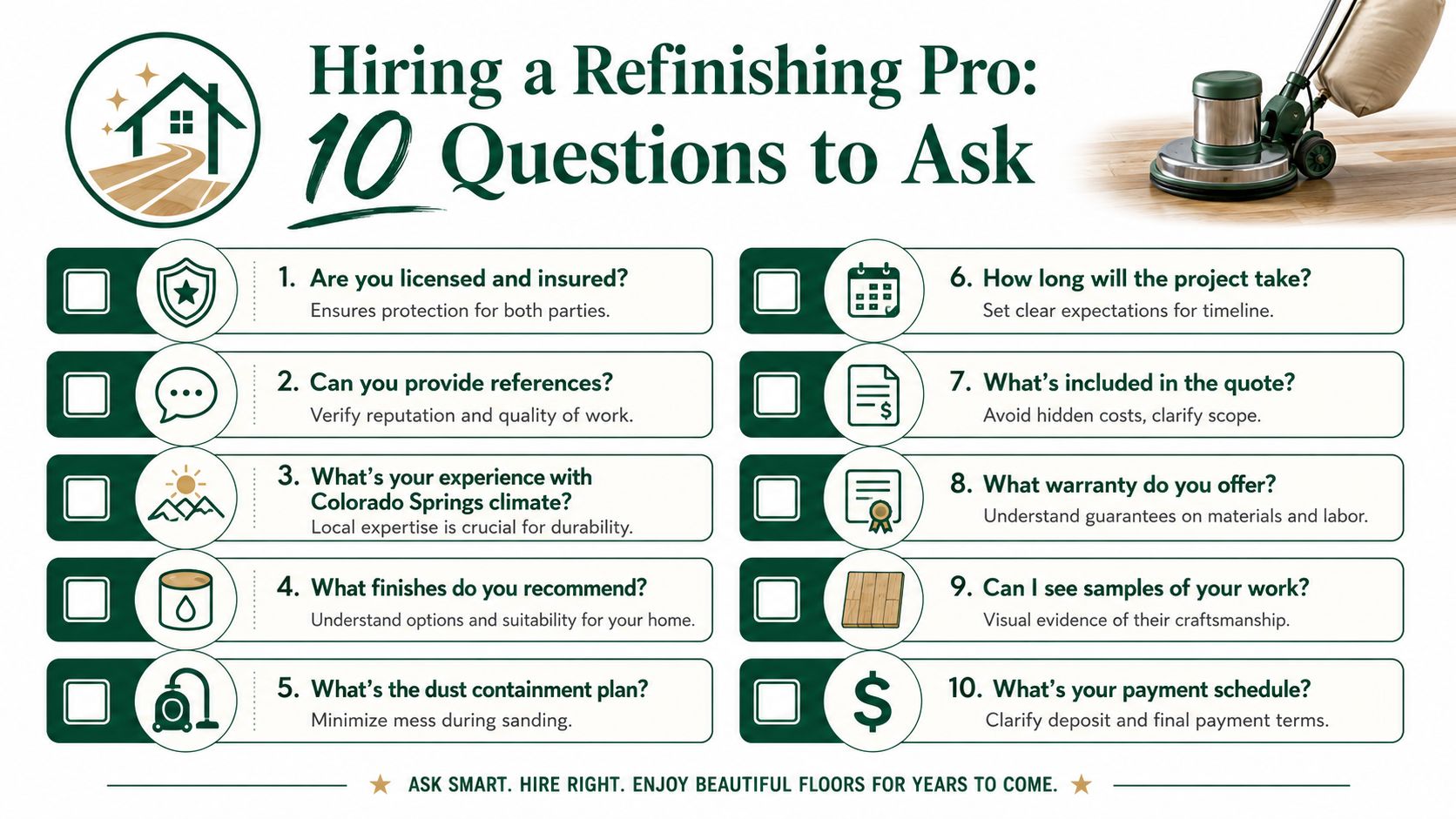
The questions worth asking
Are you licensed and insured for this work?
If a contractor gets vague here, keep looking. Homeowners who want a better sense of what licensing can involve across trades may find this breakdown of cleaning business license costs helpful background.What dust containment system do you use?
“Dustless sanding” should mean actual vacuum-assisted equipment, not just better cleanup later.What grit sequence do you follow?
A real pro should be able to explain the sanding progression clearly.How do you handle repairs before sanding starts?
Board issues shouldn't become a surprise after the machine is already in the room.What finish do you recommend for my traffic level?
Pets, kids, sunlight, and lifestyle all affect finish choice.
What separates a careful contractor from a risky one
Good contractors answer questions directly. They don't dodge the awkward parts, like cure times, furniture delays, or the limitations of a floor that may already have been sanded several times. If you want a homeowner-focused hiring checklist, this guide on floor sanding contractors is a solid place to compare what professionals should be willing to discuss.
Ask these too:
- What's included in the quote? Prep, stain, coats, minor repairs, and cleanup should be spelled out.
- How long will the project take? A local refinish commonly takes 3 to 5 days according to the earlier Colorado Springs source, but specifics should match your layout and finish choice.
- Can you show examples of similar work? You're looking for consistency, not flashy photos alone.
- What happens if you find moisture problems or severe warping?
- What does your payment schedule look like?
If a contractor can't explain the process in plain language, they probably won't execute it carefully either.
Frequently Asked Questions About Local Refinishing
Can you refinish floors with minor warping from snowmelt
Sometimes. Minor cupping from tracked-in snow or wet boots can often be sanded out, but only after the floor has dried and stopped moving. In Colorado Springs, that waiting period matters because our dry air can make a damp floor swing from swollen to shrunken faster than homeowners expect.
Sanding a floor that still has active moisture is like trimming a board before it finishes settling. You may flatten it for the moment, then end up with deeper gaps, uneven edges, or a washboard look once the wood adjusts again. Severe warping, black water staining, or boards that have started to delaminate usually point to replacement, not refinishing.
Can engineered hardwood be refinished
It depends on the wear layer. Some engineered floors have enough real wood on top for a careful sanding. Others only allow a light screen and recoat, and some are too thin for either option.
This is one area where species, plank construction, and previous work all matter. A floor can look solid from above and still have very little material left to sand. An in-person inspection gives a much better answer than photos, especially in Colorado Springs homes where dry-season gapping can make a floor look worse than its true condition.
How long does refinishing take
Most local jobs take several days for sanding, staining if selected, and finish application. The usable timeline depends on the finish system, the amount of repair work, and how evenly the home holds temperature and humidity during the job.
Full cure takes longer than basic walk-on time. That difference matters in Colorado Springs because altitude, sun exposure, and indoor dryness can change how finishes behave from one house to the next. South-facing rooms with strong UV exposure and entry areas that see snowmelt usually need a little more planning, especially for rugs, pet traffic, and furniture move-back.
How many times can solid hardwood be refinished
Solid hardwood can usually be refinished multiple times, but the practical limit is the board thickness that remains above the tongue. Each full sanding removes material, so a floor with deep old drum marks or several past refinish jobs has less margin left.
That is why timing matters. Refinishing before the surface gets badly worn often preserves more of the floor over its lifespan than waiting until every scratch, gap, and stain becomes severe.
If you're weighing hardwood floor refinishing, a buff and coat service, dustless sanding, hardwood floor repair, or even floor installation Richmond homeowners often ask us about, Buff & Coat Hardwood Floor Refinishing gives straightforward recommendations based on what the floor needs.
Why Richmond Homeowners Choose Buff & Coat
- 15 years in business
- Dustless sanding systems
- Local, owner-operated
- High-quality finishes
- Clear pricing and honest advice
- 5-star customer service
Ready to restore your hardwood floors? Buff & Coat makes the process fast, clean, and stress-free. Call 804-392-1114 or request your free estimate at buffandcoatvirginia.com.


