
Richmond homeowners usually start an LVP project by shopping color, texture, and price. That makes sense. But when you're hiring LVP flooring installers in Richmond VA, the part that decides whether the floor stays tight and quiet or starts separating later is rarely the plank itself. It's the prep work underneath.
A lot of installation problems could have been avoided with better questions before the first box was opened. If you want a floor that looks good now and still performs well later, you need to know how to spot a careful installer, how to read a quote, and which shortcuts tend to cause the most expensive callbacks.
Why Professional LVP Installation Is About More Than Just Looks
The sales pitch for LVP is simple. It looks good, it handles daily life well, and it's often marketed as an easy flooring option. That last part is where homeowners get into trouble.
LVP can look straightforward because the finished surface is clean and modern. The hard part is hidden. A bad subfloor can make a nice product fail, just like painting over a damaged wall without patching and priming it first. The paint isn't the issue. The surface is.
What homeowners usually miss
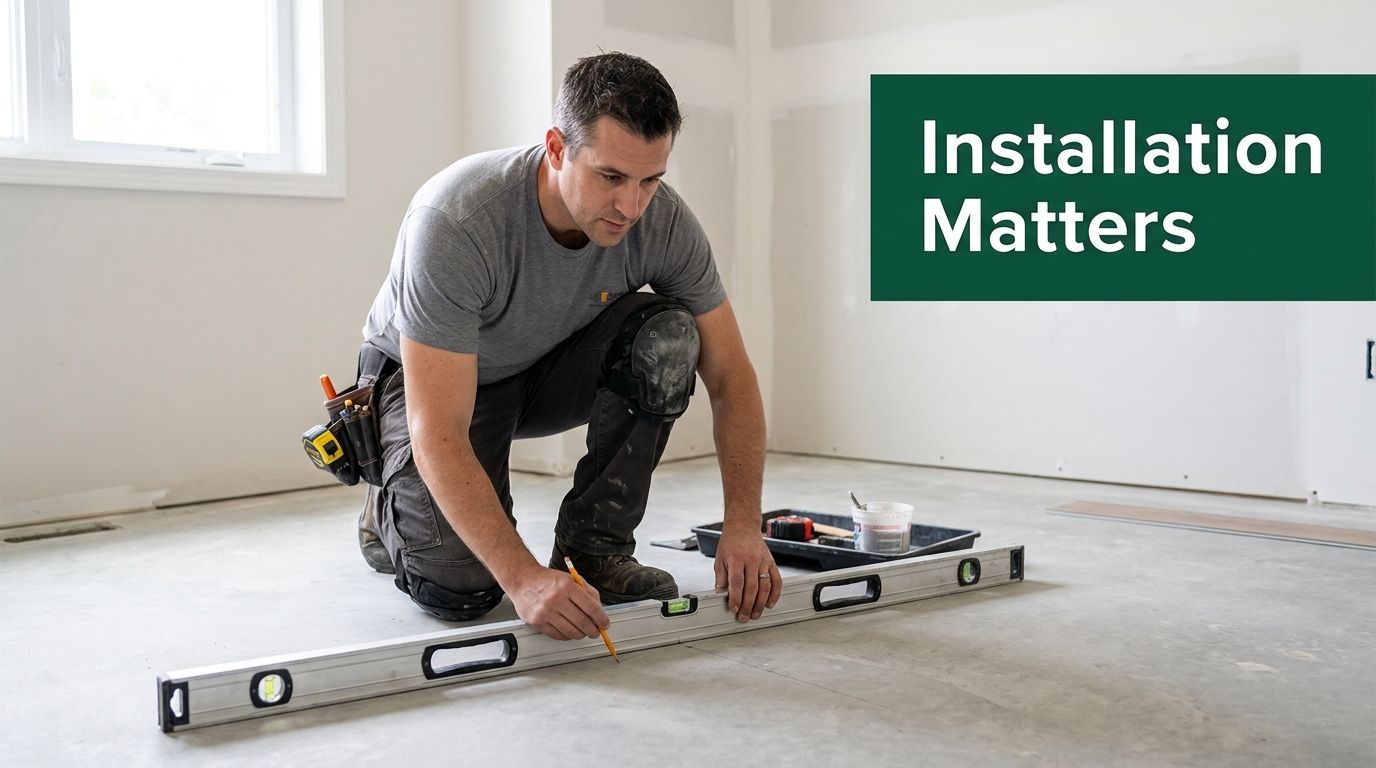
Buyers often notice wide plank visuals, wear layer marketing, and whether the floor feels “waterproof.” Fewer ask how the installer is going to flatten the slab, patch low spots, check moisture, or handle transitions between rooms.
That's a mistake, because subfloor prep is the biggest make-or-break factor in LVP installation. Contractors report that 60% of LVP installation failures in the last 12 months were traced to subfloor imperfections according to this trade discussion on LVP failure causes.
Practical rule: If an installer spends more time talking about the plank than the subfloor, keep asking questions.
A careful installer looks at dips, humps, old adhesive, cracked patch areas, door clearances, appliance resets, and how the floor will terminate at tubs, cabinets, and exterior doors. That's what protects the floor. The plank color doesn't.
What good installers do differently
Good LVP flooring installers slow down where rushed crews speed up. They measure. They document. They explain what has to happen before installation day and what may change once furniture is moved and the existing floor comes up.
If you want a useful starting point, review this guide to LVP flooring basics and pay attention to the prep requirements, not just the product features.
In Richmond VA, that matters even more because homes vary a lot. You might have a slab in one neighborhood, a crawl space in another, and multiple previous flooring layers in an older house. The installer who treats every house the same usually creates the problems the homeowner ends up paying for later.
If you're unsure whether an LVP project is a good fit for your home, get a second set of eyes before you buy materials. A short site visit can save a long headache.
How to Find Reputable LVP Installers in the Richmond Area
A search result isn't a screening process. In Richmond VA, the better route is to build a shortlist from places and people who see flooring work up close.
Start where installers are already known
Local flooring supply stores are one of the best filters. Counter staff, warehouse teams, and sales reps usually know which crews return for the right materials, ask smart technical questions, and don't generate constant complaints. Ask who they'd trust in their own house.
Neighborhood groups help too, but read them carefully. A recommendation from someone in Midlothian with a newer slab home may not translate well to an older house in Richmond with uneven subfloors or previous water damage. Context matters.
A practical shortlist often comes from three places:
- Specialty flooring stores: Ask which installers handle prep work well, not just who installs quickly.
- Local community groups: Look for detailed reviews that mention communication, cleanliness, and how problems were handled.
- Trade organizations: Use directories such as the National Wood Flooring Association to identify flooring professionals with industry involvement.
Watch for local fit, not just availability
Some installers travel through Richmond VA for volume work. That doesn't automatically make them bad, but it can create problems when you need follow-up, trim adjustments, or a return visit after the job.
Look for a contractor who regularly works in Richmond, Midlothian, Chesterfield, Henrico, Glen Allen, Short Pump, or Mechanicsville. A real local presence usually means faster communication and better accountability.
It also helps to read something that explains what a true flooring contractor should handle beyond the visible flooring layer. This overview of a professional flooring contractor's role gives homeowners a better sense of what competent project planning looks like.
Ask one simple question early: “If I have a problem after installation, who comes back to look at it?” The answer tells you a lot.
The best installers in Richmond VA aren't always the cheapest or the fastest to schedule. They're often the ones who ask more questions before they ever give you a number.
If you've gathered a few names but aren't sure who's serious, don't rush to book estimates yet. Screen them first.
Your Vetting Checklist Before Making the First Call
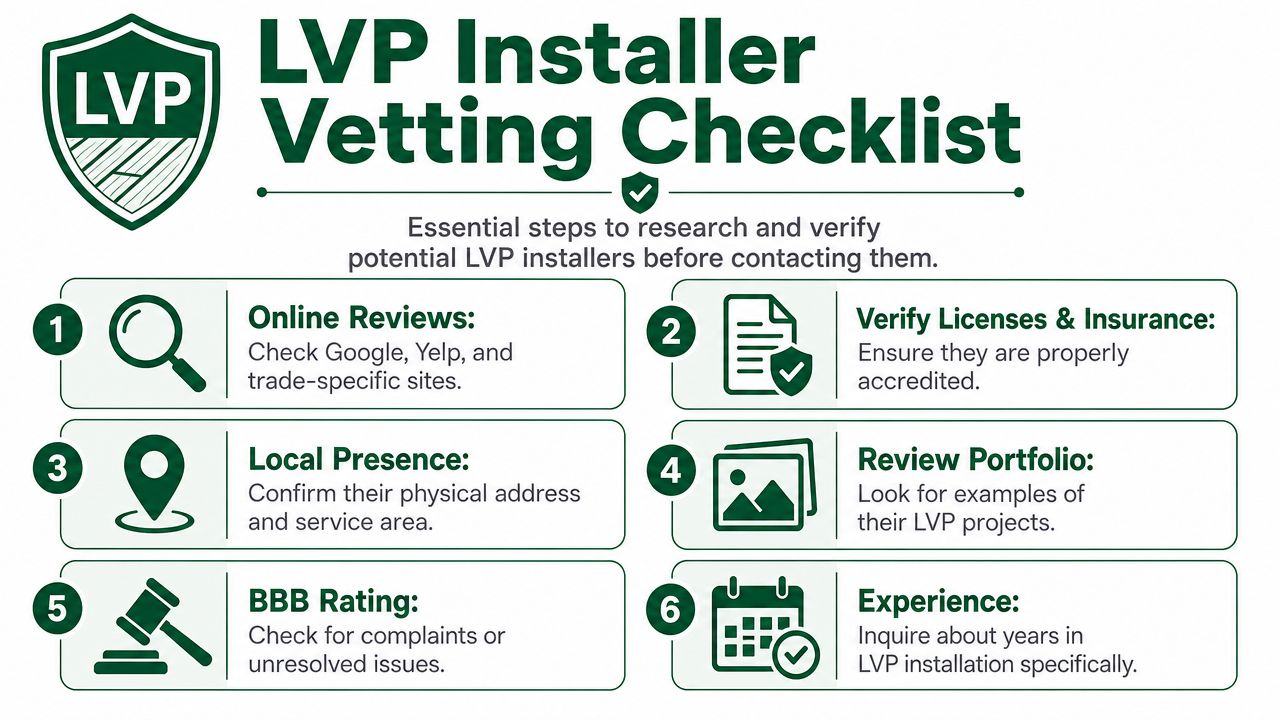
A quick online check can save hours of bad estimate appointments. Before you call any installer, look for signs that they run a real business and understand LVP as a technical flooring system, not just a quick install.
What to verify online
Use this checklist before anyone steps into your house:
- License and insurance: Make sure the company clearly states it's properly insured and operating legitimately in Virginia.
- Real project photos: Look for room transitions, stairs, tricky layouts, and close-up finish details. Stock photos don't tell you anything.
- Local footprint: A real service area, local phone number, and consistent business presence are better signs than a vague service page.
- Review quality: Read beyond star ratings. The useful reviews mention scheduling, prep, cleanup, punch-list handling, and whether the final bill matched the quote.
- Problem-solving language: Serious installers talk about subfloors, moisture, leveling, and prep. Weak ones mostly talk about “great prices.”
Two issues that get skipped in quotes
Homeowners often assume moisture testing and acclimation are automatic. They aren't. In humid conditions like Richmond's, that assumption can get expensive.
According to this homeowner discussion about questions to ask LVP installers, skipping moisture testing on a concrete subfloor leads to adhesive failure and warping in up to 40% of projects. That's exactly the sort of detail many basic quotes leave out.
So when you review websites or estimate forms, look for any mention of:
- Moisture testing: Is it included, optional, or missing?
- Acclimation: Does the installer mention how materials will be conditioned before installation?
A good contractor leaves a paper trail
If you've hired remodelers before, this part will sound familiar. Clear scope, documentation, and communication matter just as much as craftsmanship. For homeowners juggling multiple trades, The Cabinet Coach's contractor management tips are worth reading because they help you spot weak communication before a job begins.
Sloppy admin usually shows up before sloppy workmanship.
A company that can't provide basic documentation, recent local work, or a clear explanation of what's included probably won't become more organized once your furniture is in the garage and your old flooring is torn out.
If you want an honest recommendation on whether a candidate looks solid on paper, have a flooring pro review the estimate language before you sign. That's often cheaper than fixing a bad install.
Key Questions That Separate the Pros from the Amateurs
The in-home estimate is where weak installers get exposed. A polished website can hide a lot. A technical conversation in your living room can't.
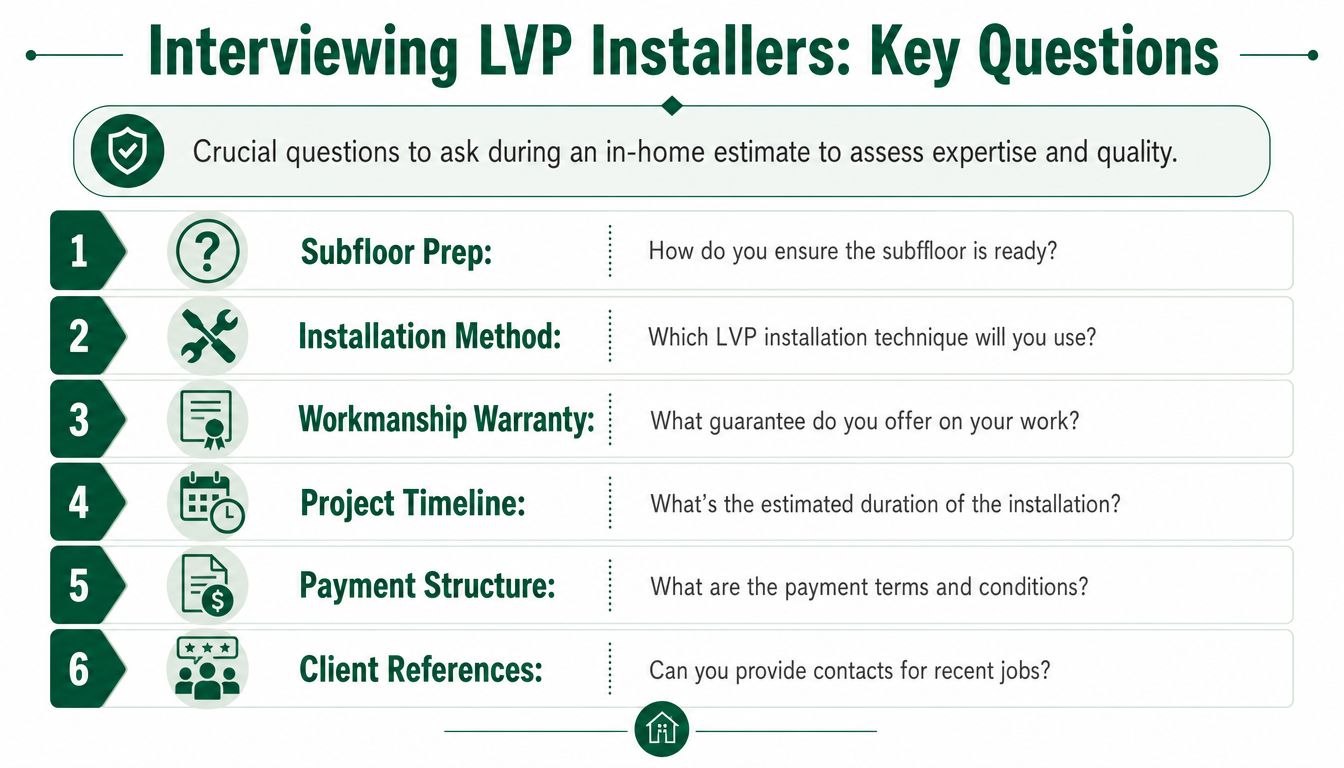
Ask about subfloor flatness first
Start here: “How will you measure the subfloor, and what flatness standard are you using?”
For LVP, the subfloor must have a flatness tolerance of no more than a 3/16 inch deviation over a 10-foot radius, and exceeding that can cause joint separation and locking-system failure in up to 68% of non-compliant projects according to CFI training guidance for LVP installation.
A good answer mentions real tools and a real process. You want to hear things like long straightedges, levels, moisture meters, patching compounds, self-leveler where needed, and a plan for documenting problem areas.
A bad answer sounds casual. “We'll make it work” is not a method.
Ask this plainly: “If you find high spots and low spots after demo, what happens next, and how is that priced?”
Ask how they handle installation details
Next, ask which installation method they're planning to use and why. A capable installer should explain whether your product is floating or glue-down, what underlayment or vapor retarder is required if any, and how room layout affects plank direction and transitions.
Then ask about perimeter spacing, door jamb cuts, and how they'll handle irregular walls or heavy fixed objects. If they don't mention expansion space, they're skipping a basic part of the conversation.
This video is a helpful reference point before your estimate:
Ask questions that reveal professionalism
A strong interview usually includes these:
What prep work do you expect in this house?
Good answer: specific and room-based. Red flag: “Hard to say” after they've already walked the floor.Do you include moisture testing and acclimation in your standard process?
Good answer: yes, with explanation. Red flag: “Usually not necessary.”Who performs the work?
Good answer: a named crew or clearly supervised team. Red flag: vague subcontracting with no accountability.What does your workmanship warranty cover?
Good answer: clear separation between product warranty and labor responsibility. Red flag: broad promises with no written scope.Can you provide recent local references for LVP jobs?
Good answer: recent and relevant. Red flag: only old jobs or unrelated flooring types.
A real pro won't be annoyed by technical questions. Usually, they're relieved to hear them because it means the homeowner understands that installation quality isn't just about snapping planks together.
If you want a second opinion before choosing between two installers, ask for a scope review. Sometimes the deciding factor is hidden in one missing line item.
Decoding Your LVP Installation Quote and Timeline
A one-line quote is cheap only on paper. Once the job starts, that kind of estimate is where surprise charges show up.
What a complete quote should include
A solid LVP proposal separates materials, labor, and prep instead of blending everything into one lump sum. At minimum, look for these categories:
| Quote item | What it should clarify |
|---|---|
| LVP material | Brand, product line, and what's actually being supplied |
| Labor | Installation labor separate from material cost |
| Demolition | Removal of old flooring and disposal details |
| Subfloor prep | Patching, grinding, self-leveling, skim work, or moisture-related prep |
| Trim and transitions | Reducers, thresholds, shoe molding, or base adjustments |
| Furniture and appliance handling | Who moves what, and what is excluded |
If subfloor prep is listed as “if needed” with no explanation, ask how the installer determines that and how they charge for it. That single line often explains why one quote is lower than another.
Why labor costs aren't just “time on the floor”
The median annual wage for flooring installers was $52,000 in May 2024, or $25.00 per hour, according to flooring industry wage data reported by FCNews. That doesn't tell you what any one company charges, but it does show why skilled labor is a meaningful part of the bill.
You're paying for more than plank placement. You're paying for layout judgment, prep decisions, trim work, moisture checks, problem-solving, and the experience to avoid expensive mistakes.
What works: a detailed estimate that names prep assumptions.
What doesn't: a bargain quote that treats the floor underneath as someone else's problem.
What affects the timeline
Timeline depends on the condition of the house as much as the square footage. Empty rooms move faster. Furnished homes, complicated cuts, uneven subfloors, and flooring removal add steps.
Ask these questions before you approve the schedule:
- Is the timeline based on rooms being fully cleared?
- Does it include demolition and disposal?
- What happens if the crew uncovers additional prep needs?
- When can furniture go back and normal traffic resume?
For a broader homeowner view of scheduling factors, this article on how long vinyl flooring installation takes is helpful.
In Richmond VA, older homes often stretch timelines because floors aren't flat and trim details are rarely simple. That doesn't mean the project is a bad idea. It means the honest estimate is usually the one that looks more detailed, not less.
If a quote feels confusing, ask the contractor to walk through it line by line. Good companies don't mind doing that.
Installation Red Flags and Long-Term Floor Care
You don't need to hover over the crew all day, but you should know what bad installation looks like while it's happening.
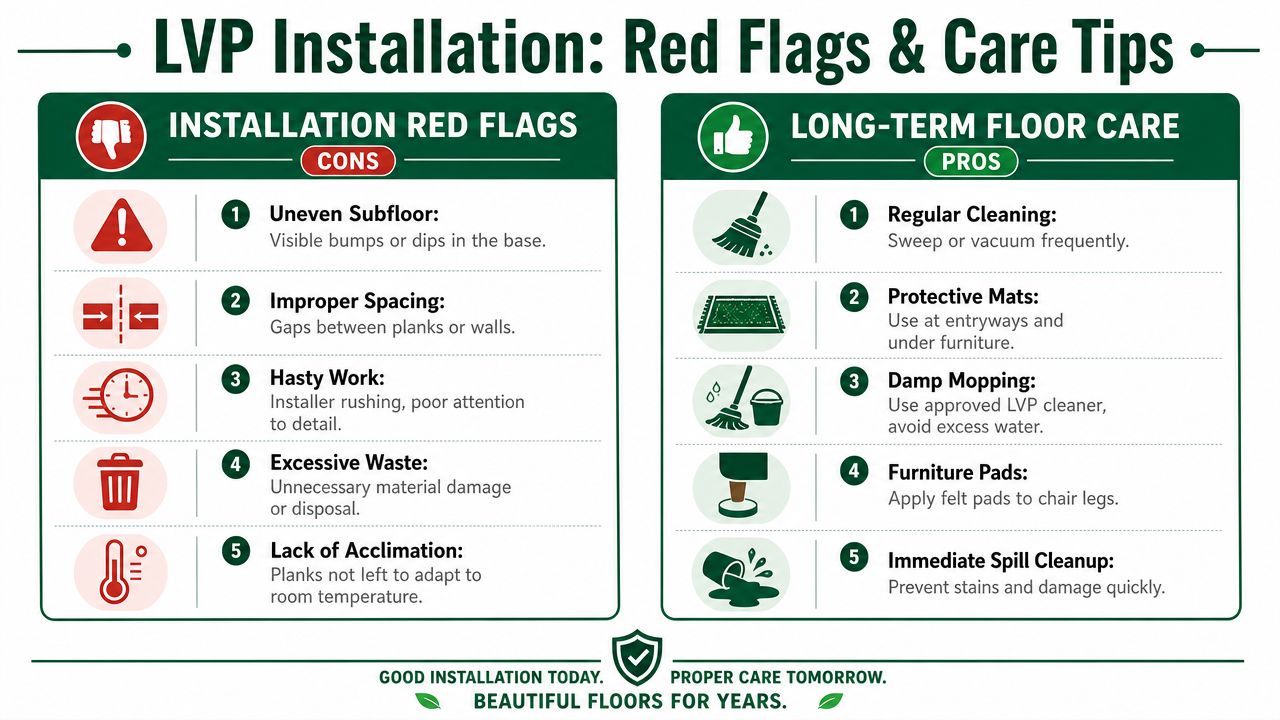
What to watch during installation
One of the biggest red flags is repetitive joint alignment. The most frequent LVP installation pitfall is improper seam staggering. Aligning end joints within 6 inches of adjacent rows increases locking mechanism stress by 52% and makes joint failure 2.3 times more probable according to Bona's professional guidance on luxury vinyl installation.
You should also notice whether the crew is working methodically or rushing. Good installation has a rhythm. Fast, careless installation tends to show up as broken locking edges, awkward cuts at jambs, or tight perimeter fits with no room for movement.
Watch for these warning signs:
- Visible subfloor irregularities: If you can already see dips telegraphing before the room is finished, speak up.
- No consistent wall spacing: Floors need perimeter space to move with seasonal conditions.
- Random plank patterning: Repeated visuals and poorly staggered seams usually mean the crew is laying too fast.
- Materials opened and installed immediately: That can signal skipped acclimation.
If the installer brushes off your concern with “you won't notice it later,” assume you probably will.
How to protect the floor after the crew leaves
Long-term care is simple, but it matters. Put felt pads under furniture, use entry mats at doors, and clean with products approved for LVP. A damp microfiber mop is safer than soaking the floor.
Don't let spills sit, especially around seams or exterior doors. The planks may resist water, but trapped moisture underneath is a different issue.
In Richmond VA, seasonal humidity swings and tracked-in grit do more damage than most homeowners expect. The cleanest-looking floors usually belong to people who do small things consistently, not people who deep-clean aggressively.
If something looks off right after installation, document it early and ask for a walkthrough before making the final payment.
Why Richmond Homeowners Choose Buff & Coat
Buff & Coat Hardwood Floor Refinishing is a Richmond-based floor refinishing and installation company with 15+ years of experience. The company serves Richmond, Midlothian, Chesterfield, Henrico, Glen Allen, Short Pump, Mechanicsville, and occasional jobs in Charlottesville, Fredericksburg, and Virginia Beach.
Homeowners usually want the same few things from a flooring contractor. Clear advice, clean work, and results that hold up. That's where Buff & Coat has built its reputation.
- 15 years in business with steady experience in homes across the Richmond area
- Dustless sanding systems for hardwood services, which helps keep the home cleaner during refinishing work
- Local, owner-operated service with accountability and direct communication
- High-quality finishes and careful installation practices
- Clear pricing and honest advice instead of vague estimates
- 5-star customer service built around respect for the home and responsive scheduling
Buff & Coat Hardwood Floor Refinishing offers dustless sanding, buffing and coating, hardwood floor installations, LVP and LVT installs, and repair work. If you want straightforward guidance on whether your home needs refinishing, repair, or new flooring, call 804-392-1114 or request a free estimate.
Frequently Asked Questions About LVP Installation
Can you install LVP over existing tile
Sometimes, yes. The tile needs to be stable, well-bonded, and flat enough for the new floor. Deep grout lines or cracked areas may need patching or leveling first so the pattern underneath doesn't show through over time.
How disruptive is LVP installation
It's usually less disruptive than hardwood floor refinishing because there's no sanding stage for the LVP itself. The biggest issue is clearing rooms, managing furniture, and allowing enough time for prep and trim work. A well-organized crew keeps the house functional as much as possible.
Is LVP actually waterproof
The planks themselves are marketed as waterproof, but that doesn't mean the entire floor system is protected from moisture problems below. Water can still get underneath the flooring and affect the subfloor if the installation details aren't handled correctly.
Is LVP the same as hardwood floor refinishing
No. LVP installation is a new floor installation project. Hardwood floor refinishing, wood floor recoating, and buff and coat service are different services used when the existing wood floor can be restored instead of covered or replaced. If you're comparing LVP to hardwood floor refinishing in Richmond VA, it helps to have a contractor look at the current floor before deciding.
If you're weighing LVP against repair or hardwood floor refinishing, Buff & Coat Hardwood Floor Refinishing can give you honest guidance based on the condition of your floors. Ready to restore your hardwood floors? Buff & Coat makes the process fast, clean, and stress-free. Call 804-392-1114 or request your free estimate at buffandcoatvirginia.com.