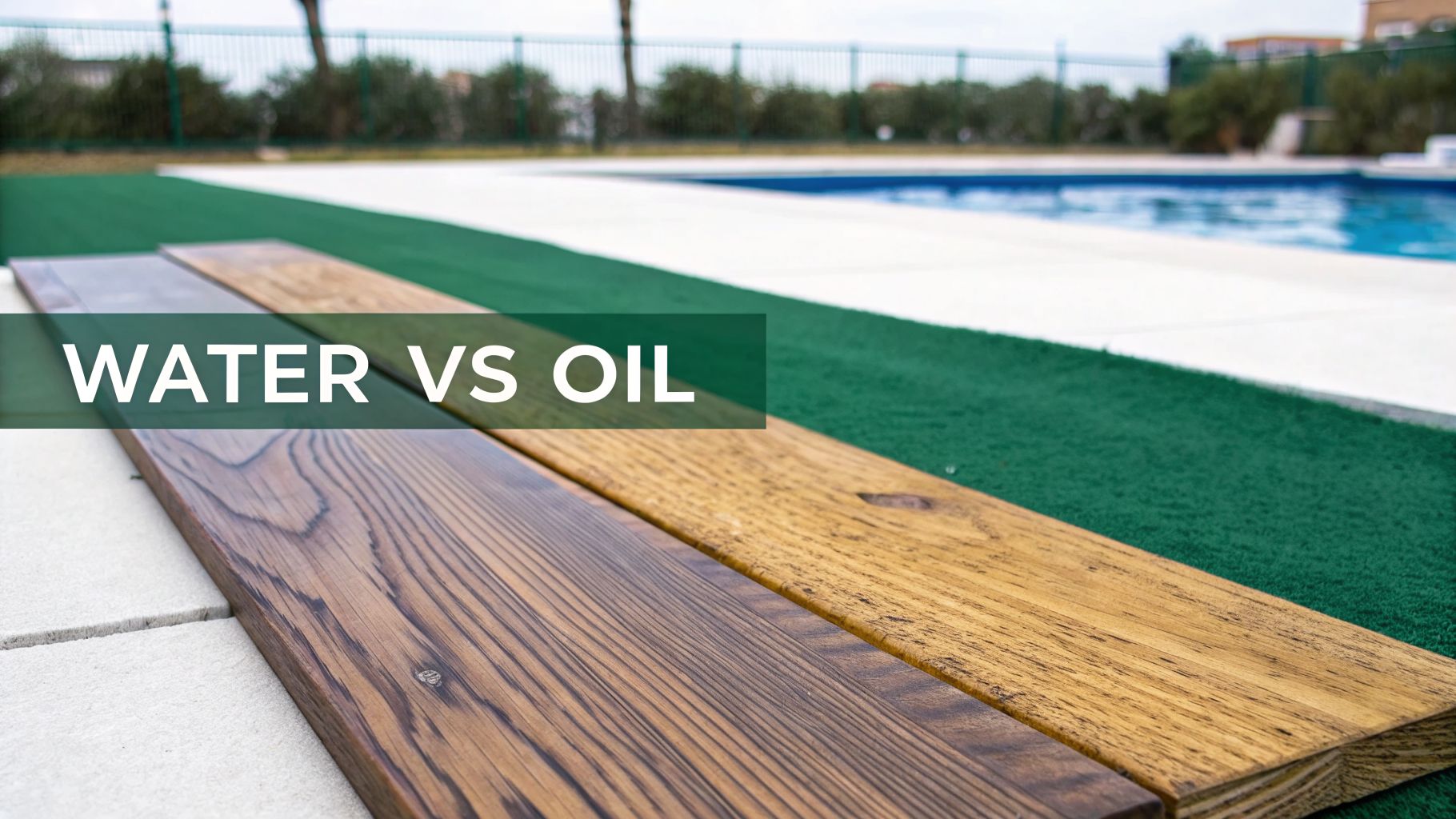
Richmond homeowners usually notice varnish damage the same way. A hallway starts looking tired, a chair scrape catches the light, or a small dull patch near the sink turns into a bigger concern once you realize regular cleaning isn't fixing it. Good wood floor varnish repair can restore protection, improve appearance, and help you avoid replacing floors that still have years of life left.
That matters because many floors don't need the most aggressive fix. Sometimes the right answer is a small repair. Sometimes it's a buff and coat service. Sometimes the only honest recommendation is full hardwood floor refinishing. Knowing the difference is what keeps a manageable problem from becoming an expensive one.
How to Diagnose Varnish Damage on Your Hardwood Floors
Before you choose any repair method, look at the floor like a finisher would. The main question is simple. Is the damage in the finish, or has it gone into the wood? That one distinction determines whether a light repair will work or whether you're looking at deeper hardwood floor repair.

Start with what the light shows you
Walk the room in daylight first, then turn on overhead lights at night and view the floor from an angle. Finish problems show up differently depending on glare.
Look for these common signs:
- Surface scuffs: These usually sit in the topcoat and show as light streaks or hazy marks.
- Dull traffic lanes: Entry paths, kitchen walkways, and spots in front of sofas often lose sheen first.
- White rings or pale spots: Minor moisture exposure can leave cloudy marks in the finish.
- Peeling or flaking: If the top layer is lifting, bonding has failed and the problem is usually bigger than a touch-up.
- Dark scratches: A dark line often means the scratch has broken through the finish and exposed raw wood or trapped dirt.
A lot of Richmond homes have strong natural light in front rooms and wear patterns near back doors, kitchens, and stair landings. Those spots tell the truth fast.
Use the fingernail test
A simple scratch test helps. Gently run your fingernail across the mark.
- If your nail doesn't catch, it's often a light surface issue in the finish.
- If your nail catches clearly, the damage is deeper and may need more than a cosmetic fix.
- If you see bare wood, don't keep experimenting. Exposed wood takes in dirt and moisture much faster.
Practical rule: If the floor looks dull across a broad area but the color is still even, that often points to wear in the topcoat, not failure of the wood itself.
Check whether the problem is isolated or widespread
A single scratch near a dining chair is one thing. Repeated wear across the whole room is another. That's where homeowners often misread the situation. They focus on one ugly spot, but the larger issue is that the entire finish has thinned out around it.
If your floor has lost sheen in walking paths, compare that pattern to nearby protected areas under furniture or along the wall. That side-by-side contrast tells you whether the room needs a broader solution like recoating.
For homeowners trying to sort out whether they're seeing wear or just overall haze, this guide on how to fix dull hardwood floors is a useful next step.
One reason repair and restoration have become such a common conversation is that homeowners increasingly choose to restore rather than replace. The global wood floor renovation services market was valued at approximately $3.1 billion in 2023, reflecting that shift toward preserving existing floors for appearance and durability, according to Dataintelo's wood floor renovation services market report.
If you're in Richmond VA and you're unsure what you're looking at, stop short of trial-and-error products. Diagnosis is where good floor work starts.
Choosing Your Repair Method Buff and Coat vs Full Sanding
After identifying the type of damage, the next step involves a practical decision. What repair method matches the actual condition of the floor? Homeowners often spend too much money at this stage, or they attempt too little and end up performing the task a second time.

Three paths that make sense
There are usually three reasonable options.
First is a DIY spot fix. That works for small, isolated finish damage where the surrounding floor is still in good shape.
Second is a wood floor recoating or buff and coat service. This is often the smartest middle-ground option when the floor has general surface wear, light scratches, or dullness, but the finish is still basically intact.
Third is full sanding and refinishing. That's the right call when scratches go into the wood, old finish is failing, or prior coatings are too uneven to recoat cleanly.
A floor can be too damaged for a simple recoat, but still too healthy to justify replacement. That middle category is where professional judgment matters most.
Comparing Hardwood Floor Repair Options
| Method | Best For | Cost | Time/Disruption |
|---|---|---|---|
| DIY spot fix | Small isolated scuffs or one localized worn patch | Lower material cost, but mistakes can become more visible than the original damage | Low disruption, but finish matching can be tricky |
| Professional buff and coat | Moderate surface wear, light scratches, dull traffic areas, even wear across a room | Mid-range option, often more cost-effective than sanding the whole floor | Less disruption than full sanding |
| Full sanding and refinish | Deep scratches, exposed wood, widespread finish failure, major unevenness | Higher investment than a recoat | More dust, more downtime, more moving parts |
For moderate varnish wear, screening or dustless buffing can outperform spot repairs with 90% client satisfaction, while preserving 80% to 90% of the original finish thickness and avoiding the 30% to 50% higher dust and cost associated with full sanding, according to this guide to refinishing old wooden floor varnish.
Best fit for each option
- Choose a spot fix if the issue is small, the sheen match is close, and the rest of the floor still looks healthy.
- Choose a buff and coat service if the room has uniform wear, shallow scratching, and no major stain, gouge, or peeling.
- Choose full sanding if the damage is through the finish, uneven across the floor, or tied to older failed coatings.
If you want a broader homeowner-level comparison before deciding how far to go, this article on DIY hardwood floor restoration gives useful context on resurfacing versus refinishing.
For a closer look at what a recoat involves, this page on buff and coat hardwood floors helps clarify where that service fits.
In Richmond VA, this choice often comes down to lifestyle as much as floor condition. Families with pets, busy hallways, and occupied homes usually want the least disruptive option that will still hold up. That's why a proper diagnosis matters more than the label.
A Guide to DIY Wood Floor Varnish Spot Repair
Some homeowners can handle a minor spot repair well. The keyword there is minor. If you've got one small worn patch or a light scratch in the finish, a careful repair may blend acceptably. If you're trying to patch a larger area in the middle of a room, expectations need to stay realistic.

What you need before you touch the floor
Get the area clean first. Any grit, polish residue, or household cleaner left on the surface can ruin adhesion.
A basic setup usually includes:
- Soft cleaning materials: Microfiber cloths, vacuum with a soft-floor attachment, and a cleaner approved for hardwood finish
- Abrasives: 150-grit paper for feathering and finer paper for de-nibbing between coats
- Finish materials: A small amount of compatible polyurethane, plus a quality brush or applicator
- Patience: Most failed spot repairs happen because someone rushes prep or applies finish too heavily
How pros handle a localized repair
The key move is feathering. You don't want a hard-edged patch. You want a soft transition where the repaired area blends into the surrounding finish.
For localized varnish repair, professionals use a feathered sanding technique with 150-grit paper to create that transition, and about 40% of DIY failures come from poor feathering or coats applied too thick, which can crack, according to this wood flooring varnish repair guide.
A workable process looks like this:
- Clean the area thoroughly. Remove dust, grease, and any product residue.
- Lightly sand around the damaged spot. Don't create a hard ring. Ease the abrasion outward so the edge disappears.
- Vacuum and tack the area. Dust left behind shows up immediately in fresh finish.
- Seal the bare section lightly. Keep the first coat thin.
- Let it dry, then smooth imperfections. A very light de-nibbing helps remove tiny particles.
- Apply additional thin coats as needed. Thin coats are easier to blend than one heavy pass.
The hardest part of wood floor varnish repair isn't putting finish down. It's making the repair disappear after it dries.
Here's a useful visual walkthrough if you want to see the general technique in action before trying it yourself:
Where DIY usually goes wrong
Most DIY spot repairs fail in one of three places:
- Sheen mismatch: Satin, semi-gloss, and matte don't hide mistakes the same way. Even if the color is close, the reflection may be off.
- Color mismatch: Older floors change over time. New finish on a small area can look clearer or lighter than the surrounding floor.
- Visible edge lines: If the repair area wasn't feathered properly, you'll see a patch every time light hits it from the side.
If you're weighing whether a local fix is worth trying, this wood floor finish repair guide can help you sort out what's realistic.
For homeowners in Richmond VA, my general advice is simple. DIY can work on a small hidden area or one minor blemish. It usually doesn't produce a clean result in a central, high-visibility part of the room.
The Buff & Coat Dustless Sanding Process Explained
A lot of Richmond homeowners call after trying to decide whether their floor needs a full sanding job or just a fresh topcoat. If the finish looks dull, lightly scratched, and worn in traffic lanes, but the wood underneath is still protected, a buff and coat service is often the right middle-ground repair. It restores protection and improves appearance without the mess, cost, and downtime of sanding down to bare wood.

What actually happens during the process
The first step is a detailed cleaning. That is not a formality. Any polish, grease, cleaner residue, or ground-in grime left on the old finish can cause bonding problems in the new coat.
Next, the floor is lightly abraded with a buffer and screen. The goal is to scratch the existing finish evenly so the new polyurethane can grip it. This is surface preparation, not a full sanding job. We are not flattening the floor, removing deep defects, or cutting back to raw wood.
Once the floor is prepped, a new coat of finish is applied across the entire area to create an even sheen and a renewed wear layer. In occupied homes, water-based polyurethane is often the practical choice because odor is lower, dry times are shorter, and the finish stays clear rather than warming the color as much as oil-based products do.
Why homeowners choose this instead of full sanding
A proper recoat works well on floors that look tired but have not crossed into finish failure. Hallways, kitchens, family rooms, and entry areas are common examples. The scratches are usually in the topcoat, not deep in the wood, and the homeowner wants the room to look better without emptying the house for a major refinish.
Dustless sanding matters here because cleanup is easier and the work fits real life better. Good containment does not mean zero dust, but it cuts down the fine airborne dust that homeowners worry about most.
I give the same caution on every estimate. A buff and coat only works if the existing finish can still accept a new coat.
Field note: A buff and coat works when the old finish is worn, not when it has failed. If the coating is peeling, contaminated, or breaking bond in patches, recoating won't solve the underlying problem.
For many homes in Henrico, Chesterfield, Midlothian, and Glen Allen, that makes recoating the more cost-effective service. Buff & Coat Hardwood Floor Refinishing offers this type of dust-controlled renewal work, along with full sanding when the floor condition calls for a more aggressive reset.
When a recoat is the wrong tool
A buff and coat has limits. It will not remove deep gouges, fix pet stains that have soaked into the wood, or correct boards with severe sun fade and color variation. It also should not be used over wax, acrylic polish buildup, silicone contamination, or areas where the old finish is already peeling.
That is the trade-off. On the right floor, a recoat buys you more life with less disruption. On the wrong floor, it adds shine for a short time and leaves the problem underneath.
Refinishing Costs Timelines and What to Expect in Richmond
A Richmond homeowner usually calls at the same point. The floors look tired, furniture has to be moved, and the big question is whether this will turn into a week-long disruption or a manageable project.
The honest answer depends less on square footage alone and more on choosing the right service. A buff and coat is often the lower-cost, lower-disruption option when the existing finish is still bonded well. Full sanding costs more because it removes the old finish, addresses deeper wear, and resets the floor more completely.
What affects the price
In Richmond, estimates usually move up or down based on the floor's condition and the amount of prep needed before any new finish goes down.
A few things change the number quickly:
- Depth of wear: Light topcoat wear is a different scope than heavy scratches, black water stains, or finish that has failed in traffic lanes.
- Repairs before refinishing: Loose boards, previous patch repairs, gaps, or damaged sections add labor before coating starts.
- Chosen process: A buff and coat is usually less expensive than full sanding because it keeps the existing finish system in place.
- Finish type: Water-based and oil-based products affect labor, dry times, odor, and how long the room stays out of service.
- Access to the space: Empty rooms are faster. Tight layouts, occupied homes, and difficult furniture logistics slow the job down.
That is the trade-off homeowners should focus on. If the floor only needs a fresh wear layer, a recoat can save money and avoid unnecessary sanding. If the finish is peeling, contaminated, or worn through into the wood, paying for a shortcut usually means paying twice.
Timeline and drying expectations
A full sanding job usually takes longer on site than a buff and coat, but the bigger scheduling issue is cure time after the crew leaves. Homeowners often plan around the work days and forget about the days when the floor still needs gentle treatment.
Expect three separate phases:
- Prep and floor work: furniture out, repairs handled, sanding or screening completed, and finish applied
- Dry time: the finish may be dry enough for careful foot traffic before it is ready for normal use
- Cure period: rugs, furniture, pets, and heavy traffic often need to wait longer than homeowners expect
That last phase matters. A floor can look finished and still be easy to scuff, dent, or mark.
Fresh finish should be treated like a new painted wall. It may look ready before it can handle daily use.
What to expect in an occupied Richmond home
For occupied homes, planning matters almost as much as the finish itself. Clear communication with your contractor keeps the project from becoming harder than it needs to be.
Homeowners should expect to:
- Empty the work area completely: rugs, furniture, floor lamps, and small items all need to come out
- Lose access to parts of the house for a period: the exact timing depends on the process and finish used
- Follow shoe, pet, and furniture rules carefully: socks are usually safer than shoes during the early return period
- Wait before replacing rugs: rugs can trap solvents and slow cure if they go back too soon
- Ask for plain-language timing: “dry,” “walkable,” and “fully cured” do not mean the same thing
In practice, professional guidance saves homeowners money. The wrong diagnosis leads to the wrong scope. A full sand job on a floor that only needed a buff and coat costs more than necessary. A recoat on a floor with finish failure looks better for a short time, then the same problems come back.
Frequently Asked Questions About Hardwood Floor Repair
Can you match the sheen on an older floor
Sometimes. An exact match is less predictable than homeowners expect.
Sheen reflects light across the whole room, so even a well-done repair can read differently if the surrounding finish has dulled with age, sunlight, or cleaning products. In practice, satin-to-satin is usually manageable. Matching a small glossy patch inside a worn floor is harder. If appearance matters more than keeping the repair small, a buff and coat across the full room often blends better than a tight spot fix.
Is a buff and coat safe for engineered hardwood
It can be, but only if the existing finish is still intact and the wear has not gone through to bare wood. That is the key distinction.
Some engineered floors have enough top layer and factory finish to handle a light screen and recoat. Others do not. Product type, plank condition, past cleanings, and any wax or polish residue all affect whether a recoat will bond properly. This is one of the clearest cases where a correct diagnosis saves money. A careful buff and coat is far less disruptive than full sanding, but it only works when the floor is a good candidate.
What finish type is usually better for occupied homes
Water-based polyurethane is often the easier choice for occupied homes because odor is lower and dry times are usually shorter. That does not make it the right answer for every floor.
Oil-based finish still has a place, especially when homeowners want its look and accept the longer odor and cure window. The better choice depends on schedule, ventilation, who is living in the home, and how quickly the rooms need to go back into service.
How often should hardwood floors be refinished
There is no single calendar that fits every house. A hallway with kids and dogs wears differently than a guest room.
Many floors can go years with routine maintenance, then need attention sooner in traffic lanes. The smarter approach is to watch the finish, not the calendar. If the sheen is wearing off but the stain color is still protected, a buff and coat may buy more life without the mess of a full sand. If the finish has failed and bare wood is exposed, refinishing becomes the safer repair.
How long should you wait before walking on new finish
Use the finisher's product-specific instructions. "Dry," "light foot traffic," and "fully cured" are different stages.
Careful sock traffic may be allowed before furniture, rugs, pet nails, or normal daily use. Homeowners get into trouble when the floor looks done and gets treated like it is fully cured. That is when fresh finish picks up scratches, dents, and rug marks.
Why Richmond homeowners choose local floor specialists
Richmond homeowners usually want a straight answer on scope. They want to know whether the floor needs a small repair, a room-wide recoat, or a full sanding job.
That judgment matters because the wrong process wastes money in both directions. A full refinish on a floor that only needs a buff and coat costs more and disrupts the house more than necessary. A recoat on a floor with peeling finish or exposed bare wood gives short-term cosmetic improvement, then the problem shows back up.
Why Richmond Homeowners Choose Buff & Coat
- Local, owner-operated service
- Dust-controlled sanding equipment
- Clear pricing
- Honest recommendations on buff and coat versus full sanding
- Professional-grade finishes
- Experienced help with repair, recoat, and refinishing decisions
If you're unsure whether your floor needs a small repair, a buff and coat, or full refinishing, Buff & Coat Hardwood Floor Refinishing can give you a straightforward recommendation. Call 804-392-1114 or request a free estimate.