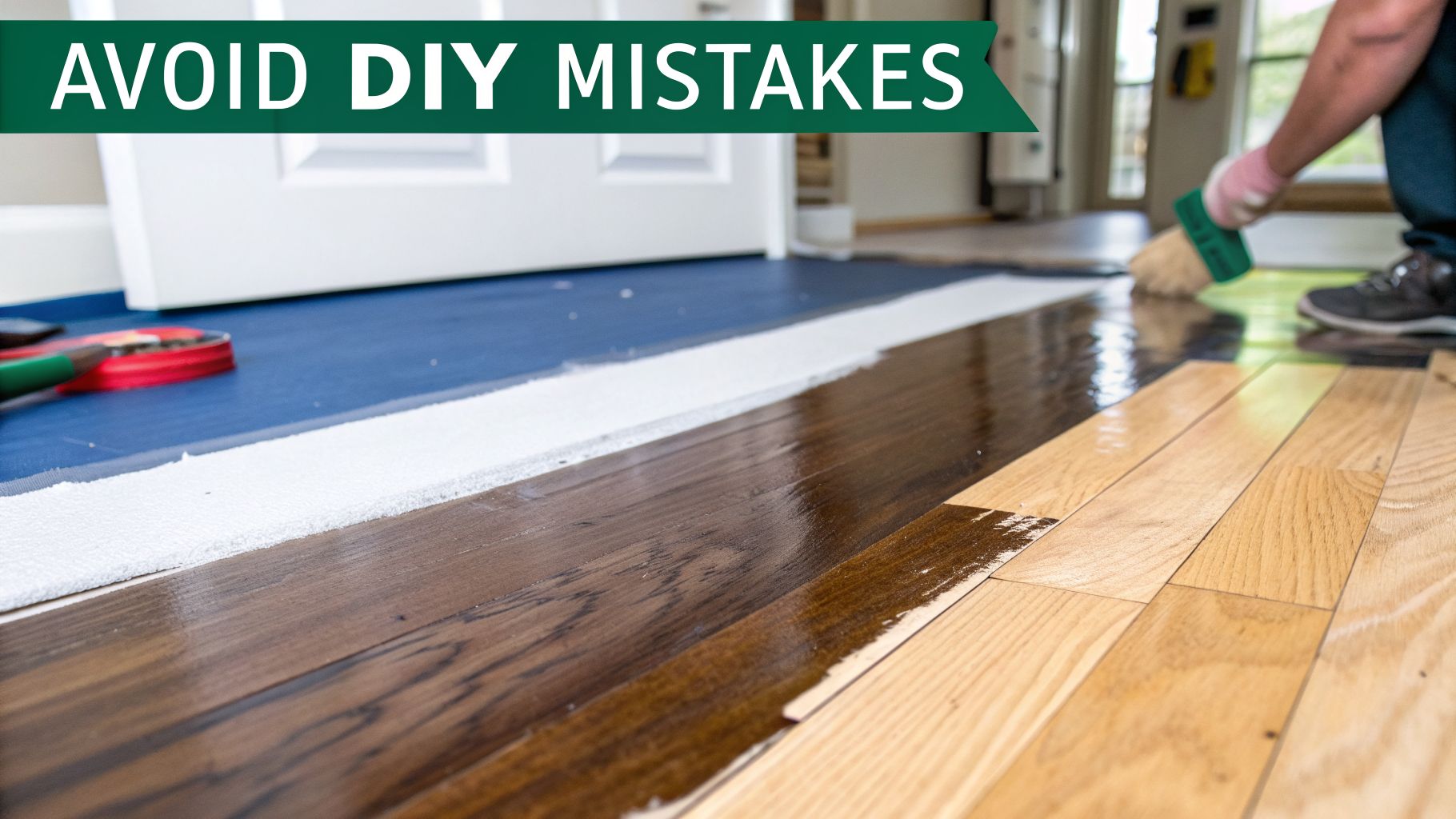
You look across the room after a refinishing job, the light hits just right, and suddenly you see tiny bubbles in the sheen. That's frustrating, especially when the floor otherwise looks clean and newly coated. For homeowners dealing with bubbles in hardwood floor finish in Richmond VA, the right move isn't to guess. It's to identify what kind of defect you're seeing so you don't turn a manageable finish issue into a full redo.
In hardwood floor refinishing, bubbles usually point to a finish problem, not a failure of the wood itself. That's good news, but only if the repair matches the defect. In Richmond VA, where older oak floors are common and indoor conditions can shift a lot during a project, diagnosis matters just as much as the fix.
What Causes Those Annoying Bubbles in a Floor Finish
When homeowners see bubbling, they often assume something is wrong with the floorboards. Most of the time, it's the coating. Bubbles usually form because air, vapor, solvents, or gases get trapped in the finish film before it has time to level out and set.

Agitation, temperature, and overworking the finish
A simple way to think about it is a shaken soda can. If you agitate finish too much, you introduce air. Technical guidance from Basic Coatings points to excess agitation, temperature mismatch, and film handling as common causes, and it recommends keeping the finish and the floor at the same temperature and avoiding overworking the material with the applicator (Basic Coatings technical guidance on bubbling).
That shows up on real jobs in a few familiar ways:
- Shaken finish cans: If a can is shaken instead of gently mixed, extra air can get carried right into the coat.
- Cold product on a warmer floor: The finish doesn't flow the way it should, so trapped air has a harder time escaping.
- Too many passes with the applicator: Going back over the same area again and again can create more bubbles instead of smoothing them out.
- Applying too heavy a coat: Thick film takes longer to settle and can trap defects.
Practical rule: Finish wants to level on its own. The more someone fights it, the more likely it is to show that fight after it dries.
Open-grain wood can make the problem worse
In Richmond VA, a lot of homes have oak floors. Oak is beautiful, durable, and common in both older neighborhoods and newer installs. It's also open-pored. That means the wood itself can hold little pockets of air that rise into the coating after application. That's often called outgassing.
Homeowners sometimes confuse bubbling with buckling, cupping, or a moisture-related wood movement problem. Those are different issues entirely. If you're trying to sort out whether you're looking at a finish defect or something happening in the floor itself, it helps to understand the broader causes of wood movement too. This guide on what causes hardwood floors to buckle is a useful comparison point.
What Richmond conditions can do
Richmond homeowners also deal with changing indoor conditions during refinishing. Air conditioning cycles, ceiling fans, open windows, and temperature swings can all affect how a finish behaves while it's trying to level and cure. That doesn't automatically mean the weather caused the bubbles, but it does mean the environment can make a marginal application go bad faster.
The key point is simple. Bubbles in hardwood floor finish are usually a process-control problem. The product matters, but handling, room conditions, and technique matter more than commonly understood.
If you're seeing this on your floor in Richmond VA, don't rush to sand randomly or throw another coat on top. The next step is figuring out whether those bubbles are only on the surface or buried deeper in the film.
Your Diagnostic Checklist Before You Try to Fix Anything
Most bad repairs start with a bad read of the problem. Bubbling is a finish-film defect, and the repair path depends on whether the bubbles are shallow and limited, or embedded deeper through the finish system. Technical guidance also notes that this defect often shows up most clearly under directional or reflective light, which is why some floors look fine until afternoon sun cuts across them (diagnostic guidance for hardwood finish bubbling).
A quick visual can tell you a lot, but you need to look at it the right way.

What to check first
Run through these questions before you touch the floor:
Can you feel the bubbles with your hand?
If the surface feels rough or pebbled, that often points to a shallow surface defect.Do you only see them in low-angle light?
Some bubbling is easiest to spot when light reflects across the floor, not when you're standing directly over it.Are they in one area or across the room?
A small isolated patch is a different problem than widespread bubbling through a whole traffic lane or multiple rooms.Do the bubbles look like they're sitting on top, or buried below the top sheen?
That's one of the biggest decision points.Did the problem appear right after coating, or only after more drying time?
That can help separate application defects from issues related to pore release in open-grain wood.
Here's a short video that helps homeowners visualize common finish issues before deciding on a repair approach.
Surface bubbles versus embedded bubbles
This is the line that matters most.
- Shallow and scattered: A few bubbles that are clearly at the top of the finish may be repairable without starting over.
- Widespread but surface-only: If the defect stays on the surface, screening and recoating can often correct it.
- Deep in the film: If bubbles are embedded below the surface, a full sand-and-refinish is usually the faster and more reliable fix.
If bubbling is only skin-deep, you may be able to repair the finish layer. If it's trapped lower in the build, adding another coat usually won't erase it.
That distinction saves homeowners from a common mistake. A lot of people assume another coat will “fill” the problem. Sometimes it won't. Sometimes it just seals the defect under more finish.
A few signs you should stop and reassess
Use caution if any of these are true:
- The floor looks uniformly speckled: That often points to a broader application issue, not a small cosmetic spot.
- The bubbles sit below a smooth top layer: That usually means they're trapped in the film.
- You're unsure how cured the finish is: Timing matters, and touching it too soon can create a second problem. If you need help judging that window, this article on how long polyurethane takes to cure gives useful homeowner context.
- The bubbling appears in more than one room: At that point, this usually isn't a touch-up job.
For homeowners in Richmond VA researching wood floor recoating or floor refinishing Richmond VA, this diagnostic step is the part that prevents wasted money. A correct diagnosis often means the difference between a manageable recoat and a full refinishing project.
Limited DIY Fixes for Very Minor Finish Bubbles
There are a few cases where a careful DIY repair makes sense. The key word is few. This is only for a couple of isolated, confirmed surface bubbles. Not a cluster. Not a room full of defects. Not anything buried under the top layer.
If you've got more than a tiny spot or two, trying to patch it yourself often leaves a repair that looks worse than the original bubble.
When a small touch-up is reasonable
A limited DIY fix is worth considering when:
- The defect is isolated: One or two spots, not a pattern across the floor.
- The bubble is clearly on the surface: You can feel it, and it doesn't appear trapped down in the film.
- The surrounding finish is otherwise sound: No peeling, clouding, or widespread texture issue.
- You can match the existing sheen closely: Satin, semi-gloss, and gloss don't hide patch work the same way.
A careful first-aid approach
For a very minor surface defect, the usual process is simple but fussy:
- Trim the raised bubble carefully: A sharp razor blade can remove the high spot if used gently.
- Feather the area lightly: Fine sandpaper can smooth the immediate edge of the repair.
- Clean the dust completely: Any residue left behind can telegraph through the touch-up.
- Apply a very small amount of matching finish: A small artist's brush gives more control than trying to flood the spot.
A spot repair works best when it disappears into the existing finish. If the patch turns into a shiny island, the bubble wasn't your biggest problem anymore.
What usually goes wrong with DIY
The trouble isn't always the technique. It's the mismatch. A repaired spot can dry at a different sheen, catch the light differently, or leave a witness line around the patch. On darker floors, high-gloss floors, or sunlit rooms, that stands out fast.
That's why I usually tell homeowners in Richmond VA to think of DIY bubble repair as cosmetic first aid, not a full solution. If you're already searching for hardwood floor repair or hardwood floor restoration, you're probably beyond the point where a razor blade and touch-up brush will leave you happy with the result.
If you're not certain the defect is minor, stop there. A professional inspection is safer than turning a simple recoat into a bigger refinishing job.
Professional Solutions A Buff and Coat Service vs Full Refinishing
Once bubbling goes beyond a tiny isolated flaw, the question becomes which professional repair path makes sense. In most cases, the choice is between a buff and coat service and a full sand-and-refinish. They are not interchangeable.
When a buff and coat makes sense
A buff and coat, also called a screen and recoat, is the right option when the bubbling is limited to the surface layer and the finish underneath is still sound. The process lightly abrades the existing topcoat, removes minor surface defects, and creates the bond needed for a fresh coat.
That makes it a practical choice for:
- Widespread shallow bubbling
- Light surface texture problems
- Floors that otherwise don't need full sanding
- Homeowners who want less disruption than a full refinish
In Richmond VA, this can be a good fit for floors with cosmetic finish issues but no deep damage to the wood itself. For comparison help, this guide on wood floor refinishing vs buff coat gives a homeowner-friendly breakdown.
When full refinishing is the smarter call
If the bubbles are embedded in the finish film, screening the top won't remove what's trapped below. In that situation, full sanding is usually the cleaner answer. You remove the failed finish system, take the floor back down, and rebuild it correctly.
That's usually the better call when you have:
| Condition | Better fit |
|---|---|
| Surface-only bubbling | Buff and coat |
| Embedded bubbling | Full refinishing |
| Isolated cosmetic flaws | Limited repair or buff and coat |
| Multiple rooms with visible film failure | Full refinishing |
| Other issues like deep scratches or worn-through finish | Full refinishing |
Why open-grain floors need an experienced approach
Oak and ash can complicate things because those open pores can trap air and release it into the finish. Guidance from The Wood Whisperer notes that open-pored hardwoods like oak and ash can create outgassing bubbles, and that one workaround on wood finishing projects is a thinned wipe-on approach, which usually needs more coats but improves leveling and bubble reduction (The Wood Whisperer on bubbles in finish).
On floors, the practical takeaway is that the early coats matter. A professional knows how to use sealer or initial coats to fill those pores properly before the final topcoats go down. That's one reason older oak floors in Richmond VA can fool DIYers. The finish issue looks simple, but the substrate is part of the story.
What the service choice means in practice
A buff and coat service is usually about correcting a finish surface. Full refinishing is about removing a failed system and rebuilding it. One is lighter intervention. The other resets the floor.
For homeowners comparing options in floor refinishing Richmond VA, dustless sanding, or engineered hardwood refinishing, the honest answer is this: choose the least invasive method that solves the defect. If the bubbling is superficial, don't overspend. If it's embedded, don't waste time trying to save a finish that has already failed.
One local option homeowners consider is Buff & Coat Hardwood Floor Refinishing, which offers both screen-and-recoat work and full sanding depending on the condition of the floor.
How to Prevent Bubbles in Your Hardwood Floor Finish
Preventing bubbles is mostly about controlling the job, not chasing them after they appear. Good finish work looks calm because the process is calm. The room, the product, the applicator, and the timing all need to work together.
The conditions matter more than people think
If the finish is too cold, the room is moving too much air, or the applicator keeps dragging back through partially leveled material, you're inviting trouble. One of the most overlooked pieces of technical guidance is to keep the jobsite free of airflow for 30–45 minutes after application so bubbles have time to rise, break, and level before the finish sets.
That means no ceiling fans, no box fans, no HVAC blasting directly across the floor, and no opening everything up the minute the coat goes down.
Air movement helps a room feel dry. It doesn't always help a fresh finish level correctly.
Practical prevention on real floors
For homeowners in Richmond VA planning hardwood floor refinishing, these habits make the biggest difference:
- Let materials acclimate: Finish should be in step with the room, not coming in cold from a truck or hot from a garage.
- Keep the process gentle: Stirring is safer than shaking, and smooth passes beat aggressive back-brushing.
- Respect open-grain species: Oak floors need a finish approach that accounts for pores and air release.
- Keep the room controlled after coating: That early window matters.
Homeowners who want to maintain your beautiful hardwood floors between recoats can benefit from a basic care routine too, especially one that avoids unnecessary product buildup and bad cleaning habits.
If you're evaluating a contractor in Richmond VA, ask how they manage room conditions, airflow, and coat application. That tells you more about the likely outcome than any generic promise. For broader homeowner education on wood flooring care, the National Wood Flooring Association homeowner resources are worth bookmarking.
Frequently Asked Questions About Floor Finishes
Will bubbles in a floor finish go away on their own
Usually, no. Once the finish has set with visible bubbling, the defect normally stays put. A few very slight imperfections may look less obvious as the sheen changes with lighting, but dried bubbles don't typically flatten themselves later.
Are bubbles a wood problem or a finish problem
Most of the time, they're a finish problem. That's an important distinction. It means you're usually dealing with application and curing behavior, not a structural failure of the hardwood itself.
Does the type of finish change the risk of bubbling
Different finishes handle differently, but the bigger issue is still technique. Poor mixing, overworking the coat, temperature mismatch, and uncontrolled airflow can create bubbling regardless of product type.
Does Richmond humidity affect floor refinishing
Indoor conditions in Richmond VA can absolutely affect how a finish behaves, especially if the space has temperature swings, open windows, active fans, or uneven climate control during application and cure. Humidity is part of the picture, but so are room temperature and airflow.
Can a recoat fix all bubbling problems
No. A recoat can help when the bubbles are shallow and limited to the surface. If the bubbles are embedded in the finish film, recoating usually won't remove them. That's when full sanding becomes the more reliable option.
Is this a good candidate for dustless sanding
Sometimes, yes. If the finish has failed deeper in the film or the floor has other wear issues, dustless sanding can be the right path because it removes the failed layers and lets the floor be finished correctly from the ground up.
How do I know whether I need hardwood floor repair or refinishing
If the defect is only in the finish, you may only need recoating or refinishing. If the wood itself is damaged, moving, stained, or uneven, that pushes the project toward actual hardwood floor repair along with refinishing. That's why an in-person evaluation is worth it.
If you're unsure whether the bubbles on your floor are superficial or a sign of deeper finish failure, Buff & Coat Hardwood Floor Refinishing can take a look and give you a straight answer. Richmond homeowners choose them for practical recommendations, dustless sanding options, clear pricing, and local experience working on everything from older oak floors to newer engineered products. Ready to restore your hardwood floors? Buff & Coat makes the process fast, clean, and stress-free. Call 804-392-1114 or request your free estimate at buffandcoatvirginia.com.