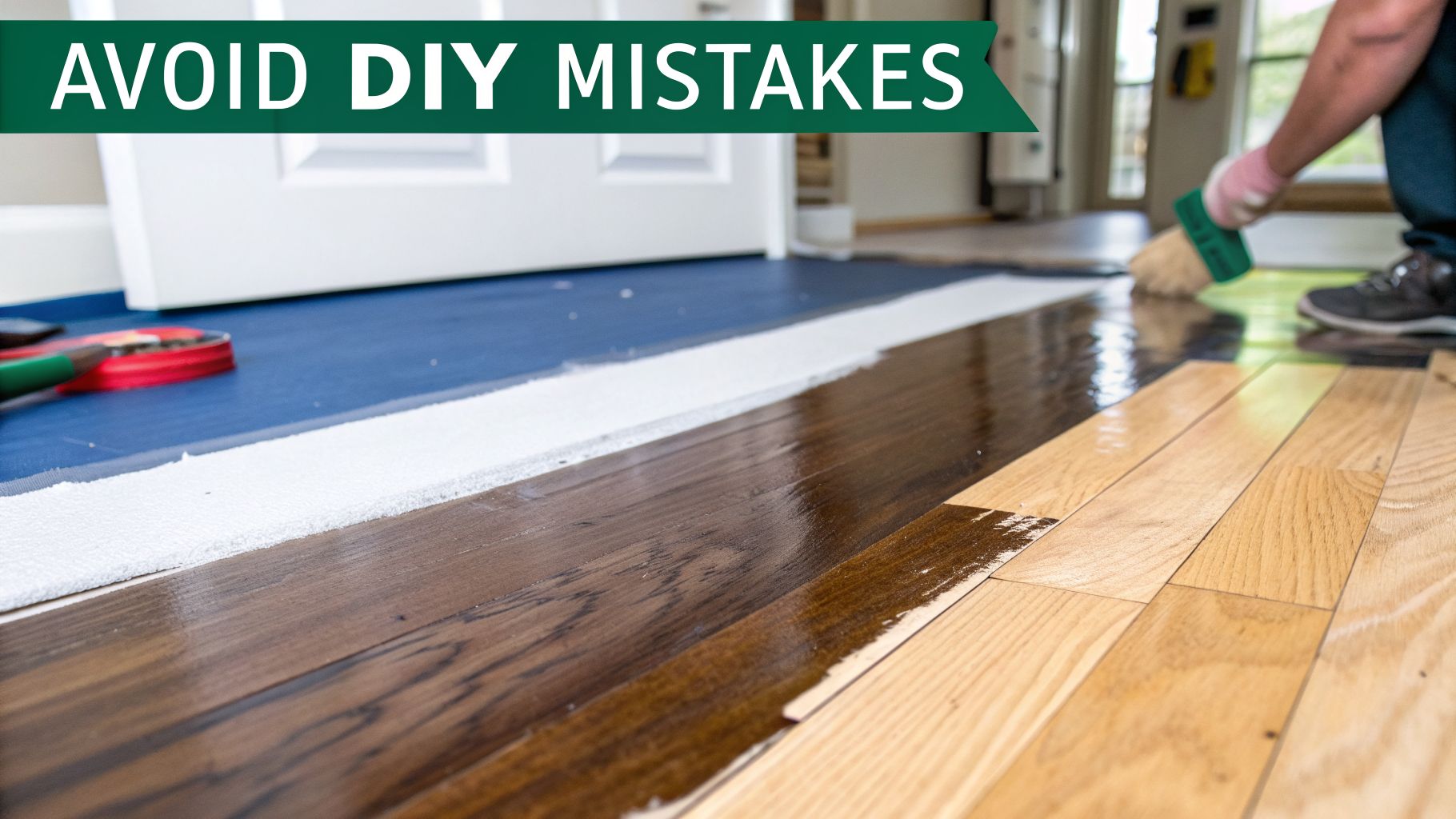
If you’re shopping for hardwood flooring in Charlotte NC, the biggest mistake is picking a floor based only on color and price. Charlotte homes deal with real humidity swings, and that changes what works, what fails early, and what ends up costing more than it should.
Homeowners usually start with a simple question: install new hardwood, refinish what’s there, or just refresh the finish. The smart answer depends on your subfloor, your floor’s current condition, and how your house handles moisture through the year.
Why Your Flooring Choice Matters in the Charlotte Climate
Charlotte has the kind of weather that can be hard on wood floors. Humid air in warmer months and drier indoor conditions during heating season make wood move. That movement shows up as small gaps, slight cupping, raised edges, or boards that feel tighter at one time of year than another.
That doesn’t mean hardwood is a bad choice. It means generic advice isn’t enough for this market. The floor has to fit the house, the room, and the local moisture conditions.

Charlotte homes need climate-aware flooring decisions
A flooring choice that behaves well in a dry climate can be trouble in the Carolinas. Older homes with crawl spaces, homes built on slabs, and additions with different HVAC performance all create their own moisture patterns. That’s why the same wood species can perform beautifully in one house and act up in another.
One of the first things professionals look at is whether the floor has time to adjust to indoor conditions before installation. If you want a deeper explanation of that part of the job, this guide to hardwood floor acclimation time lays out why rushing this step causes preventable problems.
Practical rule: In Charlotte, the right hardwood floor isn’t just the one you like looking at. It’s the one your house can support year after year.
Hardwood still carries weight with buyers
Hardwood remains a meaningful category in housing. The U.S. hardwood flooring industry saw $1.845 billion in sales in 2024, and 66.4% of sales were tied to residential replacement, which shows how often homeowners choose to upgrade existing homes rather than start from scratch, according to Floor Covering News on hardwood market stats.
That lines up with what buyers tend to respond to in Charlotte. Real hardwood still reads as durable, established, and easier to trust than a floor that looks good for a few months but doesn’t wear well.
A bad flooring decision usually doesn’t fail all at once. It starts with movement, finish wear, or recurring trouble spots near exterior doors, kitchens, and sunlit rooms. Then the homeowner has to pay twice.
Solid vs Engineered Hardwood A Charlotte Homeowner’s Guide
The solid-versus-engineered question matters more in Charlotte than it does in milder, drier places. Both are real wood. Both can look excellent. The difference is how they react when indoor humidity changes.
Where solid hardwood makes sense
Solid hardwood is exactly what it sounds like. Each board is one piece of wood. That’s part of why people love it. It has a traditional feel, it can often be refinished multiple times, and it fits older homes especially well.
It also asks more from the house.
Solid wood is less forgiving when moisture shifts. In a stable interior environment, that may not be a problem. In a home with a crawl space, inconsistent HVAC, or rooms that pick up seasonal dampness, solid can show more movement than some homeowners expect.

A simple way to think about it:
- Solid hardwood works well when the home has steady interior conditions and the owner wants maximum long-term refinish potential.
- Solid hardwood is less ideal for below-grade areas, slab-heavy situations, or homes with recurring humidity issues.
Why engineered hardwood often fits Charlotte better
Engineered hardwood has a real wood top layer over a layered core. That layered construction gives it more stability when humidity changes. In Charlotte’s moisture-variable conditions, that matters.
According to Hartco hardwood specifications and guides, engineered hardwood limits expansion and contraction to under 0.15% across a 40-65% relative humidity range and reduces cup-to-cup gaps by 70% compared to solid planks. For Charlotte homeowners, that stability is often the deciding factor.
Here’s a useful visual on the topic:
Engineered hardwood isn’t a downgrade. In many Charlotte homes, it’s the more practical product.
The trade-offs that actually matter
This decision gets clearer when you strip away showroom talk.
| Floor type | Strongest advantage | Main limitation | Best fit |
|---|---|---|---|
| Solid hardwood | More refinish potential over a long lifespan | More movement with moisture swings | Main-level living spaces with stable indoor conditions |
| Engineered hardwood | Better dimensional stability | Refinishing depends on wear-layer thickness | Slabs, variable environments, and wider-plank designs |
If you’re comparing the two for hardwood flooring in Charlotte NC, don’t ask which one is better in the abstract. Ask which one fits your home’s conditions, your layout, and how long you plan to stay.
Best Wood Species and Finishes for Carolina Homes
Once you have chosen between solid and engineered planks, you must select the right species and finish. Style and durability meet at this stage of the process. Some homeowners focus too much on color and overlook how the floor will wear with pets, kids, chair legs, and daily traffic.
Hickory for durability
If your house is busy, hickory deserves a serious look. In Charlotte’s humid climate, hickory engineered hardwood stands out because it has a Janka hardness rating of 1820, compared with 1290 for red oak, making it over 50% harder than red oak, according to Charlotte Lumber’s hickory engineered flooring product details.
That added hardness helps with dent resistance. Hickory also has more visual movement in the grain, which can be a plus if you want character and a minus if you want a quiet, uniform look.

Oak and maple for different looks
Oak remains a dependable choice because it balances classic appearance with broad design flexibility. If you want a traditional floor that doesn’t feel trendy, oak is usually the safe bet.
Maple gives a cleaner, more contemporary look. It can be a strong fit in homes with brighter interiors and simpler trim details. The trade-off is that some homeowners expect maple to hide everything, and it doesn’t. Certain light finishes can show dust and surface marks more readily.
A practical way to narrow the field:
- Choose hickory if wear resistance matters most.
- Choose oak if you want flexibility in stain color and a familiar hardwood look.
- Choose maple if your style leans modern and clean.
Finish choice changes day-to-day maintenance
The finish matters almost as much as the wood itself. In real homes, sheen level often affects satisfaction more than homeowners expect.
- Matte finishes hide small scratches, dust, and pet hair better.
- Satin finishes are a middle ground and work in almost any room.
- Semi-gloss finishes reflect more light but also show more of the floor’s daily life.
What works: A lower-sheen finish in active homes usually ages better visually than a shinier one.
For coating systems, many homeowners prefer low-odor finishes because they’re easier to live with during and after the project. Water-based polyurethane is a common choice when faster dry times and a more natural wood tone matter. Some people still prefer the warmer tone associated with oil-based systems, but that usually comes with a different odor profile and a different look over time.
The right combination isn’t universal. A quiet guest room and a kitchen entry don’t need the same floor.
Understanding the Cost of Hardwood Flooring in Charlotte NC
Price matters, but the lowest quote on a flooring project often leaves out something important. For hardwood flooring in Charlotte NC, the more useful question is what the number includes and what conditions in the house could change it.
Local cost ranges worth knowing
In Charlotte, the average cost for wood flooring installation is $7.39 per square foot, with a typical range of $6.15 to $8.63 per square foot. Wood floor refinishing averages $3.39 per square foot, with a range of $3.06 to $3.72 per square foot, based on Charlotte wood flooring cost data from ProMatcher.
Here’s the quick view:
| Service | Average Cost (per sq. ft.) | Typical Price Range (per sq. ft.) |
|---|---|---|
| Wood flooring installation | $7.39 | $6.15 to $8.63 |
| Wood floor refinishing | $3.39 | $3.06 to $3.72 |
That local installation figure generally includes labor, mid-grade solid hardwood, trim, molding, and underlayment, but it doesn’t cover every possible variable. If a house needs subfloor replacement, furniture relocation, or a more expensive wood, the final number changes.
If you’re comparing regional pricing outside North Carolina, this overview of hardwood installation costs for Albany homeowners is useful for seeing how market and scope differences affect budgeting from one area to another.
What pushes a quote up or down
The square-foot price is only part of the story. Final cost usually moves because of one or more of these factors:
- Subfloor condition: Uneven or damaged subfloors add labor before any wood goes down.
- Material choice: A standard oak install won’t price out like a premium wide-plank product.
- Layout complexity: Stairs, flush vents, borders, and tricky room transitions increase labor.
- Existing floor condition: Refinishing is more straightforward when boards are flat and stable.
For Richmond-area readers comparing similar installation decisions, this guide to new hardwood floor installation cost explains how estimates usually break down.
A trustworthy flooring quote tells you what is included, what is excluded, and what could change after the crew sees the subfloor.
Installation versus refinishing
If the existing floor is structurally sound, refinishing is often the more economical path. If the boards are failing, mismatched, too thin to refinish, or the layout no longer works for the home, replacement may be the better long-term move.
Good advice is essential for saving money. Some floors need a full reset. Others just need the right kind of restoration.
The Installation and Refinishing Process What to Expect
Homeowners usually worry about two things more than anything else. How long will this take, and how messy will it be?
The answer depends on whether you’re installing new flooring, doing a full refinish, or choosing a lighter renewal service.
What a new hardwood installation involves
A proper installation starts before any boards are fastened or glued. The crew checks the subfloor, confirms flatness, verifies moisture conditions, and makes sure the material is suited to the space.
Then comes the physical work:
- Prep the room. Old flooring comes out if needed, and the subfloor gets cleaned and corrected.
- Stage and acclimate the wood. This helps the flooring adjust to interior conditions before installation.
- Install the boards. Method depends on product and subfloor. Nail-down, glue-down, and floating systems each have their place.
- Handle trim and transitions. This step distinguishes a clean job from a rushed one.
- Finish and protect. If it’s site-finished wood, coating and cure time need to be respected.
Refinishing versus a buff and coat
Not every worn floor needs to be sanded to bare wood. That’s where homeowners can save time, money, and disruption.
A buff and coat service can restore 70-80% of worn floor surfaces in a single day with zero dust, and it typically costs $2-4 per square foot. A full sanding usually costs $5-8 per square foot and takes 3-5 days, according to Carolina Pro Flooring’s overview of buff and coat versus full sanding.
That distinction matters.
- Buff and coat works best when the finish is dull, lightly scratched, or worn at the surface, but the wood underneath is still in good shape.
- Full sanding makes more sense when there are deeper scratches, heavy wear, discoloration, or finish failure.
For a closer look at what refinishing projects often involve in this market, this article on refinishing hardwood floors in Charlotte NC is a helpful companion.
On real jobs: The cleanest projects come from good containment, careful prep, and honest scope decisions. A floor that only needs recoating should not be sanded just because sanding is available.
Dustless sanding and realistic expectations
Dustless sanding doesn’t mean magic. It means the sanding equipment is connected to collection systems that capture dust at the source, which makes the project much easier on the home.
That matters if you’re living in the house during the work, have sensitive occupants, or don’t want fine dust drifting into closets and vents. It also makes cleanup more manageable and gives the whole job a more professional feel.
The key is matching the process to the floor. An overbuilt solution wastes money. An undersized solution leaves damage behind.
Key Questions to Ask Your Charlotte Flooring Contractor
A flooring estimate should do more than give you a number. It should tell you whether the contractor understands Charlotte homes and whether the scope matches your actual floor.
Ask questions that reveal judgment
Some questions are basic, but they still matter. Ask whether the contractor is insured, what type of hardwood projects they do most often, and how they handle communication once work starts.
Then ask the questions homeowners often skip:
- How do you evaluate moisture before installation or refinishing?
- Do you use dust containment or dustless sanding systems?
- What finish products do you recommend for homes with pets, kids, or heavy traffic?
- How do you decide between buff and coat, full sanding, and replacement?
A good contractor should answer these without dancing around them.
Pay attention to how they talk about your house
The strongest flooring pros don’t give one-size-fits-all answers. They ask whether your home sits on a slab or crawl space. They ask where sunlight hits hardest. They ask whether you’re trying to match existing boards or change everything.
If you live in a community with an HOA, or in an area where exterior access, work hours, or material changes can be an issue, verify those rules before the project starts. That may not change the floor selection, but it can absolutely affect the schedule and approval process.
If a contractor only wants to talk about wood color and square footage, you’re not getting the full evaluation.
The right hire isn’t always the cheapest one. It’s the one who can explain what your floor needs, what can go wrong, and how they’ll avoid it.
Frequently Asked Questions About Hardwood Floors in Charlotte
Do hardwood floors hold up well with pets?
Yes, if you choose the right species and finish. Harder woods and lower-sheen finishes tend to hide day-to-day wear better. Keeping nails trimmed and using mats at entry points also helps more than people think.
Is engineered hardwood a good fit for Charlotte homes?
In many homes, yes. It’s often a strong choice where moisture conditions vary more than you’d like, especially on slab foundations or in areas where solid wood may move too much seasonally.
Can new hardwood be matched to existing floors?
Sometimes. A close match is more realistic than a perfect one, especially if the original floor has aged, darkened, or been refinished before. Species, board width, grade, and finish all affect how cohesive the final blend looks.
What’s the best way to maintain hardwood in a humid climate?
Keep indoor conditions as steady as you can. Clean with hardwood-safe products, wipe up spills promptly, and avoid letting wet shoes or pet bowls sit on the floor. Consistent HVAC operation helps more than occasional deep cleaning.
What if I suspect moisture damage or mold around the floor?
That needs attention before cosmetic work. If you’re dealing with staining, odor, or visible growth, this guide to safely handling mold on hardwood floors is a useful starting point for understanding the issue before a flooring contractor addresses the wood itself.
Should I refinish, recoat, or replace?
That depends on the wear. A surface-level problem may only need recoating. Deep scratches, color changes, or exposed wood usually call for sanding. Replacement makes sense when the boards are too damaged, too thin, or no longer appropriate for the room.
If you’re in Richmond and want straightforward advice on refinishing, dustless sanding, hardwood floor repair, or a buff and coat service, Buff & Coat Hardwood Floor Refinishing gives homeowners clear recommendations without the usual sales pressure. Richmond homeowners choose them because they bring 15+ years in business, dustless sanding systems, local owner-operated service, high-quality finishes, clear pricing, and honest advice to every project. Ready to restore your hardwood floors? Buff & Coat makes the process fast, clean, and stress-free. Call 804-392-1114 or request your free estimate at buffandcoatvirginia.com.