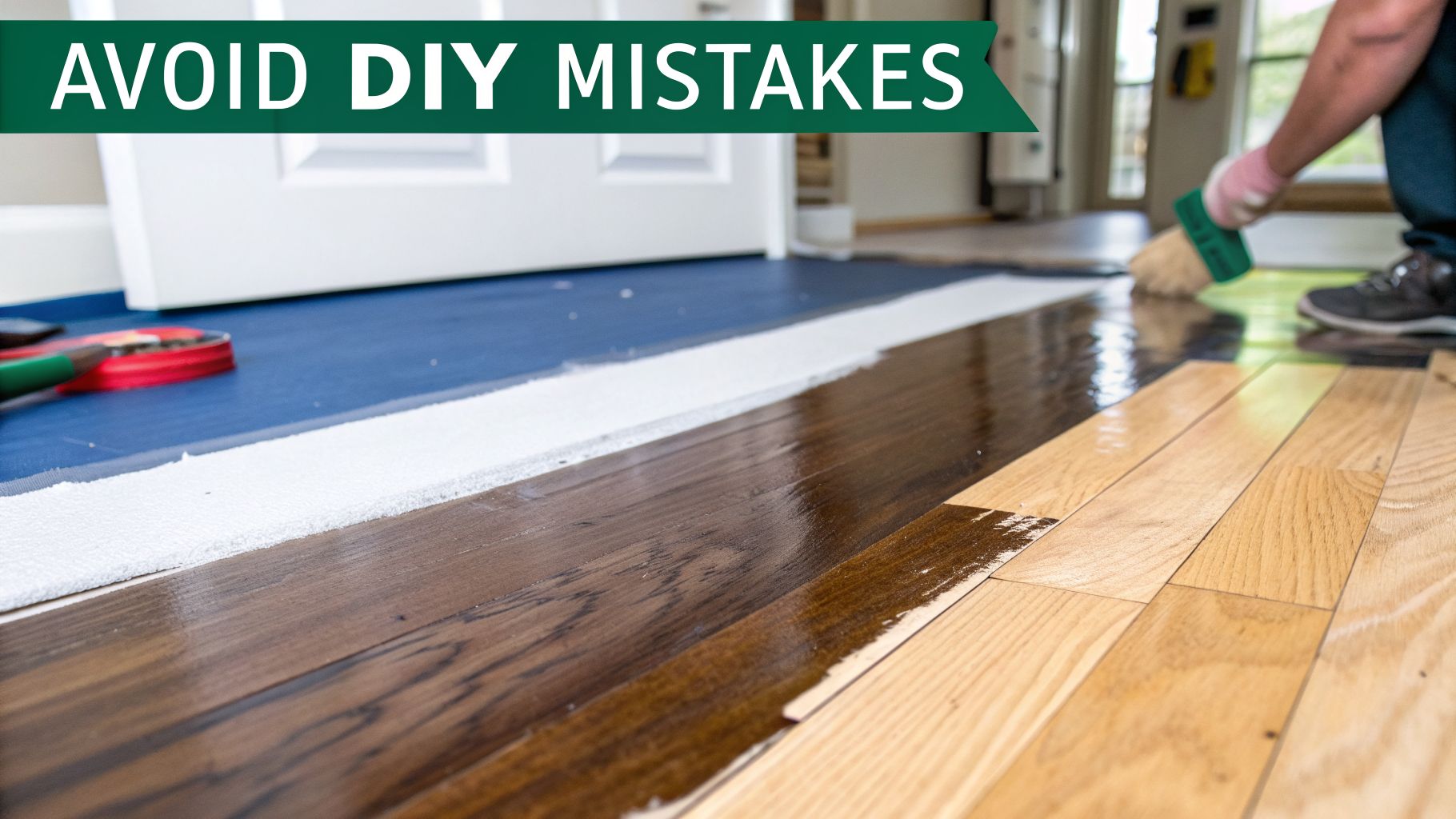
TL;DR: In the Richmond, VA area, a buff and coat service usually runs about $2 to $4 per square foot, while a full dustless sand-and-refinish usually lands around $4 to $8 per square foot. Your total hardwood floor restoration cost depends mostly on the floor’s condition, the size of the area, and whether repairs are needed before the finish work starts.
A lot of Richmond homeowners end up in the same spot. The floors still have good bones, but they’re dull, scratched, cloudy in traffic lanes, or showing wear near doors, kitchens, and pet areas. The hard part isn’t always deciding whether to do something. It’s figuring out what the right fix is and what it’s going to cost.
That’s where most national pricing guides fall short. They give broad numbers, but they don’t help much when you’re trying to decide between a quick wood floor recoating and a full sanding job in a real house in Richmond VA. The right choice depends on what’s happening at the surface, what’s happening in the wood itself, and how much disruption you’re willing to deal with.
Your Guide to Hardwood Floor Restoration Costs in Richmond VA
If you’re searching for hardwood floor restoration cost, you probably don’t want a vague answer. You want to know whether your floors need a light refresh or a full reset, and you want a realistic sense of price before you invite anyone into your home.
In Richmond VA, that usually comes down to two paths. One is a buff and coat service, sometimes called a screen and recoat. The other is full sanding and refinishing, often with dustless sanding equipment to keep the job cleaner. They solve different problems, and that’s why the price gap can be significant.
For broad national context, hardwood floor refinishing typically falls between $3 and $8 per square foot, with a standard 400-square-foot room costing about $1,200 to $3,200 according to HomeAdvisor’s hardwood floor refinishing cost guide. In practice, homeowners in Richmond VA usually need a more specific decision than that. More specifically, the question is whether your floor needs surface renewal or deep restoration.
Practical rule: If the wear is mostly in the finish, recoating may be enough. If the damage is in the wood, sanding is usually the right call.
That distinction matters for cost, timeline, dust level, and how dramatic the end result will be. It also matters for engineered hardwood refinishing, where aggressive sanding isn’t always the safest first move.
If you’re unsure whether your hardwood floors need refinishing or just a recoat, it helps to look at the floor the way a flooring contractor does. Surface wear, color loss, black water marks, deep pet scratches, exposed raw wood, and loose boards all point in different directions. Richmond homeowners who understand those signals usually make better decisions and avoid paying for the wrong service.
The Two Paths to Restoration Buff and Coat vs Full Sanding
A good way to think about this is car paint. A buff and coat is like a professional detail that restores gloss and protection when the finish looks tired. Full sanding is closer to stripping things back and repainting because the underlying layer is damaged.

When a buff and coat makes sense
A buff and coat service works best when the floor is worn but the damage is superficial. The process lightly abrades the existing finish and adds new protective coats on top. It doesn’t remove deep gouges, old stain color, or water stains that have already soaked into the wood.
This option is often the best fit when you see:
- Dull traffic lanes where the shine has faded
- Light surface scratches from daily use
- Minor finish wear near kitchen entries or hallways
- A floor that still looks structurally sound with no major board damage
National content often skips over this service, but that’s a mistake. A buff-and-coat can be 30 to 50 percent cheaper, often landing around $2 to $4 per square foot, because it addresses surface wear and can often be done in a single day, according to Fabulous Floors USA’s 2026 refinishing cost discussion. It’s also especially useful for engineered wood where heavy sanding may put the veneer at risk.
For homeowners comparing maintenance options, this deeper look at hardwood floor buffing cost in Richmond can help clarify what’s included.
A recoat doesn’t fix everything, and that’s exactly why it works so well when used at the right time. You preserve more of the original floor and avoid paying for unnecessary sanding.
When full sanding is the right call
Full sanding is for floors with damage that lives below the top finish layer. That includes scratches that catch your fingernail, worn-through spots where bare wood is exposed, dark water marks, uneven coloration, or floors that need a stain change.
It’s usually the right route if you’re dealing with:
- Deep scratches and gouges
- Pet damage that cut into the wood
- Black stains or water staining
- Old finish failure
- Color mismatch or a planned stain change
- Localized board replacement before refinishing
This is the more intensive process. The existing finish is removed, the wood is sanded flat, repairs are blended, and the new stain and finish are applied. It takes more labor, more equipment, and more drying time, but it also gives you the most complete transformation.
Where dustless sanding fits in
When homeowners hear “sanding,” they often picture a cloud of dust through the whole house. Modern dustless sanding changes that. It doesn’t mean zero dust, but it does mean a much cleaner process with far better containment than older methods.
That matters in occupied homes in Richmond VA, especially for families with kids, pets, or anyone sensitive to airborne dust. It also changes the price. Dustless refinishing is a premium service because the equipment and setup are more involved, but many homeowners decide the cleaner process is worth it.
What doesn’t work
The main mistake I see homeowners make is waiting too long for a recoat, then hoping a light service will solve wood-level damage. It won’t. Once finish wear turns into exposed wood, staining, or board damage, recoating becomes the wrong tool.
The opposite mistake happens too. Some floors get quoted for full hardwood floor refinishing when a simpler wood floor recoating would have handled the job well. That’s why a careful inspection matters.
If you’re unsure, the most honest answer is this: choose the least invasive service that will solve the problem. That’s the sweet spot for both cost and long-term floor life.
Hardwood Floor Restoration Cost Per Square Foot in 2026
A Richmond homeowner with 700 square feet of worn oak floors can get two very different quotes and both can be reasonable. One price reflects a maintenance-style renewal. The other reflects taking the floor back to bare wood and rebuilding the finish system. If you only compare the bottom-line number, it gets confusing fast.
For budgeting in Richmond VA, separate the work into the two services that get quoted:
- Buff and coat service: about $2 to $4 per square foot
- Full sand and refinish: about $4 to $8 per square foot
- Dustless refinishing systems: usually land toward the higher end of a full sanding quote because the setup, containment, and equipment are more involved
For national context, HomeAdvisor places hardwood refinishing in a broader $3 to $8 per square foot range. Richmond jobs still move up or down inside that window based on the house, the floor, and how much detail work the crew has to handle.
Sample project cost estimates in Richmond VA 2026
| Project Size | Estimated Buff & Coat Cost | Estimated Full Sand & Refinish Cost |
|---|---|---|
| 100 sq ft | $200 to $400 | $400 to $800 |
| 400 sq ft | $800 to $1,600 | $1,600 to $3,200 |
| 1,000 sq ft | $2,000 to $4,000 | $4,000 to $8,000 |
Those numbers help with rough planning, but older Richmond homes often break the neat math. A fan of connected rooms in the West End or a simple ranch layout in Chesterfield usually prices more efficiently than a Museum District home with tight rooms, closets, thresholds, and a lot of edging.
Small jobs are a good example. A bedroom may have less square footage, but the crew still has to arrive, protect surrounding areas, edge the perimeter, coat the floor, and clean up. That fixed labor is why a small room can feel expensive on a per-foot basis even when the total ticket is lower.
What is usually included in the square-foot price
A standard restoration quote often includes:
- Basic floor prep
- Buffing or sanding
- Finish application
- Normal labor
- Standard containment and cleanup
It often does not include board replacement, stain changes, heavy repair work, furniture moving, carpet removal, or upgraded finish systems. That is where two quotes with similar square-foot pricing can separate once the actual scope is written out.
If you want a clearer breakdown of those line items, this guide on cost to refinish hardwood floors is a helpful companion.
Homeowners weighing restoration against replacement during a larger remodel sometimes compare hardwood work with other flooring categories too. For that angle, 2026 Hybrid Flooring Costs gives a useful replacement-side reference point.
A simple budgeting framework
Start with the square footage. Then accurately answer one question. Is the problem mainly a tired finish, or is the wood itself affected?
If the finish is dull, lightly scratched, and still protecting the wood, a buff and coat usually keeps the budget in the lower range. If the floor has deep wear, black staining, pet damage, cupping, or old finish failure, full sanding is usually the more realistic number to plan around.
That decision matters more than any online calculator. In Richmond, two houses with the same floor area can end up far apart in cost because one floor needs renewal and the other needs restoration.
Key Factors That Influence Your Final Quote
The condition of the floor is the biggest driver behind the final number. Two Richmond homes can have the same square footage and end up with very different quotes because one floor only needs a new topcoat, while the other needs repairs before any finish goes down.

Floor condition sets the scope
A worn finish is usually straightforward. Deep scratches, black pet stains, loose boards, cupping, termite damage, or old water marks change the job fast.
This is the point where a buff and coat stops making sense. If the finish has failed and the wood itself is affected, full sanding is usually the honest recommendation. In older Richmond neighborhoods like the Fan, Museum District, and Bellevue, we also see patch repairs from older plumbing leaks and uneven board movement from seasonal humidity. Those issues add labor because they need to be addressed before the new finish has a fair chance to hold up.
Wood species and floor age affect labor
Oak is usually the most predictable floor to restore in this market. It sands well, takes finish evenly, and replacement boards are easier to match. Pine is softer and can show drum marks or chatter if the sanding is rushed. Maple can be harder to sand evenly and less forgiving if the client wants a stain.
Older floors also deserve a careful look. Some have already been sanded more than once. Some have face nails, thin wear layers, or mixed species from past repairs. That does not always mean the project becomes expensive, but it does mean the quote has to reflect what the floor can safely handle.
Finish choice affects both price and disruption
Homeowners usually ask about finish cost first. In practice, the bigger difference is often how the product fits the house.
Water-based polyurethane is popular in occupied homes because odor is lower and dry times are shorter. Oil-based polyurethane still has its place, especially if someone wants that warmer traditional look, but the smell is stronger and the house stays disrupted longer. If you are trying to schedule around pets, kids, tenants, or a move-in date, how long polyurethane takes to cure matters just as much as the material price.
Dust containment can also affect the quote. Dustless sanding equipment costs more to run than a basic setup, but many Richmond homeowners decide it is worth it in occupied houses, especially with allergies, recent painting, or detailed trim work they want to protect.
Layout, access, and prep work add real time
A wide-open first floor is efficient. A house with tight stairs, small bedrooms, heavy furniture, short board runs, and lots of cut-ins is slower from the first hour.
These are common items that change the quote:
- Furniture moving
- Appliance moves or working around built-ins
- Carpet or tack strip removal
- Board replacement and lacing in repairs
- Extra masking in occupied homes
- Stair treads, landings, and nosings
- Transitions where hardwood meets tile, LVP, or carpet
Rental properties add another layer to the decision. If the goal is fast turnover and durable surfaces, it helps to compare hardwood restoration against other best flooring types for basements, kitchens, or units that do not currently have wood.
A good quote should show what the floor needs, what can be skipped, and which path makes financial sense. That is how Richmond homeowners avoid paying for a full sanding when a buff and coat will do the job, and avoid wasting money on a quick topcoat when the floor is already past that stage.
Understanding the Timeline and Return on Investment
A lot of Richmond homeowners reach this point with the same practical question. If the floors look tired, is this a one-day cleanup job, or are you about to turn the house upside down for a week?

How long restoration usually takes
The timeline depends first on which path the floor qualifies for.
A buff and coat service is usually the faster, lower-disruption option. If the finish is dull and scratched but not worn through to bare wood, the work can often be done in a day. That is why this route makes sense for occupied homes, rentals between tenants, and sellers who want visible improvement without a long shutdown.
A full sanding and refinishing takes more time because the job is doing more. It removes the old finish, addresses deeper wear, and builds a new finish system from the wood up. In a Richmond home with multiple rooms, furniture to work around, or repairs mixed in, that can mean several days of active work plus additional time before the floor is ready for normal life again.
The part that catches homeowners off guard is finish timing. A floor can feel dry to the touch and still be too soft for rugs, pet traffic, or heavy furniture. If you are planning around kids, dogs, or move-back dates, this guide on how long polyurethane takes to cure lays out the difference clearly.
Where the return actually comes from
The return is not only resale. It is choosing the right level of work before minor wear turns into a more expensive problem.
A buff and coat usually gives the best return when the wood itself is still in good shape and the finish has lost its look. It costs less, keeps the original stain color, and buys more time before a full sand is needed. For many Richmond owners, especially in well-kept Fan, Near West End, or Bon Air homes, that is the smartest use of money if the floor has not been sanded through, heavily stained, or contaminated with waxy cleaners.
Full sanding earns its keep when a topcoat will not solve the underlying issue. Pet stains, worn-through traffic lanes, black edges, old finish buildup, and mismatched patches all fall into that category. Paying for a buff and coat on a floor that is already past that stage usually means paying twice.
The best return comes from matching the service to the condition of the floor, not from choosing the cheapest quote.
According to a 2022 National Association of Realtors study, hardwood floor refinishing delivers a 147% return on investment, as summarized in Hudson Hardwood’s review of the NAR data. That lines up with what homeowners see in practice. Clean, properly restored wood floors make a house show better, photograph better, and feel better the day you walk back in.
There is also a replacement question behind all of this. In many older Richmond houses, the existing hardwood is better than what would be installed new at an entry-level replacement budget. If the boards are structurally sound, restoration often keeps more character in the house and costs less than tearing everything out and starting over.
For homeowners who want a quick visual explanation of finish timing and floor recovery, this short video helps frame what to expect:
How We Provide an Accurate and Honest Quote for Your Floors
You call for a price, send a few phone photos, and the floor looks “not too bad.” Then an in-home visit shows pet stains along the dining room edge, cleaner buildup in the traffic lane, and two loose boards by the back door. That is why an honest quote has to start in the house.
Good pricing comes from diagnosis, not guessing. In Richmond homes, especially older houses in the Fan, Bellevue, Bon Air, and parts of Near West End, the same floor can have three different stories happening at once. The finish may be worn out in one room, the wood may be sound in another, and an older repair may be hiding under a rug near a transition.
During the estimate, we measure the job and identify the floor type, but the larger question is whether the floor is a candidate for a Buff & Coat or whether full dustless sanding is the smarter spend. That decision affects the price more than almost anything else.
We also check for job-scope items that change labor and material needs:
- Surface wear versus finish worn through to bare wood
- Loose boards, movement, or small gaps that need attention first
- Dark stains or pet damage that may remain after sanding
- Old wax, polish, or residue that can interfere with adhesion
- Previous repairs, patched boards, or mismatched species
- Closets, stair nosings, tight transitions, and other detail-heavy areas
That inspection protects homeowners from the two most common quote problems. One is pricing a recoat on a floor that really needs sanding. The other is pricing a simple sanding job without accounting for repairs, contamination, or detail work that only shows up in person.
Repair pricing should be discussed before work starts, in plain language. Minor board replacement or isolated repairs can be manageable. More involved repairs, especially when stain has soaked deep into the wood or movement points to subfloor issues, can change the scope quickly. As noted earlier, repair costs vary by condition, access, and whether the damaged boards can be blended cleanly into the existing floor.
A straightforward estimate should spell out what you are paying for: restoration method, repair work, finish system, and any areas that take extra time.
The right estimate matches the floor’s condition, the homeowner’s goals, and the budget. It does not default to the biggest job.
Some homeowners in Richmond ask specifically about Buff & Coat Hardwood Floor Refinishing because the service mix includes both dustless buff-and-coat renewal and full sanding. That matters. A company that offers both options can recommend the right path more objectively than one that only sells one type of job.
If you live in Richmond, Midlothian, Chesterfield, Henrico, or Glen Allen, an in-home estimate is usually the fastest way to stop guessing and get a clear plan.
Frequently Asked Questions About Hardwood Floor Restoration
Can you refinish engineered hardwood floors
Sometimes, yes. It depends on the thickness of the top veneer and the current condition of the floor. If the wear is mostly in the finish, a buff and coat service is often the safer approach because it refreshes the top layer without aggressive sanding. If the veneer is thin, full sanding may not be the right move.
How strong are the odors during refinishing
That depends mostly on the finish system. Water-based finishes are usually the better choice when homeowners want lower odor and a faster return to normal living. Oil-based finishes tend to have a stronger smell and a longer cure window. If odor sensitivity is a concern, bring that up during the estimate so the finish choice fits the household.
What should I do with pets during the project
Keep pets out of the work area from the start of prep until the floor is ready for safe use. That protects the finish and keeps animals away from equipment, dust containment setup, and wet coatings. In most homes, the easiest plan is arranging for pets to stay in an unaffected part of the home or with family for the day if it’s a one-day recoat.
How long until I can walk on the floors again
That depends on whether you’re doing a buff and coat or a full sanding project, and on the finish that’s applied. A light renewal usually gets you back to careful foot traffic sooner than a full restoration, but the safest answer is to follow the finish-specific guidance from your contractor. Dry enough to touch and ready for full use are not the same thing.
Will refinishing remove deep scratches and black stains
Deep scratches often require full sanding, not recoating. Black stains are trickier. Some lighten with sanding, but stains that have penetrated extensively may still require board replacement to get a uniform result. That’s one reason a site visit matters more than a phone quote.
Is hardwood floor repair separate from refinishing
Often, yes. Repair work and refinishing are related, but they aren’t the same task. If boards are cracked, loose, stained beyond recovery, or mismatched from prior patching, the repair work usually happens first. Then the floor can be sanded or recoated as the condition allows.
Why Richmond Homeowners Choose Buff & Coat
Homeowners in Richmond VA usually want the same few things from a flooring contractor. They want a straight answer, clean work, a floor that holds up, and pricing that makes sense once it’s explained.
That’s why local homeowners keep looking for companies that offer:
- 15 years in business with real experience in occupied homes
- Dustless sanding systems for a cleaner refinishing process
- Local, owner-operated service instead of a call-center feel
- High-quality finishes that match the job and the household
- Clear pricing and honest advice about buff and coat service versus full sanding
- 5-star customer service and responsive scheduling
For floor refinishing Richmond VA projects, that local piece matters. Homes in the Richmond area vary a lot. You may be dealing with older oak floors in the Fan, newer engineered hardwood in Short Pump, or a mix of old and new flooring in Chesterfield or Midlothian. A useful estimate has to reflect the actual floor in front of you, not just a generic national average.
If you’re not sure whether you need hardwood floor repair, wood floor recoating, or complete hardwood floor refinishing, getting an honest inspection is the smartest next step. The right answer is usually clear once someone looks closely at the wear pattern, the finish condition, and any repair areas.
Ready to restore your hardwood floors? Buff & Coat Hardwood Floor Refinishing makes the process fast, clean, and stress-free. Call 804-392-1114 or request your free estimate today.