That unmistakable, stomach-dropping sight of a hardwood floor lifting up is a clear sign something’s wrong. For Richmond homeowners, figuring out what causes hardwood floors to buckle almost always comes down to one main culprit: excess moisture. When wood planks soak up too much water too quickly, they swell. Pushed tightly against each other, they have nowhere to go but up, eventually popping loose from the subfloor.
Common Causes of Hardwood Floor Buckling at a Glance
To help you quickly diagnose the problem, we’ve put together a quick summary of the usual suspects we see in Richmond-area homes.
| Cause | What It Looks Like | Common Triggers in Richmond Homes |
|---|---|---|
| High Humidity | Widespread, gentle swelling (cupping) that can turn into full buckling over time. | Muggy Virginia summers, poorly ventilated crawl spaces, or not using a dehumidifier. |
| Water Leak | Localized, often severe buckling right near the source of the water. | A leaky dishwasher, a pinhole leak in a pipe under the sink, or a failing refrigerator ice line. |
| Flooding Event | Extreme and widespread buckling across an entire room or floor. | Heavy rainstorms causing basement flooding or a major plumbing failure like a burst pipe. |
| Bad Installation | Planks buckling soon after installation, often without an obvious water source. | The installer didn’t leave enough room for expansion (expansion gaps) or failed to acclimate the wood first. |
| Subfloor Issues | Buckling that appears random or is accompanied by bouncy or uneven spots. | Moisture coming up through a concrete slab that wasn’t properly sealed. |
Spotting these signs early can make all the difference between a simple fix and a major repair job.
The Telltale Signs of a Buckled Hardwood Floor
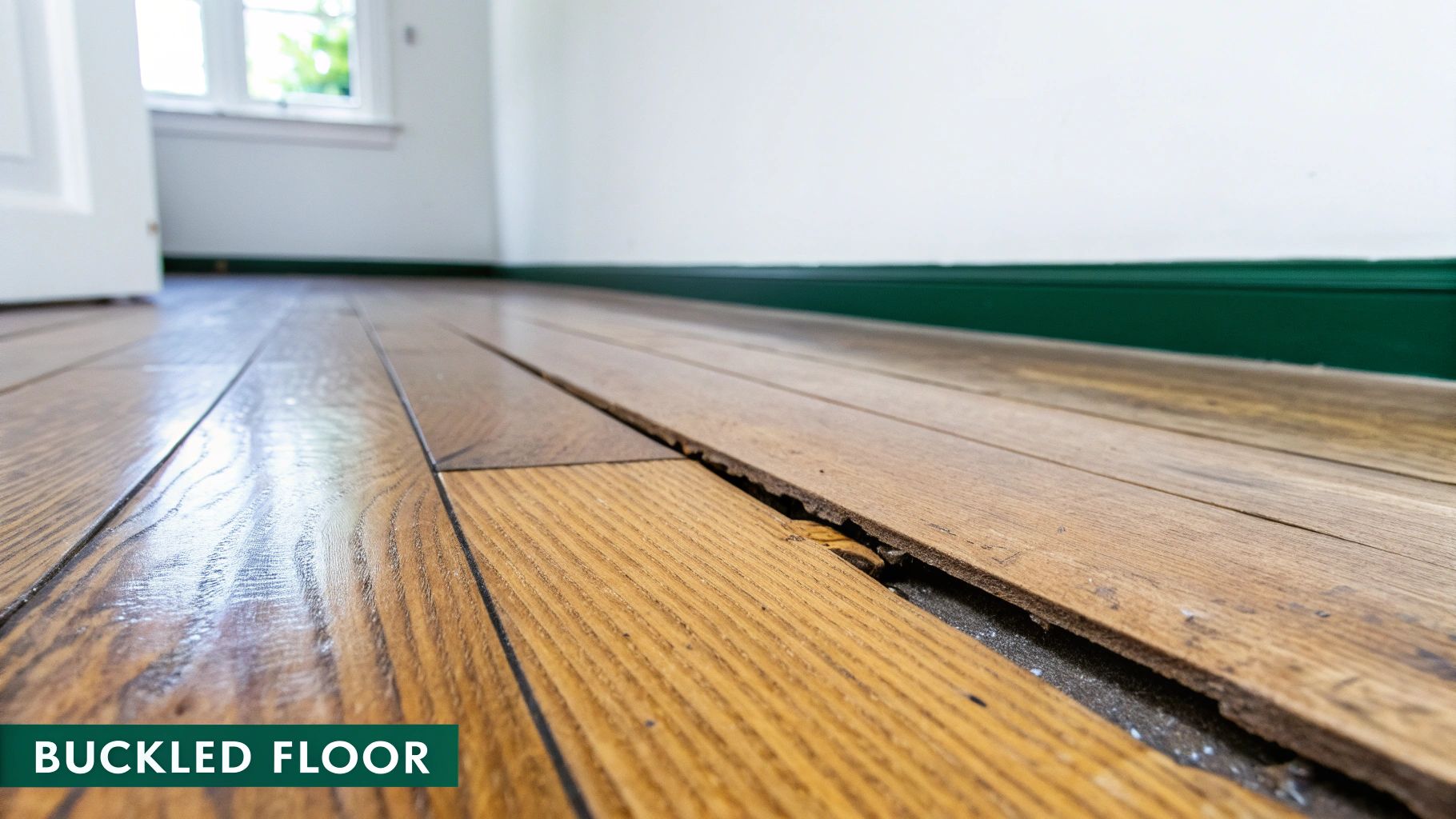
When your once perfectly flat floor starts to look more like a series of small hills and valleys, you’re looking at more than just a cosmetic flaw. Buckling is the most severe form of moisture damage your wood floors can experience, and it quickly becomes a serious tripping hazard if you ignore it.
The good news? The problem rarely happens overnight. Being able to spot the early warning signs gives you a fighting chance to fix the root cause before you’re facing an expensive repair.
Early Warning Signs to Watch For
Long before a floor develops a dramatic peak, it sends out subtle distress signals. Keep an eye out for these clues:
- Cupping: This is when the edges of a floorboard are higher than the center, creating a slight concave or “cupped” shape. It’s the classic first sign that moisture is creeping in from underneath.
- Crowning: The exact opposite of cupping. Crowning is when the center of the board swells up, becoming higher than the edges. This usually points to moisture on the surface, like from a big spill that wasn’t cleaned up fast enough.
- Visible Gaps: Some minor gapping between boards is normal as the seasons change. But if you start seeing new or widening spaces, it means the wood is going through major expansion and contraction cycles—a precursor to bigger problems.
At Buff & Coat, we often find that by the time a homeowner calls us about a full-blown buckle, the floor has been showing these smaller signs for weeks, if not months. Finding the moisture source is always the most critical first step.
Why Richmond’s Climate Plays a Major Role
Anyone who lives in the Richmond area knows all about our humidity, especially during those sticky summer months. That environmental factor has a direct and powerful impact on your hardwood floors.
Wood is hygroscopic, which is just a technical way of saying it acts like a natural sponge, absorbing moisture from the air and releasing it. This is what causes it to expand in the summer and contract in the winter.
During a humid Virginia summer, when the outdoor relative humidity (RH) can easily hit 80-90%, your indoor levels can climb way past the 30-50% range that’s considered safe for hardwood. That constant exposure to damp air makes the boards swell, pushing against each other with immense pressure until they have no choice but to buckle. You can learn more about how humidity affects wood floors and find some practical solutions.
If you see any signs of lifting, peaking, or cupping, don’t wait for it to get worse. Our team can help you pinpoint the cause and give you an honest, straightforward assessment of what needs to be done.
Ready for a professional opinion? Request a free, no-obligation estimate from Buff & Coat today.
Why Moisture Is the Number One Enemy of Your Wood Floors
To get to the bottom of why hardwood floors buckle, we have to talk about one thing: moisture. Wood is a natural, porous material, and its constant interaction with water is the root cause of nearly every buckling, cupping, and warping issue we see in homes across the Richmond area.
Think of your floorboards like a bundle of tiny, microscopic straws. They are always trying to absorb or release moisture to find equilibrium with the air around them. This constant push-and-pull is what puts your beautiful floors at risk.
When a wood plank absorbs moisture faster than it can get rid of it, its fibers swell up. Because your floorboards are installed tightly against one another, this expansion creates an incredible amount of pressure. With nowhere else to go, the boards are forced to lift right off the subfloor. That’s buckling.
Ambient Humidity: The Invisible Threat
The most common source of moisture, especially here in Virginia, is simply the air itself. We all know that thick, muggy feeling of a Richmond summer. That high ambient humidity is a relentless force working against your floors day and night.
When the relative humidity (RH) in your home climbs above the ideal 30-50% range, your floors start soaking up that excess moisture from the air. It’s a slow, steady absorption that causes widespread swelling, often showing up first as minor cupping. But let that go on for a whole season, and the pressure can build until the floors finally give way and buckle. This is exactly why we get so many calls from Midlothian to Mechanicsville in the late summer.
Direct Water Damage: Sudden and Severe
Unlike the slow creep of humidity, direct water damage is a sudden, high-impact event. A single plumbing failure or major spill can dump a massive amount of liquid onto your floor in a very short time, completely overwhelming its ability to resist.
Some of the most common culprits we see are:
- A leaking dishwasher or refrigerator ice maker line
- An overflowing sink, toilet, or bathtub
- A hidden plumbing leak inside a cabinet or behind a wall
- Large spills that aren’t cleaned up right away
In these situations, the buckling is usually intense and concentrated right around the source of the water. Knowing how to spot a leak early is crucial, which is why effective water leak detection is so important for catching small problems before they become catastrophes.
Subfloor Moisture: A Hidden Problem
Perhaps the most deceptive type of moisture is the one you can’t even see. Subfloor moisture is water vapor that rises from a damp source underneath your hardwood, slowly saturating the boards from the bottom up.
This is a frequent headache in homes with:
- Unsealed or poorly ventilated crawl spaces
- Basements with known dampness or water intrusion issues
- Concrete slab foundations that weren’t properly sealed before the wood floors were installed
Because the moisture is coming from below, the first sign is almost always cupping—where the edges of the boards curl upward. If that’s not addressed, buckling is the inevitable next step. We cover this in more detail in our guide to dealing with hardwood floor water damage.
The Sponge Analogy: Think of your hardwood floor as a big, flat, dry sponge. If you leave it in a humid room, it slowly plumps up all over. If you spill a glass of water on it, it swells up fast in that one spot. And if you set it on a damp countertop, the bottom gets soaked first. Your floor reacts to these three types of moisture in exactly the same way.
If you even suspect that moisture is compromising your floors, don’t wait for it to get worse. Our team can perform a professional assessment to pinpoint the source and lay out a clear, effective plan to fix it.
Call Buff & Coat at 804-392-1114 for an expert moisture assessment and a free estimate.
How Poor Installation Sets Floors Up for Failure
While moisture is the undisputed king of what causes buckled floors, the second biggest culprit is often a problem you can’t see: shortcuts taken during the original installation. Even a floor that looks perfect on day one can be a ticking time bomb if the foundational work isn’t done right. For homeowners in Richmond, a shoddy installation can turn our humid climate from a manageable issue into a full-blown disaster.
Think of it this way: a true professional isn’t just laying down wood planks; they’re setting that floor up to successfully breathe and adapt to your home’s unique environment for decades to come. When critical steps are rushed or skipped entirely, that stability is gone before you even move the furniture in.
The Critical Mistake of Skipping Acclimation
One of the most common and damaging installation errors is failing to properly acclimate the wood. You simply can’t take hardwood planks straight from a warehouse and nail them down on the same day. Wood is a natural material that needs time to adjust to the specific temperature and humidity levels inside your home—a process we call acclimation.
Skipping this step is like asking the floor to adjust after it’s already been permanently fixed in place. When the wood inevitably expands or contracts to match its new environment, it’s already locked down with nails or glue. This creates immense internal pressure, leaving the boards with nowhere to go but up.
Improper installation is behind a huge number of buckling cases, often stemming from rushed jobs that skip these vital preparations. In fact, a lack of proper acclimation is a leading cause of severe buckling, sometimes causing planks to lift several inches off the subfloor. You can find detailed flooring failure analysis if you want to dig into the technical side of these investigations.
Forgetting the Importance of Expansion Gaps
Another hidden but absolutely crucial detail is the expansion gap. This is a small, intentional space left around the perimeter of the room, which is typically hidden underneath the baseboards. It acts as a safety valve, giving the entire floor system room to expand and contract naturally as the seasons change.
When an installer lays the flooring flush against the walls, they’ve effectively trapped it. As the humidity rises during a Henrico or Chesterfield summer, the wood swells, the planks push against each other, and then they hit a solid wall. The resulting force has no outlet, and the floor buckles under the pressure.
At Buff & Coat, we see this all the time. A homeowner calls us about a buckled floor, and when we pull back the baseboard, we find there’s zero expansion gap along the walls. It’s a foundational error that sets an otherwise beautiful floor up for failure.
Improper Nailing and Subfloor Preparation
How the floor is fastened—and what it’s fastened to—are just as important. A successful, long-lasting installation requires careful attention to the subfloor and the fastening schedule.
Here are a few common mistakes we see:
- Incorrect Nailing Schedule: Using too few or too many fasteners can create stress points. Too few, and the boards are loose; too many, and you’re restricting their natural movement.
- Wet Subfloor: Installing wood over a concrete slab or wood subfloor that still has a high moisture content is a guaranteed recipe for problems. The new flooring will just soak up that moisture from below, leading to cupping and buckling.
- Uneven Subfloor: Laying planks over a subfloor that isn’t perfectly flat and level creates hollow spots and pressure points. This leads to squeaks, movement, and eventually, failure.
A quality installation is about so much more than just looks; it’s about the long-term health and stability of your floors. For a deeper look into our meticulous process, check out our complete guide to hardwood floor installation in Richmond.
Exploring Your Options for Repairing Buckled Floors
That moment you spot a buckled section in your hardwood floor is a frustrating one, but here’s the good news: it’s almost always fixable. Once you’ve figured out what’s causing the problem—whether it was a sneaky leaky pipe or just Virginia’s humid summers—the next step is picking the right repair strategy. The best approach really depends on how widespread and severe the damage is.
For any homeowner in the Richmond area, this means you have a few solid options, from a small, targeted fix to a full-on restoration. It’s definitely not a one-size-fits-all situation. Our job is to give you a clear, honest assessment so you can make a confident choice without feeling pressured.
Option 1: Localized Board Replacement
If the buckling is contained to just a few planks in a specific spot—say, right in front of a dishwasher that had a minor leak—there’s usually no need for a massive refinishing project. In cases like this, a localized board replacement is the smartest, most cost-effective solution.
The process is pretty straightforward:
- Our technicians carefully take out only the damaged, buckled boards.
- We make absolutely sure the subfloor underneath is completely dry and structurally sound.
- New, matching hardwood planks are then expertly woven into the existing floor.
- Finally, we sand and finish the new boards to blend in seamlessly with the rest of the floor.
This method is perfect for isolated damage because it minimizes the disruption to your home and your life. Think of it as a precise, surgical repair that solves the problem without the time and expense of redoing the entire floor.
Option 2: Dustless Sanding and Refinishing
When the buckling is more widespread or comes with a lot of cupping and surface damage across the room, swapping out individual boards just isn’t practical. This is where a full dustless sanding and refinishing becomes the best way forward. This process doesn’t just fix the buckling; it brings your whole floor back to its original glory.
Our hardwood floor refinishing service in Richmond VA involves sanding down the entire surface of the floor. This powerful process strips away the old finish, erases scratches and stains, and—most importantly—levels out the warped and buckled areas. You’re left with a perfectly flat, smooth surface once again.
After sanding, we apply a fresh stain and seal it with multiple coats of a high-quality, durable finish. The result? A floor that looks and feels brand new, with every sign of the old damage completely gone. Plus, our advanced dustless sanding systems keep the whole process clean and mess-free for your home.
Option 3: Full Floor Replacement
In the most severe cases, especially after a major flood or when the subfloor has suffered from long-term water damage, the wood itself can be too far gone to save. If the planks are delaminating (a common issue with engineered hardwood), showing signs of rot, or have been buckled for a long time, trying to sand them flat just won’t work.
In these situations, a full replacement is the only way to guarantee a stable, beautiful, and long-lasting result. While it’s the most intensive option, it gives you a completely fresh start. It also ensures your new floor is installed correctly with proper acclimation and moisture barriers to prevent problems from popping up again down the road. The Buff & Coat team also handles hardwood floor installation in Richmond, so we can manage the entire project from tear-out to the final, beautiful product.
This flowchart helps visualize how installation mistakes—one of the key things that causes hardwood floors to buckle—can be traced back to just a few critical errors.
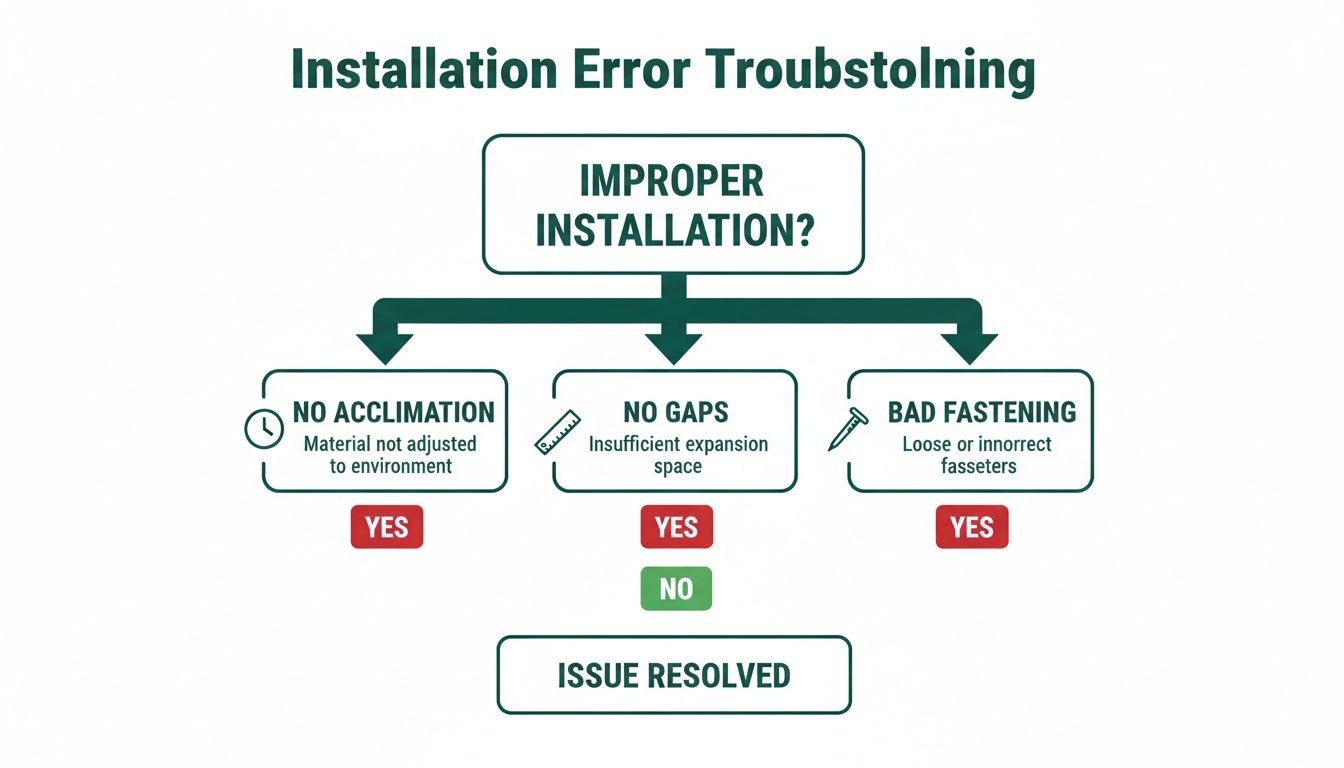
Each branch highlights a preventable step that, when skipped, creates the exact kind of pressure and instability that leads to buckling.
Comparing Hardwood Floor Repair Options
To help homeowners in Chesterfield, Glen Allen, and across the greater Richmond area figure out the best course of action, we’ve put together a simple comparison of the main repair methods.
| Repair Method | Best Suited For | The Process Explained | Typical Project Timeline |
|---|---|---|---|
| Board Replacement | Small, isolated areas of buckling or severe damage to just a handful of planks. | Damaged boards are surgically removed, the subfloor is checked, and new planks are woven in, sanded, and finished to match. | 1-2 days |
| Dustless Sanding & Refinishing | Widespread cupping, moderate buckling, or floors with significant surface wear and tear. | The entire floor is sanded down to bare wood, leveled, stained, and coated with a new protective finish. | 3-5 days |
| Full Replacement | Extreme, irreparable damage from flooding, rotted subfloors, or severely warped planks. | The old flooring is completely removed, the subfloor is repaired/prepped, and a brand-new floor is installed. | 5-7+ days, depending on scope |
Not sure which path is right for your home? That’s what we’re here for. The Buff & Coat team will come out, assess the damage, measure moisture levels, and give you honest, expert advice on the most effective solution for your specific situation.
If you’re seeing buckled floors, Buff & Coat can take a look and give you honest recommendations. Request your free estimate today.
Our Process for a Lasting Floor Repair
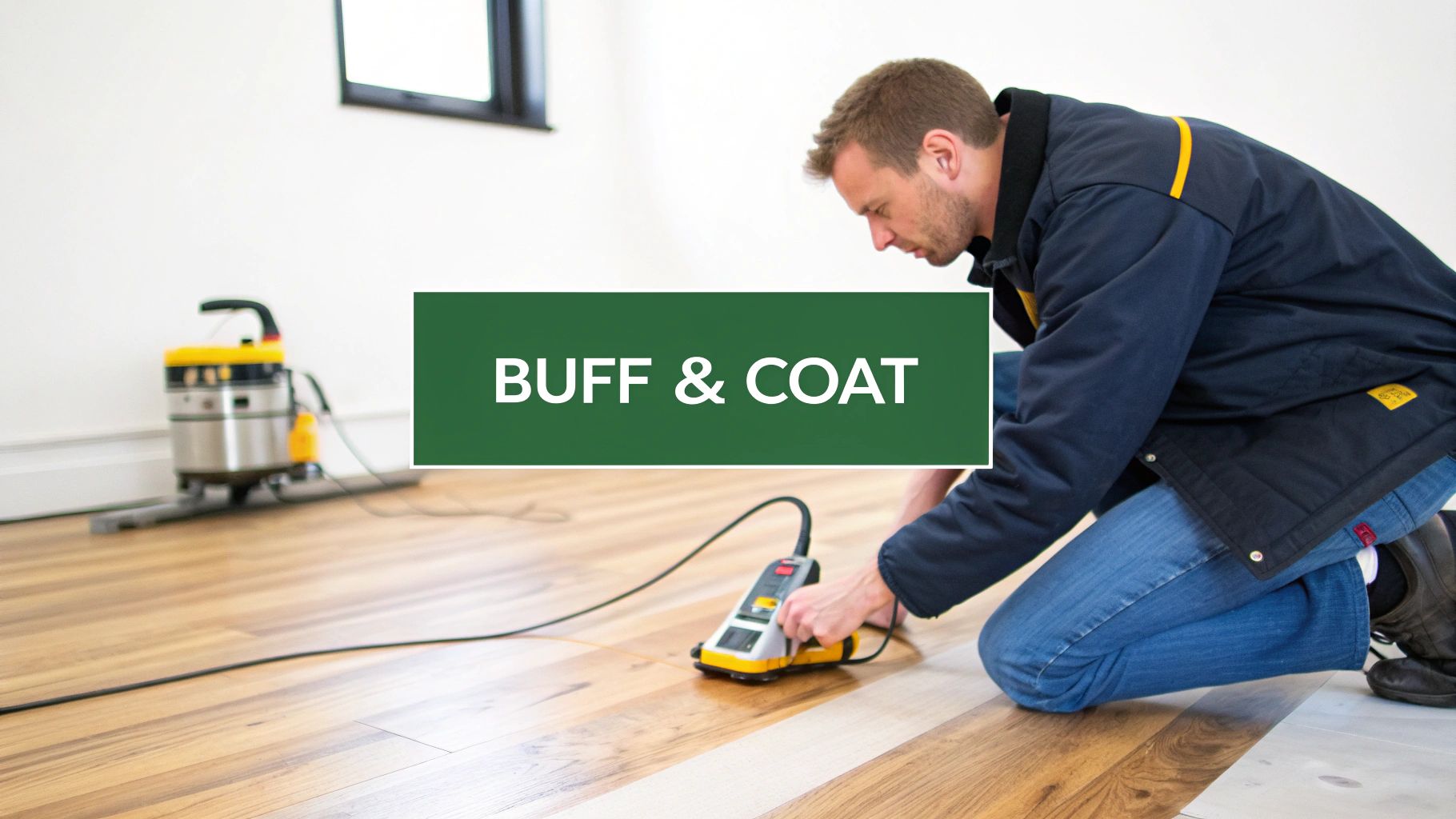
Fixing a buckled floor the right way means getting to the root cause, not just slapping a band-aid on the visible problem. At Buff & Coat, we’ve spent more than 15 years perfecting a straightforward, expert process that correctly diagnoses the issue and delivers a fix that actually lasts. We don’t guess—we investigate, then we get to work.
Our approach is built on years of experience repairing floors in homes all across the area, from Short Pump to Chesterfield. We get it. You need clear answers, minimal disruption to your life, and results you can count on.
Step 1: An Honest and Thorough Assessment
Everything kicks off with a free, in-home consultation. This isn’t some high-pressure sales pitch; it’s a fact-finding mission to figure out exactly what’s going on with your floors. Our first job is to pinpoint the source of the buckling. Why? Because simply replacing boards without fixing the underlying moisture problem is just asking for the same issue to pop up again down the road.
To get the real story, we bring out the professional-grade tools:
- Moisture Meters: We take precise readings of your hardwood and the subfloor underneath. This data is critical—it tells us if there’s an active moisture issue that has to be resolved before any repairs can even start.
- Visual Inspection: With a trained eye, we look for the subtle clues: faint water stains, the specific shape of the warp (cupping vs. crowning), and the condition of the surrounding baseboards and walls.
- Honest Recommendations: Once we have all the facts, we’ll give you a clear, no-nonsense game plan. We’ll tell you straight up if a simple board replacement is all you need, if a full refinishing is the better route, or if the damage is too extensive for anything but replacement.
Our promise is to set clear expectations from day one. You’ll get a detailed estimate that explains exactly what we plan to do, why we recommend it, and what the timeline looks like. No surprises, just professional advice.
Step 2: Meticulous Repair and Dustless Sanding
With a solid plan in place, our skilled technicians get to work. If the project requires sanding to level out widespread buckling, we roll out our advanced dustless sanding systems. This is an absolute game-changer for homeowners. Our equipment captures 99% of the airborne dust, keeping your home clean and your family safe from that fine layer of grit that gets everywhere.
The repair and refinishing process itself is meticulous. We carefully remove any damaged boards, make sure the subfloor is sound, and then sand the entire surface until it’s perfectly smooth and level. This is the step that completely erases any signs of buckling, cupping, and surface damage.
Step 3: Applying High-Quality, Durable Finishes
A beautiful repair is only as good as the finish protecting it. We don’t cut corners here. We only use high-quality, commercial-grade polyurethane finishes that are engineered for durability and longevity. These modern coatings offer far superior resistance to scratches, scuffs, and the daily grind of foot traffic.
We also offer low-odor, fast-curing options to get you back to your normal routine as quickly as possible. The process involves multiple coats to build up a strong, protective layer that not only looks incredible but also helps seal the wood against future moisture. Our expertise isn’t just in the sanding but in the crucial recoating that follows, which you can read more about in our guide to the Buff & Coat service.
From start to finish, our goal is a clean, efficient, and stress-free experience that leaves you with floors that aren’t just repaired—they’re fully restored.
If your floors need a professional eye, Buff & Coat can provide an honest diagnosis and a clear path forward. Call 804-392-1114 or request a free estimate today.
Why Richmond Homeowners Choose Buff & Coat
When you’re staring at a buckled floor, wondering who in the world to call, you need more than just a contractor—you need a local expert who knows Richmond-area homes. For over 15 years, Buff & Coat has been that trusted partner for homeowners from Midlothian to Mechanicsville who just want honest work and floors that look fantastic again.
We get it. A floor repair project feels like a huge disruption. That’s why our entire process is built around making it as clean, smooth, and painless for you as possible.
Here’s why homeowners trust us for their hardwood floor repair needs:
- 15+ Years in Business: Our experience means we’ve seen every type of flooring issue imaginable. We know how to diagnose the problem correctly and apply a lasting solution.
- Dustless Sanding Systems: We invest in modern equipment that captures over 99% of airborne dust, keeping your home clean and your air healthy throughout the repair and refinishing process.
- Local, Owner-Operated: You’re not dealing with a faceless national chain. We live and work right here in Richmond. The owner is directly involved, ensuring quality workmanship and accountability on every job.
- High-Quality Finishes: We use professional-grade, low-VOC finishes that are durable enough for daily life. They protect your investment and look beautiful for years, without harsh odors.
- Clear Pricing and Honest Advice: You’ll get a detailed, straightforward quote with no hidden fees. We give you our honest professional opinion, not an inflated sales pitch.
- 5-Star Customer Service: We respect your home and your time. From your first call to the final walkthrough, we prioritize clear communication and a stress-free experience.
Ready to restore your hardwood floors? Buff & Coat makes the process fast, clean, and stress-free. Call 804-392-1114 or request your free estimate at buffandcoatvirginia.com.
Frequently Asked Questions About Buckled Hardwood Floors
Once you see your floor start to warp, the big-picture “why” questions quickly turn into practical “what now” questions. As the go-to experts for hardwood floor repair in Richmond, we get calls about this all the time. Here are some straight answers to the most common concerns we hear from homeowners dealing with this stressful situation.
Can Buckled Hardwood Floors Fix Themselves?
This is the big one everyone hopes for, but the answer is almost always no. In some very minor cases of humidity-related cupping (where the edges of the boards are just slightly raised), you might see the floor settle a bit after you run a dehumidifier for a while.
However, true buckling—where the planks have physically lifted and pulled away from the subfloor—will not fix itself.
Think of it like a bent piece of metal. The force that caused the wood to lift has created permanent stress and changed its shape. Even after the moisture is gone, the boards won’t magically flatten back into place. Trying to weigh them down with furniture or books is a waste of time and can actually cause more harm. At this point, you need a professional to properly reset or replace the damaged boards to make the floor stable and safe again.
What Factors Affect the Cost of Repair in Richmond?
There’s no single price tag for fixing a buckled floor here in Richmond. The final cost really depends on how bad the damage is and which repair route we need to take.
Here are the key things that will influence the price on your estimate:
- Extent of Damage: This is the biggest driver. Are we talking about a small two-foot section by a leaky dishwasher, or has the buckling spread across half the living room? The total square footage of the affected area matters most.
- Repair Method: A simple, localized board replacement is far less expensive than having to do a full dustless sanding and refinishing for the entire room to make it all blend together. A complete tear-out and replacement is, of course, the most involved and costly option.
- Type of Hardwood: The species and width of your floorboards play a big role. Finding matching planks for a 50-year-old oak floor or an exotic species can be more challenging and expensive than sourcing a common, modern hardwood.
- Subfloor Condition: Sometimes the problem isn’t just the flooring. If the plywood or OSB subfloor underneath is water-damaged and spongy, it has to be repaired or replaced first. This adds both labor and material costs to the job.
How Can I Prevent My Floors from Buckling in the Future?
Honestly, prevention is the best medicine. Protecting your beautiful hardwood floors comes down to controlling the one thing that causes more problems than anything else: moisture.
Pro Tip: If you do one thing, make it this: get a good dehumidifier. Keeping your home’s indoor relative humidity between 35% and 55% year-round is the gold standard for happy, stable hardwood floors.
Here are a few other simple habits every Richmond homeowner should adopt:
- Clean Up Spills Immediately: Don’t let any liquid sit. Water is wood’s worst enemy. Grab an absorbent cloth and wipe up spills the moment they happen.
- Use Appliance Drip Pans: For a few bucks at a home improvement store, you can slide plastic trays under your refrigerator and dishwasher. They can catch slow, silent leaks before they ever touch your wood.
- Check Your Crawl Space: A damp, musty crawl space is a major source of moisture that can seep up through the subfloor. Make sure yours is dry and has a proper vapor barrier.
- Maintain Your Gutters: Clogged gutters cause rainwater to spill over and pool right next to your foundation. Keep them clean so water is directed far away from your house.
By staying on top of moisture control, you dramatically reduce the odds of ever having to deal with the headache of a buckled floor again.
If you have more questions or need a professional eye on your floors, Buff & Coat Hardwood Floor Refinishing is here to give you honest answers and expert solutions.