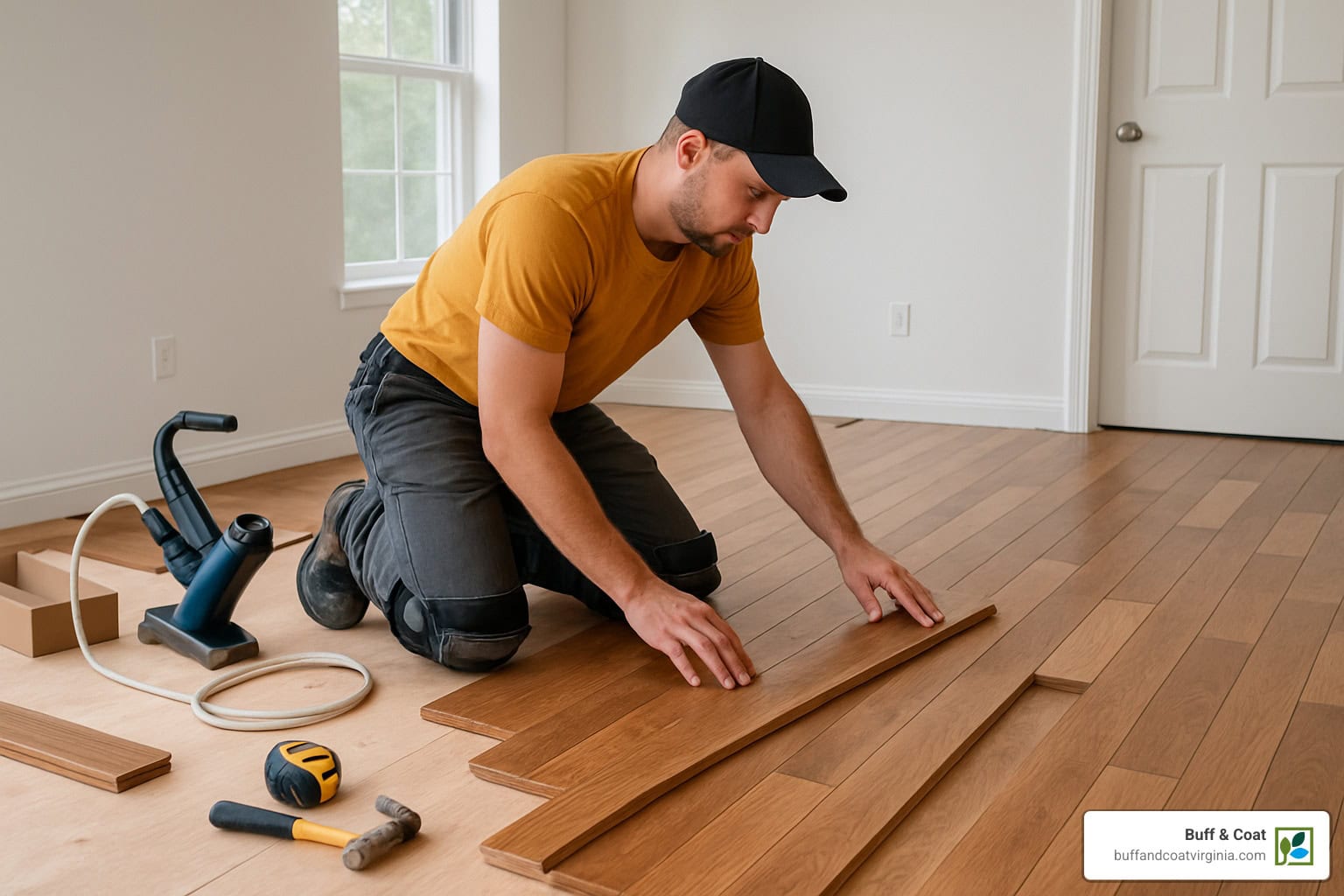
Why Finding the Right Wood Floor Contractor Can Make or Break Your Home Investment
Wood floor contractors provide essential services that can transform your home’s value and appearance, but choosing the wrong one can cost you thousands in repairs and headaches.
Here’s what you need to know about wood floor contractors at a glance:
Key Services Wood Floor Contractors Provide:
- Hardwood floor installation (solid, engineered, laminate)
- Floor refinishing and restoration
- Repairs and patching
- Buff and coat services
- Subfloor preparation and moisture barrier installation
Average Costs:
- Installation: $4,800 ($6-$12 per sq ft)
- Refinishing: $1,900 ($3-$8 per sq ft)
- High-end projects: $13-$25 per sq ft
Timeline Expectations:
- Installation: 3-14 days depending on project size
- Refinishing: 2-5 days for traditional methods
- Buff and coat: Often completed in 1 day
The stakes are high when hiring wood floor contractors. According to industry data, hardwood floors can provide a 70-80% return on investment when done right, but poor workmanship can actually decrease your home’s value. With installation costs averaging nearly $5,000 and refinishing running close to $2,000, you can’t afford to get this decision wrong.
Finding quality wood floor contractors in the Richmond area means looking beyond the lowest bid. You need professionals who understand moisture control, proper acclimation, dust management, and long-term floor care – especially in Virginia’s humid climate.
I’m David Emmerling, President of Buff & Coat Hardwood Floor Refinishing, and I’ve spent over 20 years working with homeowners to restore their hardwood floors using dustless techniques.
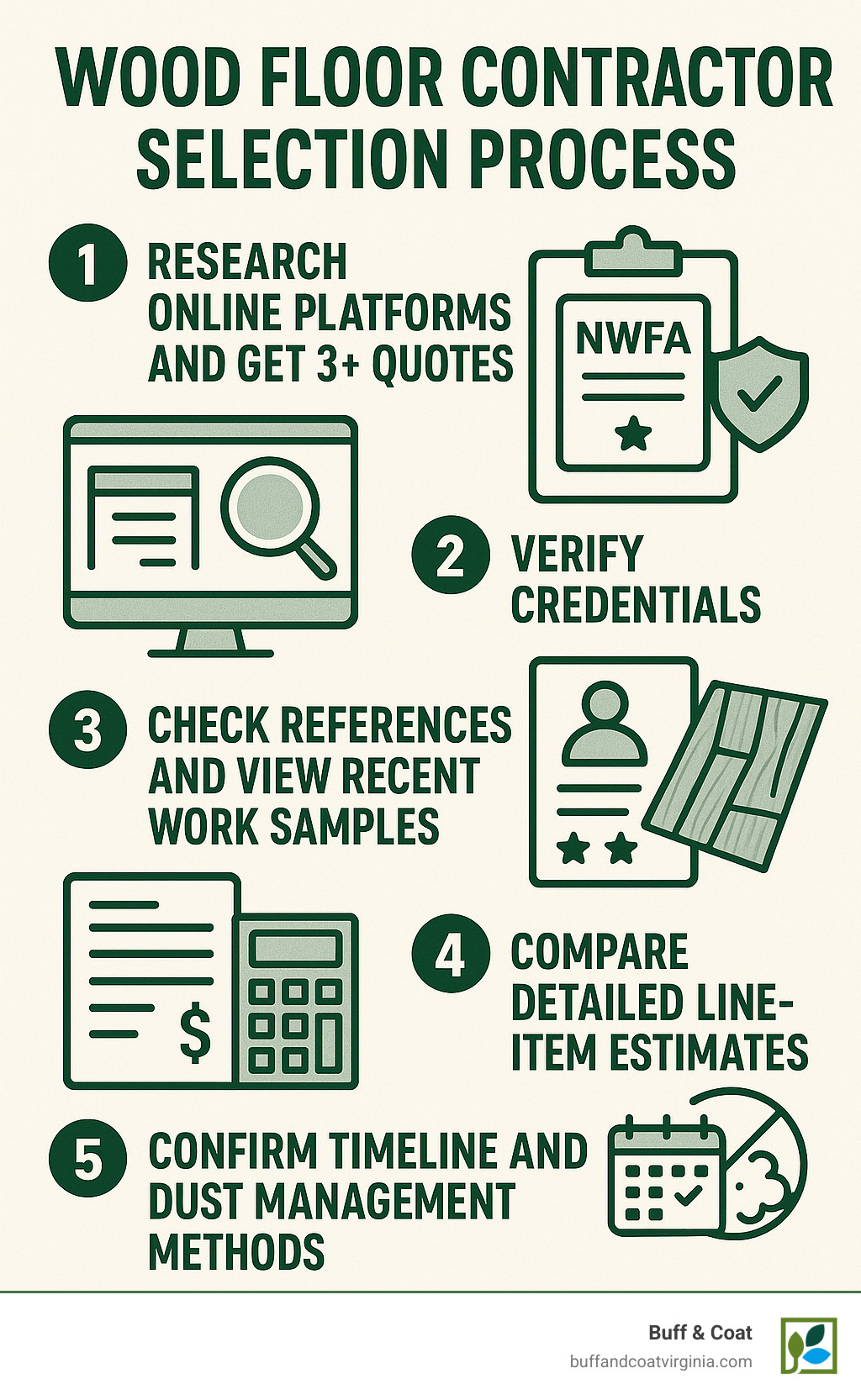
7 Ridiculously Awesome Ways to Find Wood Floor Contractors
The best wood floor contractors aren’t always the ones with the biggest Yellow Pages ads or the flashiest websites. Here are the seven most effective methods we’ve seen work consistently in the Richmond, Glen Allen, and Midlothian markets.
Way #1 – Pro-Matching Platforms for Same-Day Quotes
Online matching services like Angi and Thumbtack have revolutionized how homeowners connect with wood floor contractors. These platforms work by having you enter your ZIP code and project details, then matching you with up to three pre-screened professionals in your area.
The beauty of these services lies in their verification process. Contractors on these platforms typically undergo background checks, insurance verification, and customer review monitoring. When you’re looking at a contractor with 50+ verified reviews and a 4.8-star rating, you’re getting valuable data that would take weeks to collect on your own.
Here’s how to maximize these platforms:
- Be specific about your project: Instead of “hardwood floors,” specify “refinish 800 sq ft oak floors with dustless sanding”
- Request multiple quotes: Research shows homeowners save an average of $2,500 by comparing three quotes
- Check recent reviews: Look for reviews from the last 6 months that mention similar projects

Way #2 – Local Showrooms & Big-Box Pro Desks
Don’t overlook the contractor networks at local flooring showrooms and home improvement stores. These businesses stake their reputation on the quality of contractors they recommend, creating a natural vetting system.
Many showrooms offer “sample check-out” services where you can take flooring samples home for a few days. This gives you time to see how different woods look in your lighting while also building a relationship with knowledgeable staff who can recommend trusted installers.
The pro desks at stores like Home Depot and Lowe’s maintain databases of licensed contractors who’ve completed successful projects for other customers. While these contractors may not be the cheapest option, they’re typically reliable and properly insured.
Way #3 – Certification Hubs & Industry Associations
The National Wood Flooring Association (NWFA) maintains a directory of Certified Professionals who’ve completed rigorous training programs and demonstrated expertise in installation, sanding, and finishing techniques.
When evaluating wood floor contractors, look for these credentials:
- NWFA Certified Professional status: This voluntary certification program validates technical competence
- Better Business Bureau rating: Look for A+ ratings with resolved complaint histories
- Proper licensing and insurance: In Virginia, contractors should carry both liability and workers’ compensation insurance
You can search the Industry Guide to find certified professionals in your area. NWFA-certified contractors typically charge 10-15% more than uncertified competitors, but their work quality and problem-solving abilities justify the premium.
Way #4 – Social Media Portfolios & Job-Site Reels
Instagram and Facebook have become powerful tools for finding skilled wood floor contractors. Many contractors now document their projects from start to finish, giving you an unfiltered look at their work quality and attention to detail.
Search hashtags like #RichmondFlooring, #VirginiaHardwood, or #FloorRefinishing to find local contractors. Pay attention to:
- Before-and-after changes: Look for dramatic improvements that showcase skill
- Process videos: Contractors who show their sanding, staining, and finishing techniques demonstrate confidence in their methods
- Client testimonials in comments: Real customers often leave detailed feedback on project posts
Way #5 – Dust-Free Site Visits & Reference Calls
Nothing beats an in-person consultation with potential wood floor contractors. The best contractors will offer free on-site estimates and won’t pressure you to sign immediately.
During these visits, pay attention to:
- Equipment quality: Professional-grade sanders and dust collection systems indicate serious investment in their craft
- Knowledge demonstration: Can they explain the difference between oil-based and water-based finishes? Do they understand moisture testing?
- Problem identification: Good contractors will spot potential issues like subfloor problems or moisture concerns

Always ask for references from projects completed within the last year. When you call these references, ask specific questions:
- “Did they complete the project on time?”
- “How was the dust management?”
- “Would you hire them again?”
- “Any surprises with the final bill?”
Way #6 – Line-Item Quote Comparison
Professional wood floor contractors provide detailed, written estimates that break down every aspect of your project. This transparency allows you to compare quotes fairly and understand exactly what you’re paying for.
A comprehensive quote should include:
- Materials specifications: Wood species, grade, finish type, and quantities
- Labor breakdown: Prep work, installation, sanding, and finishing hours
- Additional costs: Subfloor repairs, moisture barriers, furniture moving
- Timeline: Start date, daily schedule, and completion estimate
- Warranty terms: Coverage period and what’s included
When comparing quotes, don’t automatically choose the lowest bid. A quote that’s significantly below others often indicates lower-quality materials, inexperienced labor, or hidden costs that will emerge later.
Way #7 – Ongoing Maintenance & Refinishing Plans
The best wood floor contractors don’t disappear after installation. They offer maintenance services, emergency repairs, and refinishing plans that protect your investment long-term.
Look for contractors who provide:
- Annual maintenance checkups: Professional assessment of floor condition and care recommendations
- Emergency repair services: Quick response for water damage or major scratches
- Refinishing schedules: Guidance on when to buff and coat versus full refinishing
- Care product recommendations: Proper cleaners and maintenance supplies
At Buff & Coat, we’ve built our business around this maintenance-focused approach. Our signature buff and coat process can extend the life of your floors by years, often eliminating the need for full refinishing.
Flooring Materials, Costs & Timelines Explained
When you’re talking to wood floor contractors, knowing the difference between solid hardwood, engineered wood, and laminate can save you thousands of dollars and years of regret. Each material has its own personality, price point, and perfect use case.
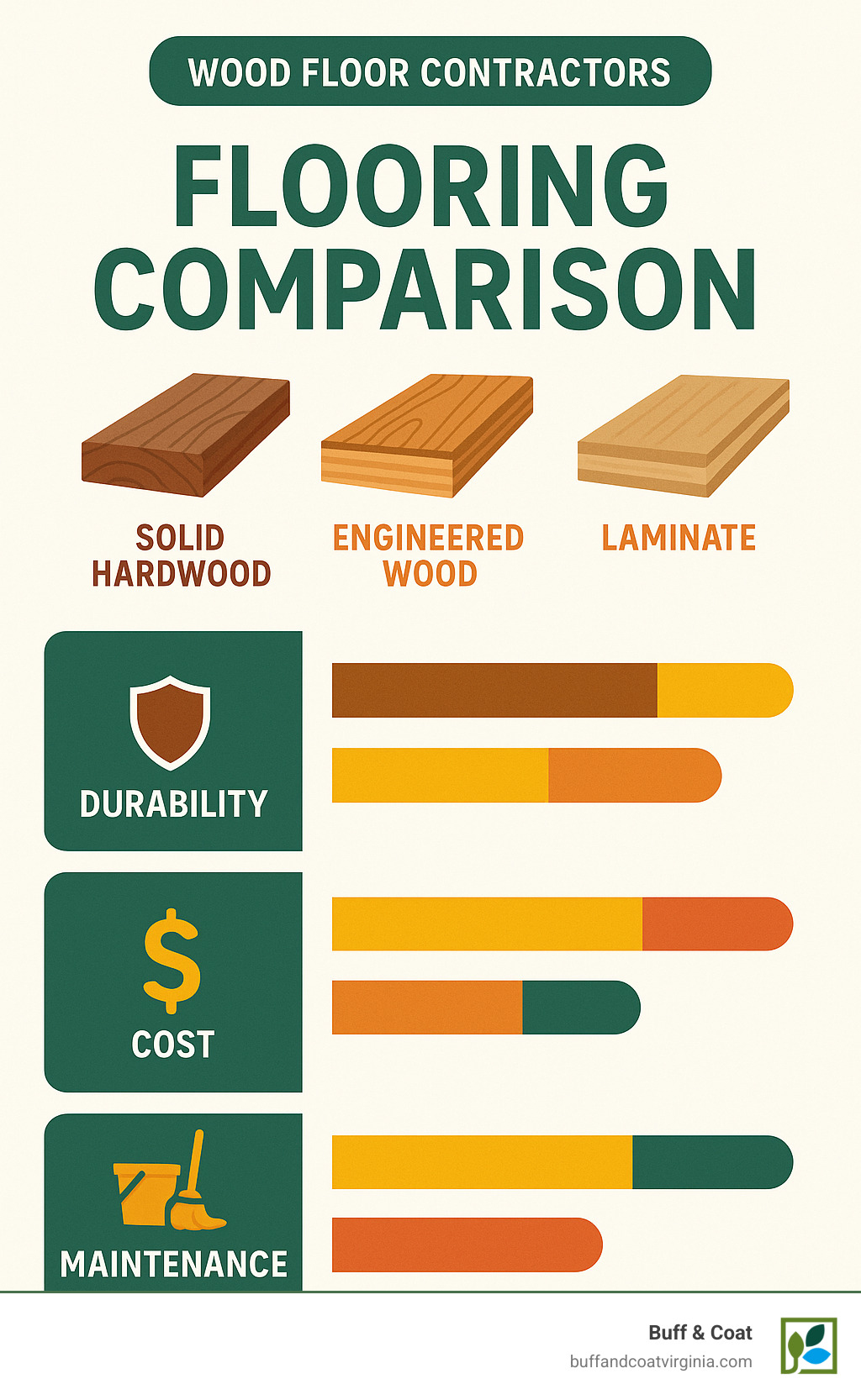
Solid vs. Engineered vs. Laminate: Pros & Cons
Solid hardwood is like buying a classic car – it costs more upfront, but it holds its value and can be restored to like-new condition multiple times. These floors are exactly what they sound like: solid wood planks, usually 3/4 inch thick, that can handle 6 to 10 refinishing cycles over their century-plus lifespan.
The beauty of solid hardwood lies in its authentic wood grain and character. When it comes to resale value, solid hardwood delivers the highest ROI of any flooring option – often returning 70-80% of your investment.
But solid hardwood isn’t perfect. It’s the most expensive option at $8-$15 per square foot for quality oak, and Virginia’s humidity can cause problems if your contractor doesn’t handle moisture control properly.
Engineered wood offers a smart compromise that many Richmond homeowners love. These floors feature a real hardwood veneer over a plywood core, giving you authentic wood beauty with better stability. The plywood base makes them less susceptible to moisture damage – a real advantage in our humid climate.
Most engineered floors come pre-finished, which means faster installation and less dust in your home. You can typically refinish them once or twice, though not as many times as solid hardwood.
Laminate flooring gets a bad rap, but modern laminates have come a long way. These floors use photographic imaging to simulate wood grain over a composite core, and the results can be surprisingly convincing.
The biggest advantage of laminate is the budget-friendly price point of $5-$10 per square foot installed. It’s also incredibly durable and scratch-resistant – perfect for homes with pets or young children.
The downside? Laminate cannot be refinished, so when it’s worn out, it’s replacement time. It also provides lower resale value than real wood options.
Typical Wood Floor Contractors’ Install Process
Professional wood floor contractors follow a time-tested process that separates the pros from the weekend warriors.
Acclimation comes first – and it’s non-negotiable. Your contractor should deliver materials 2-5 days before installation begins, allowing the wood to adjust to your home’s temperature and humidity.
Subfloor preparation is where experienced contractors really shine. They’ll test for moisture problems, install barriers if needed, and use leveling compound to fix uneven areas.
The layout and planning phase might look simple, but it requires real skill. Professional contractors carefully plan starting points and room transitions to minimize waste and create attractive visual flow.
Installation techniques vary by material type. Solid hardwood gets nailed down with professional-grade nailers, while engineered wood can be nailed, stapled, or floated depending on thickness.
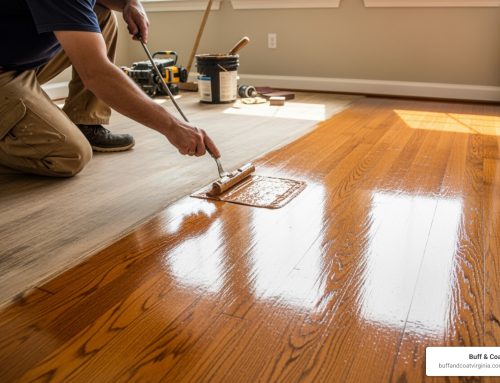
For unfinished solid hardwood, sanding and finishing add 2-3 days to the timeline. This involves progressive sanding with increasingly fine grits, optional stain application, and multiple finish coats with proper drying time between each layer.
What Drives Price & Duration?
Several factors can dramatically impact both your project cost and timeline.
Wood species selection makes a huge difference in both cost and installation complexity. Pine runs $5-$10 per square foot but shows dents easily, while red oak costs $8-$13 and offers the classic look most buyers expect. White oak jumps to $8-$15 but provides superior durability, and Brazilian walnut can hit $11-$20 for exotic beauty.
Board width and specialty patterns significantly impact both cost and timeline. Wider planks cost more due to material expenses and require more precise installation. Specialty patterns like herringbone or chevron can double installation time and increase costs by 50-100%.
Regional labor rates vary considerably across markets. Here in the Richmond area, skilled wood floor contractors typically charge $3-$8 per square foot for installation labor. Dustless refinishing commands premium rates of $5-$8 per square foot, but most homeowners find the cleaner, healthier work environment worth the upgrade.
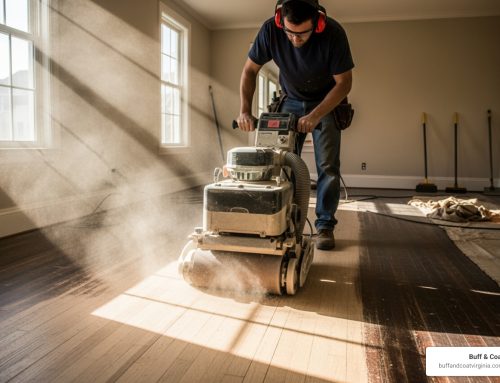
Dust management upgrades represent one of the most valuable investments you can make. Traditional sanding creates clouds of fine dust that infiltrate every corner of your home. Dustless sanding systems add $1-$2 per square foot but eliminate 99% of airborne particles, protecting your family’s health and reducing cleanup time.
For detailed information about flooring ROI and how different materials affect resale value, Realtor.com’s flooring advice provides excellent guidance for homeowners making these important decisions.
Care, Repairs & Refinishing After You Hire Wood Floor Contractors
Your beautiful new floors are installed, but the story doesn’t end there. The best wood floor contractors will tell you that proper care and timely maintenance can double or even triple your floors’ lifespan.
Most homeowners don’t realize that simple daily habits make the biggest difference. Routine cleaning with the right products prevents dirt from acting like sandpaper on your finish. Humidity control between 30-50% prevents boards from shrinking and gapping in winter or swelling in summer. And those felt pads under furniture legs? They’re like insurance policies for your floors.
When minor issues pop up – and they will – knowing whether to call for spot repairs or schedule full refinishing saves you serious money. Our buff and coat process often provides the perfect middle ground, restoring that showroom shine without the dust and expense of complete refinishing.
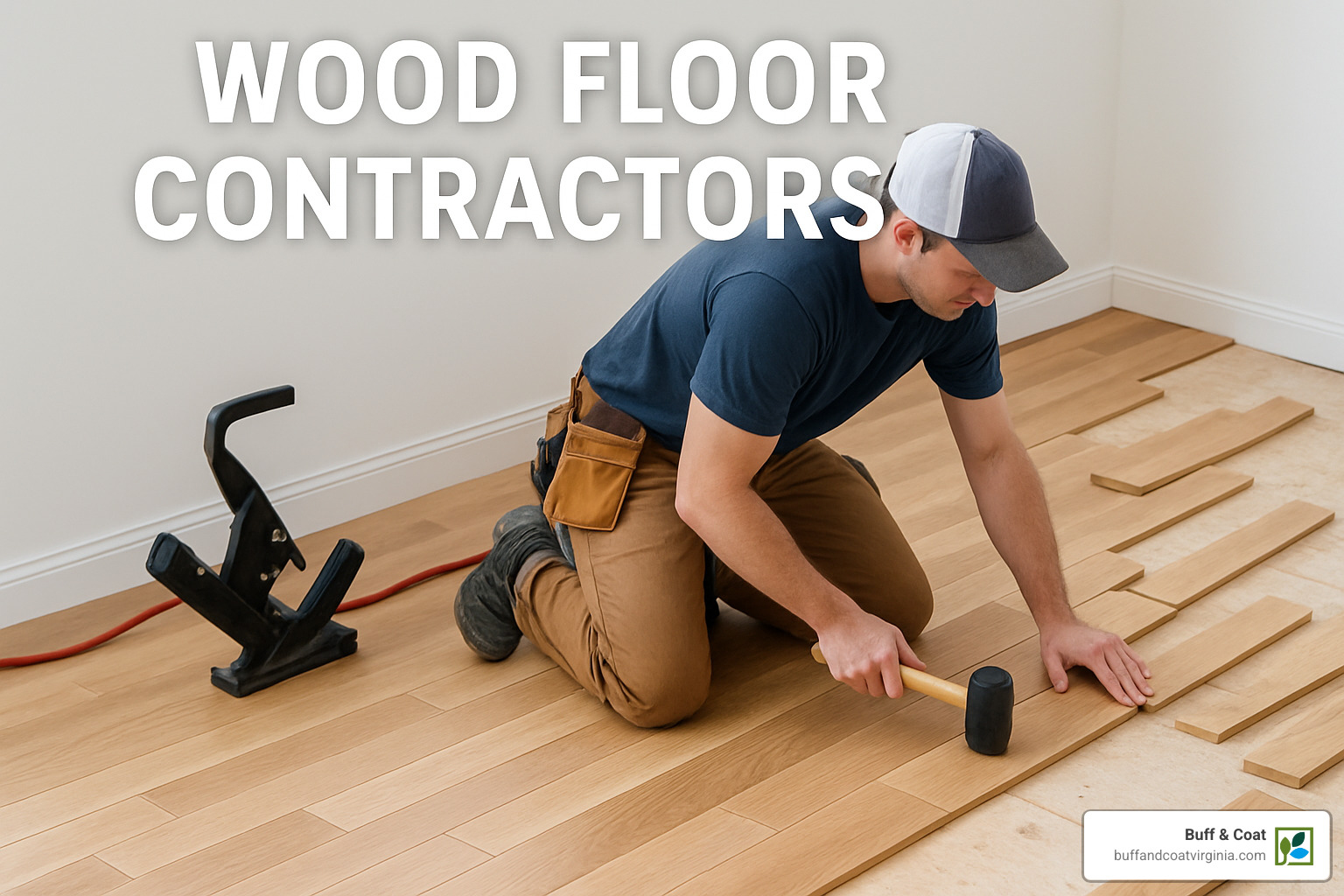
Spot Repairs vs. Full Sanding
Here’s the million-dollar question every homeowner faces: when do you patch things up versus going all-in on full refinishing? Experienced wood floor contractors can usually tell within minutes, but understanding the basics helps you make smart decisions.
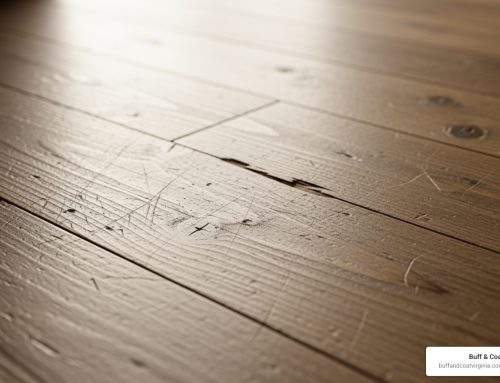
Spot repairs work beautifully when you’re dealing with isolated problems. That single board your dog scratched during his puppy phase? Easy fix. Small water stains from the Christmas tree stand? Usually no problem. Even those annoying pet scratches can often be handled with targeted sanding and color matching.
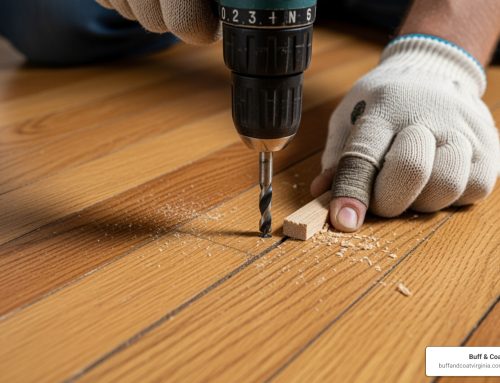
The magic happens when skilled contractors can replace individual boards or sand small sections to blend seamlessly with surrounding areas. We’ve seen homeowners spend $200 on spot repairs instead of $2,000 on full room refinishing.
Full refinishing becomes necessary when problems spread across the entire floor surface. If your floors look tired and dull throughout the room, or if you’re counting scratches instead of individual boards, it’s time for the full treatment.
The numbers tell the story clearly: traditional sanding runs $3-$8 per square foot, while dustless refinishing costs $5-$8 per square foot. But here’s where our buff and coat process shines – it often delivers dramatic results at a fraction of full refinishing costs.
Trends & Eco-Friendly Innovations
The flooring world keeps evolving, and staying current helps you make better decisions when working with wood floor contractors.
Wide planks continue dominating design magazines and Pinterest boards. Planks 5 inches and wider make rooms feel larger and more luxurious. But wider planks require more careful installation and acclimation – they’re more likely to cup or gap if not handled properly.
Matte and low-sheen finishes have practically revolutionized floor maintenance. Remember those high-gloss floors that showed every footprint? Modern matte finishes hide daily wear while actually providing better durability.
Reclaimed lumber appeals to environmentally conscious homeowners and those who love unique character. Each board tells a story, with nail holes and weathering that can’t be replicated. However, reclaimed materials require wood floor contractors who understand potential contamination issues and varied wood conditions.
Low-VOC and water-based finishes represent the industry’s environmental progress. These products cure faster, smell less during application, and reduce environmental impact without sacrificing durability.
For the latest industry innovations and professional techniques, Hardwood Floors Magazine provides excellent insights for both contractors and homeowners who want to stay informed.
Refinish or Replace Decision Tree
This decision keeps homeowners awake at night, but it doesn’t have to be complicated. Smart wood floor contractors help you evaluate several key factors to determine the most cost-effective approach.
Refinishing makes perfect sense when you have solid hardwood with adequate remaining thickness. If your floors feel structurally sound and you’re happy with the current wood species and layout, refinishing often provides excellent value. Budget considerations also favor refinishing, especially when you’re looking at $1,900 for refinishing versus $4,800 for complete replacement.
Replacement becomes the better choice when you’re dealing with engineered floors that have thin wear layers, or extensive water damage that’s compromised structural integrity. Sometimes homeowners simply want to change wood species or move to wider planks, making replacement the logical path forward.
The thickness check provides the clearest guidance. If your floors have been refinished multiple times already, they may not have enough wood remaining for another sanding cycle.
Floor Refinishing Contractors Near Me
Frequently Asked Questions about Wood Floor Contractors
Finding the right wood floor contractors often raises more questions than answers. After helping hundreds of Richmond homeowners through their flooring projects, I’ve heard the same concerns over and over. Let me address the big ones that keep people up at night.
How do I verify a wood floor contractor’s credentials?
Nothing breaks my heart more than hearing about homeowners who got burned by unlicensed contractors. Last month, a Glen Allen family called us in tears after their “contractor” disappeared mid-project with their $3,000 deposit. Don’t let this be you.
Start with the basics – every legitimate contractor in Virginia needs a license through the Department of Professional and Occupational Regulation. You can verify this online in about two minutes. If they can’t produce a current license number, walk away immediately.
Insurance is your safety net. Ask for certificates directly from their insurance company, not just a photocopy they could have made at Kinko’s. You need to see both liability insurance and workers’ compensation coverage. If someone gets hurt on your property and they’re not properly covered, guess who’s liable?
Look for professional certifications like NWFA Certified Professional status. This isn’t just alphabet soup after their name – it represents real training and commitment to industry standards.
The Better Business Bureau rating tells a story too. An A+ rating with resolved complaints actually gives me more confidence than a contractor with no BBB presence at all.
References should be recent and local. Anyone can dig up a happy customer from five years ago. Ask for jobs completed in the last six months, preferably in your neighborhood.
How much does installation or refinishing cost?
Money talk makes everyone uncomfortable, but let’s be honest about what quality flooring costs in the Richmond market.
Installation typically runs $6-$12 per square foot for standard projects, with high-end work reaching $13-$25 per square foot. The national average project cost sits around $4,800, but your actual cost depends on countless variables.
Refinishing is usually more budget-friendly at $3-$8 per square foot for traditional methods. Our dustless refinishing runs $5-$8 per square foot because the equipment and expertise cost more, but most homeowners tell us it’s worth every penny for the cleaner process.
Here’s what drives those price differences: Wood species selection makes a huge impact. Basic pine flooring starts around $5-$10 per square foot, while exotic Brazilian walnut can hit $11-$20 per square foot. Red oak and white oak fall somewhere in the middle at $8-$15 per square foot.
Board width and patterns affect both cost and timeline. Those gorgeous wide planks everyone wants? They cost more and take longer to install properly. Herringbone and chevron patterns can double your installation time and bump costs up 50-100%.
Subfloor preparation is where surprise costs often hide. If we find moisture issues, squeaks, or leveling problems, addressing them properly adds to your bill but saves you headaches later.
Always get detailed written estimates from at least three wood floor contractors. If one quote is dramatically lower than the others, there’s usually a reason – and it’s rarely a good one.
How long will my flooring project take?
Time is money, and most homeowners are eager to get their lives back to normal. Project timelines depend on several factors, but I can give you realistic expectations.
Small rooms under 200 square feet typically take 2-3 days from start to finish. Whole-house installations usually run 1-2 weeks, depending on square footage and complexity. Add 2-5 extra days if you’re doing complex patterns or need significant subfloor repairs.
Refinishing moves faster than new installation. Traditional sanding and finishing takes 3-5 days, while our dustless refinishing process usually wraps up in 2-4 days. Our signature buff and coat service often gets completed in just one day, which is why so many busy families choose this option.
Material acclimation adds 2-5 days before we even start working. Wood needs time to adjust to your home’s temperature and humidity. Contractors who skip this step are setting you up for problems down the road.
Drying time between finish coats can’t be rushed, no matter how eager you are to move furniture back. Water-based finishes dry faster than oil-based, but both need proper cure time for durability.
Weather affects timelines more than people realize. High humidity slows drying times, while very dry conditions can cause wood movement issues. Professional wood floor contractors adjust schedules accordingly rather than pushing through and compromising quality.
The contractors who promise unrealistic timelines usually deliver unrealistic results. Quality work takes time, and rushing leads to callbacks, complaints, and headaches for everyone involved.
Conclusion
You’ve got everything you need to find amazing wood floor contractors who’ll treat your home with the care it deserves. It’s not about finding the cheapest option – it’s about finding professionals who understand that your floors are a major investment in your family’s comfort and your home’s future value.
The seven strategies we’ve covered work because they help you see beyond flashy advertisements and smooth sales pitches. When you use pro-matching platforms, visit local showrooms, check industry certifications, browse social media portfolios, conduct thorough site visits, compare detailed quotes, and look for ongoing maintenance relationships, you’re building a complete picture of each contractor’s capabilities.
What really matters when choosing wood floor contractors? Look for NWFA certification – it shows they’ve invested in proper training. Verify their insurance coverage so you’re protected if something goes wrong. Get those detailed written estimates that break down every cost, because surprises on the final bill are never fun. And don’t skip checking recent references – past customers tell you everything you need to know about how a contractor really operates.
Understanding your material options makes these conversations so much easier. Whether you’re considering solid hardwood for maximum refinishing potential, engineered wood for moisture-prone areas, or laminate for budget-conscious projects, knowing the pros and cons helps you communicate exactly what you want.
Here in Richmond, we’ve seen too many homeowners learn expensive lessons from choosing the wrong contractors. That’s why we built Buff & Coat around a different philosophy. Our dust-free buff and coat process isn’t just about avoiding the mess of traditional sanding – though your family will definitely appreciate that. It’s about extending your floors’ life by years, often eliminating the need for full refinishing entirely.
This approach has saved our Glen Allen and Midlothian neighbors thousands of dollars over the years. Instead of full refinishing every 7-10 years, many of our customers can go 15-20 years with periodic buff and coat treatments. That’s real money back in your pocket.
The bottom line? Great wood floor contractors don’t just install or refinish your floors and disappear. They become partners in protecting your investment for decades. They answer your maintenance questions, respond when emergencies happen, and help you make smart decisions about when to repair versus replace.
Your floors should be something you love walking on every single day. When you take the time to find the right contractor using these proven methods, that’s exactly what you’ll get – beautiful, durable floors that make your house feel like home.
Ready to see what dust-free refinishing can do for your floors? We’d love to show you the difference our techniques make. Schedule your free consultation today and find how we can restore your floors’ original beauty while protecting them for years to come.