

Home Blog Wide Plank Hardwood Floors: Richmond Home Guide
Wide Plank Hardwood Floors: Richmond Home Guide

Richmond homeowners usually start looking at wide plank hardwood floors when their current floor feels dated, chopped up, or just doesn't fit the house anymore. Done well, wide planks can make a room feel calmer, cleaner, and more substantial, but they also raise real questions about humidity, installation, refinishing, and cost.
If you're researching floor installation in Richmond, weighing hardwood floor refinishing, or trying to understand whether a wide plank floor makes sense in Richmond VA, this guide will give you the practical version. No showroom fluff. Just what works, what doesn't, and what to think through before you spend the money.
What Exactly Are Wide Plank Hardwood Floors
Walk into a Fan row house with tight rooms and heavy trim, then step into a newer West End home with long sightlines and an open kitchen. The same floor width will not read the same way in both spaces. That is why "wide plank" is more than a style label.
Wide plank hardwood flooring usually means boards that start at about 5 inches wide and go up from there. In many current projects, homeowners are looking at widths in the 7 inch range and wider. Traditional strip flooring is much narrower, so the floor shows more lines, more board ends, and more pattern across the room.
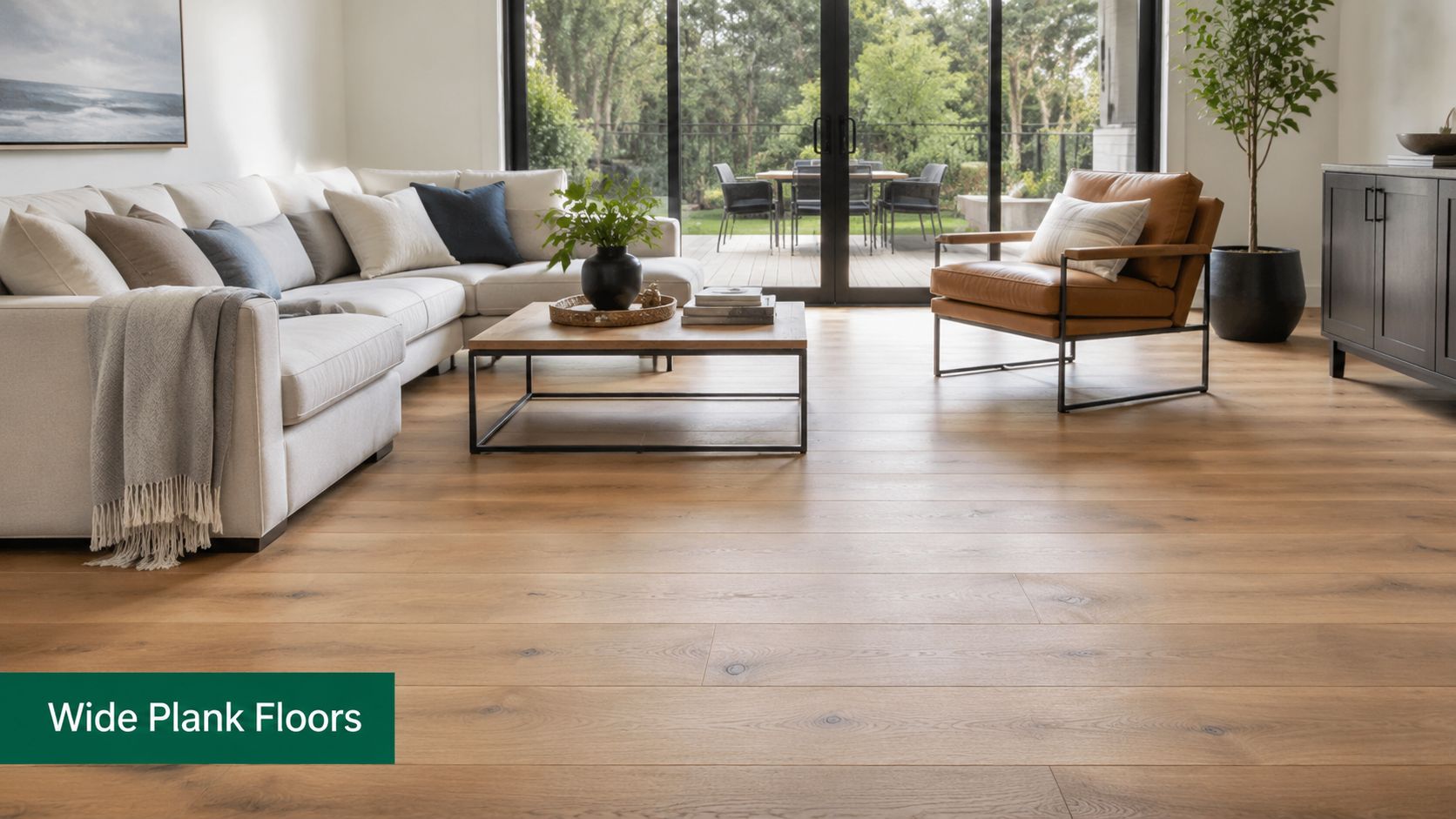
How the look changes a room
Board width changes the scale of the room more than many homeowners expect.
Narrow strip floors create a busier visual pattern because there are more seams. That can be a good fit in historic Richmond homes where the goal is to keep the original character in place. Colonial homes, older brick houses, and rooms with detailed millwork often carry that narrower rhythm well.
Wide planks quiet the floor down. You see fewer seams, longer runs, and more of the grain in each board. In open layouts, renovated kitchens, and larger family rooms, that usually feels cleaner and more intentional.
In practice, wide planks often work best when the house already has some breathing room. They can make a small room feel broader, but in a very formal or tightly scaled older home, extra-wide boards can look oversized for the architecture. The right answer depends on the room, the trim, and the age of the house, not just what is popular in a showroom.
Why the width matters beyond appearance
Wider boards show more of the wood itself. That brings out character marks, grain variation, and long natural movement across each plank. Homeowners usually like that part.
The trade-off is that every board has more visible surface area, so gaps, cupping, and seasonal movement can stand out faster when indoor humidity is not controlled. In Richmond, that matters. Our summers are humid, our heating season dries houses out, and those swings affect wood flooring, especially in wider formats.
That is also why width should be discussed early with the floor construction, not as a separate design choice. A helpful starting point is this guide on solid vs engineered hardwood flooring, since the best plank width for a Richmond home is often tied to subfloor conditions, HVAC consistency, and whether the home is historic, renovated, or new construction.
Wide plank is not automatically better
Some homes look right with wide planks. Some do not.
A few general rules help:
- Modern and transitional homes: Wide planks often fit open sightlines, simpler trim, and larger rooms.
- Historic homes: Moderate widths usually look more natural unless the house is being restored with a specific antique-plank look.
- Mixed-style renovations: A middle width can keep the floor from feeling too rustic or too contemporary.
For Richmond homeowners, wide plank hardwood floors make sense when the scale matches the house and the installation plan respects local humidity. That combination matters more than trend language.
Solid vs Engineered The Big Decision for Wide Planks
Homeowners usually want to start with color and character. In practice, the construction choice decides whether a wide plank floor behaves well in the house you have.
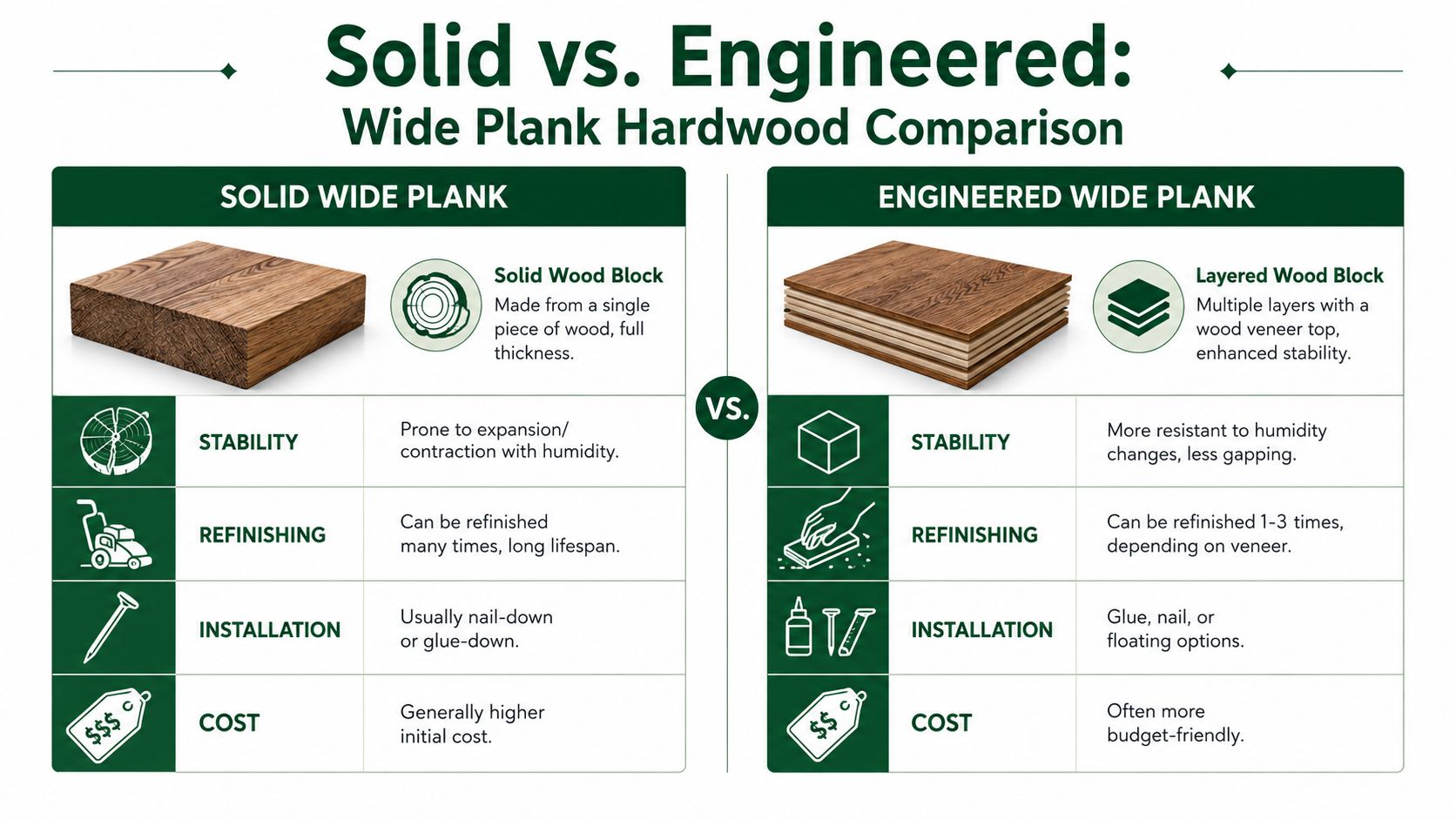
In Richmond, I look at three things first. Subfloor type, indoor humidity control, and the age and layout of the home. A Fan District row house with older framing and seasonal airflow issues does not get the same recommendation as a newer West End home with stable HVAC and a dry main level.
What each one actually is
Solid wide plank is a full-thickness board made from one piece of hardwood.
Engineered wide plank uses a real hardwood wear layer over a layered core built for better dimensional stability. That layered construction usually handles seasonal moisture swings better, which matters more as boards get wider.
Homeowners evaluating each room on its own often benefit from this solid vs engineered hardwood flooring guide before they commit to material.
Where Richmond climate changes the answer
Richmond is hard on wood movement. Summer humidity pushes boards to expand. Winter heating dries them out and can pull small gaps open. With wide planks, those changes are easier to see because each board covers more surface area.
That does not mean wide planks are a problem. It means the margin for error gets smaller.
Solid wide plank usually makes the most sense in houses with wood subfloors, steady indoor conditions, and enough board thickness to justify future sanding. It is a strong option for main levels where the house stays reasonably consistent year-round.
Engineered wide plank fits more of the homes I see day to day. It is often the safer choice over concrete, in renovated kitchens, in lower levels, and in houses where humidity swings are harder to control. It also gives homeowners more flexibility with wider formats that would be riskier in solid wood.
Historic Richmond homes deserve a little more caution. Older homes can have uneven subfloors, crawlspace moisture, and less predictable insulation and HVAC performance. In those settings, engineered is often the better technical answer even if solid sounds more traditional on paper.
Solid vs Engineered Wide Plank Flooring At a Glance
| Feature | Solid Wide Plank | Engineered Wide Plank |
|---|---|---|
| Construction | Single piece of hardwood | Layered construction with real wood top layer |
| Humidity behavior | More sensitive to seasonal change | More dimensionally stable |
| Best subfloor match | Typically wood subfloors | Wood subfloors or concrete |
| Refinishing potential | Strong long-term refinishing value | Depends on wear layer thickness |
| Typical use case | Main-level spaces with stable indoor conditions | Homes with humidity swings, slabs, or below-grade needs |
One trade-off gets missed a lot. Solid usually offers more sanding life over the long run, but that only matters if the floor is a good fit for the house in the first place. A floor that can be refinished many times is not automatically the better investment if it spends years reacting to moisture.
The opposite mistake happens too. Some engineered products are excellent. Some are built to a price point and have thin wear layers that limit future refinishing. Product quality matters just as much as the solid-versus-engineered label.
Later in the decision process, many homeowners find it helpful to hear a visual explanation before they choose materials. This short video does that well.
Solid is not automatically the premium choice. In many Richmond homes, engineered is the smarter long-term floor.
Choosing Your Species Finish and Layout
Once the construction is settled, the fun part starts. Then, a floor stops being a product and starts looking like it belongs in a specific house.
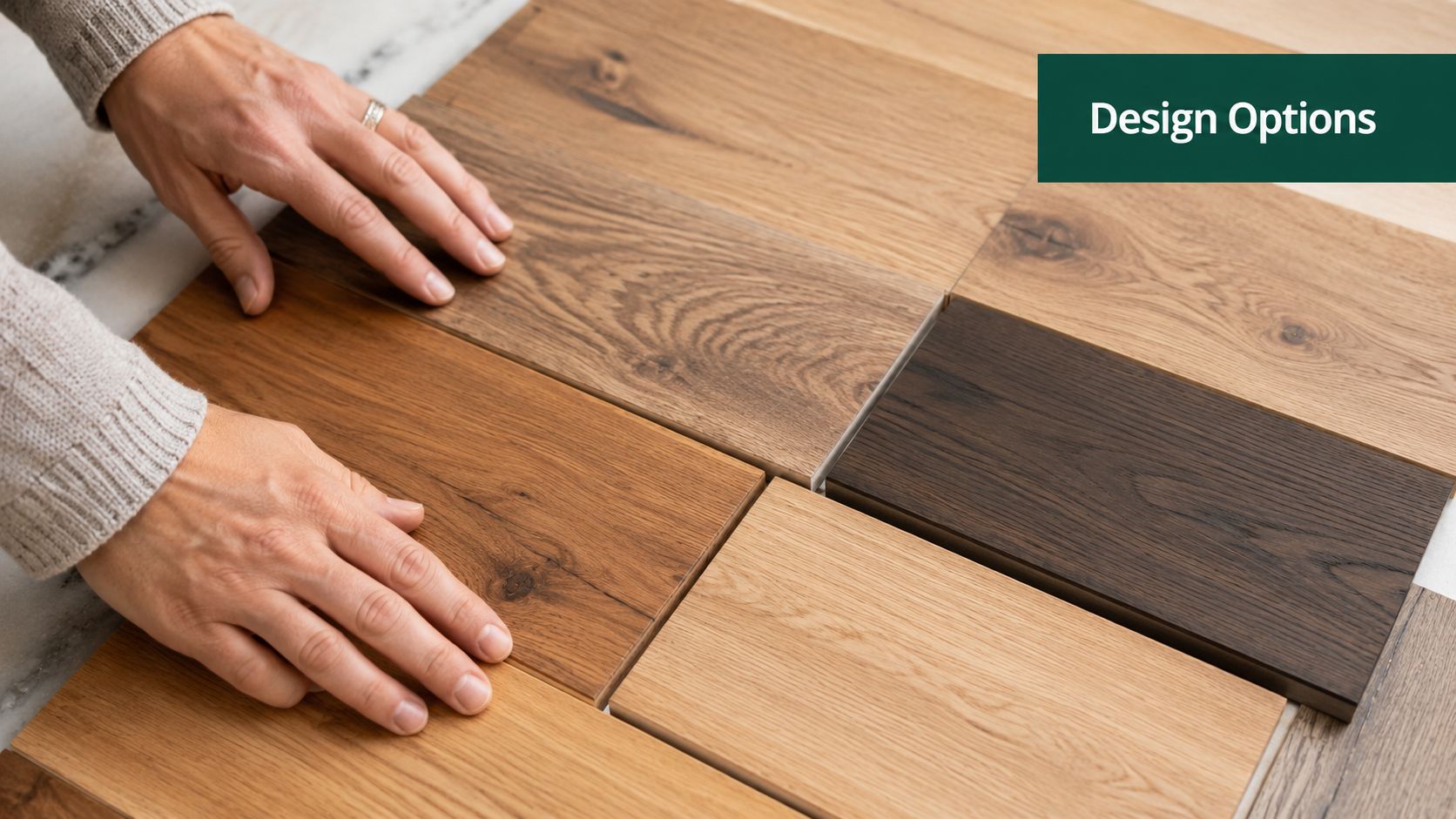
Start with oak before you get exotic
Most homeowners circle back to oak for good reason. According to Crossville Studios' hardwood flooring trends article, white and red oak account for about 67% of the domestic hardwood flooring market, and they remain the expected leaders for wide plank styles. The same source notes that homeowners are moving away from honey and yellow finishes and toward low-gloss, gray, and cerused finishes that show grain contrast.
That lines up with what works in actual homes around Richmond VA. White oak gives a quieter, more contemporary grain. Red oak has a more familiar traditional look and can still work beautifully if the stain choice is right.
If you're considering a lighter European-style look, this guide on European white oak flooring can help you sort through the visual differences.
Match the floor to the house, not the trend
A few examples make this easier:
- The Fan or Museum District renovation: White oak in a matte or satin finish often balances old architecture with a cleaner update.
- Short Pump or newer Midlothian home: Wider, longer boards with lower sheen usually fit the larger rooms and open layouts.
- Farmhouse or more rustic property outside Richmond: Character-grade oak with visible knots and tonal variation can feel grounded instead of polished.
A wide plank floor shows more grain because the boards are larger. That means every species choice becomes more visible. If you love movement, variation, and character, wide planks highlight that. If you want a quieter floor, choose a cleaner grade and keep the sheen low.
Design note: Matte and satin finishes usually age better visually than glossier finishes because they don't spotlight every small scuff the same way.
Layout matters more than people think
Plank direction changes how a room reads. Running boards with the longest visual line in the room often helps the space feel more continuous. In rectangular rooms, that can make the footprint feel calmer and less segmented.
Transitions matter too. A wide plank that looks perfect in a large family room can feel abrupt if it crashes into several small adjoining rooms with busy thresholds and awkward direction changes. Good layout planning fixes that before installation day.
For anyone comparing hardwood floor restoration with full replacement in Richmond VA, this is one of the tipping points. If the existing floor has the wrong scale for the house, refinishing may improve color and wear, but it won't change the visual structure.
Why Professional Installation is Non-Negotiable
The biggest myth around wide plank hardwood floors is simple. People blame the width when the actual problem is usually prep.
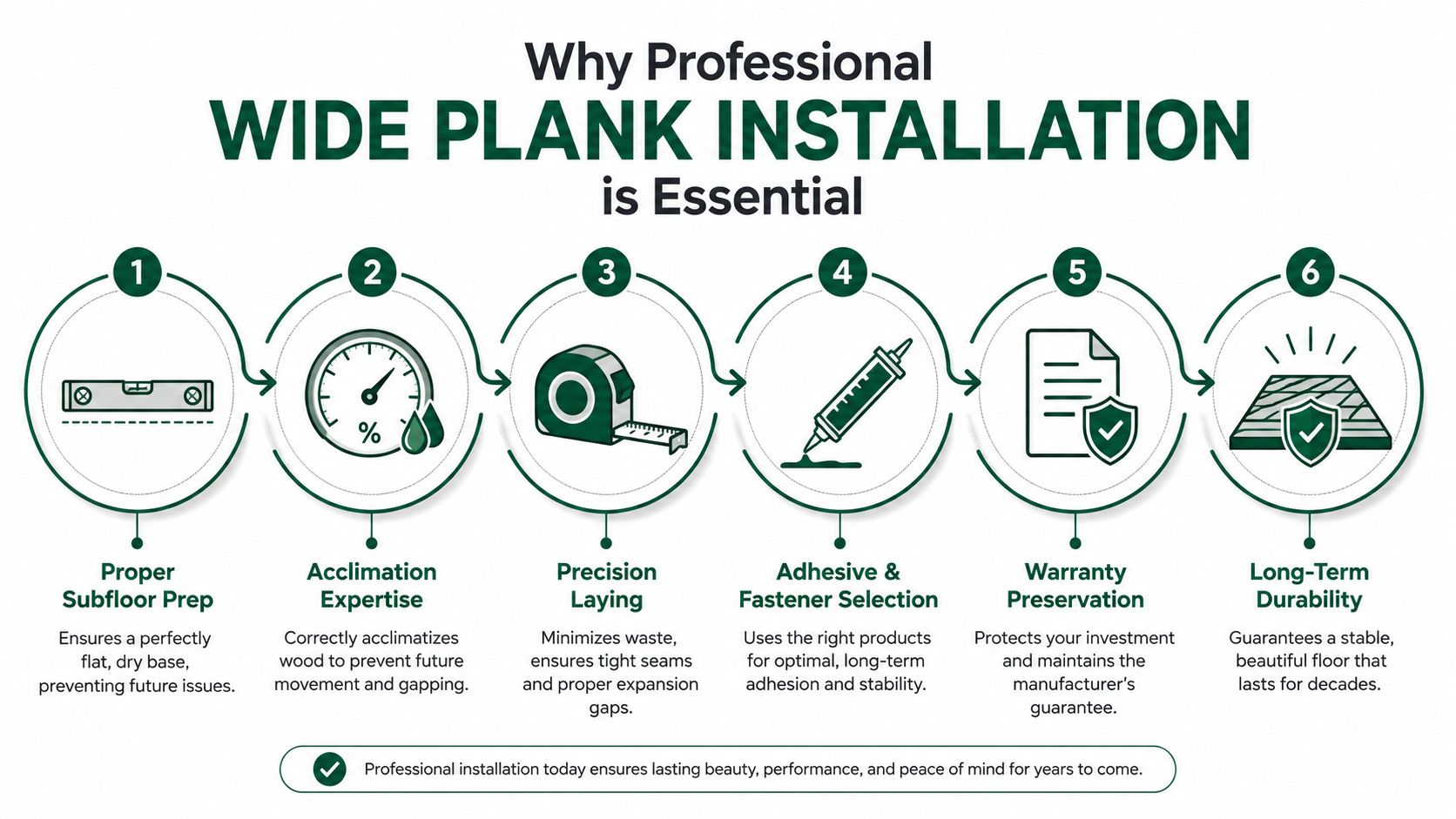
Cupping doesn't start with width
The claim that wide boards are prone to cupping has been directly challenged by flooring experts. According to Wide Plank Flooring's article on common misconceptions, movement depends on moisture gradients and subfloor preparation, not plank width alone. That same source points to a subfloor flatness tolerance of 3/16 inch over 10 feet.
That number matters. On a real jobsite, a floor can look close enough and still be wrong for wide material.
If the subfloor is uneven, wet, or poorly prepared, a wide plank floor will show you the mistake faster than a narrow strip floor will.
For homeowners comparing bids, this is a good place to read about professional floor installation before signing anything. The low bid often leaves out the prep work that keeps the floor stable.
What good installers handle before the first row goes down
A proper wide plank installation has several essential requirements:
- Moisture testing: The installer needs to know what the wood and subfloor are doing before layout starts.
- Subfloor correction: Flatness issues need to be fixed, not worked around.
- Acclimation: The flooring needs time to adjust to the house conditions it will live in.
- Expansion planning: Perimeter gaps and transition details can't be guessed.
- Fastener or adhesive choice: The method has to match the product and subfloor.
This is why DIY wide plank work often looks fine for the first few months. Trouble tends to show up later, after a humid spell, a heating season, or a full seasonal cycle in Richmond VA.
Why this matters more in Richmond homes
Richmond has a mix of older crawl-space homes, renovated city houses, slab additions, and newer suburban construction. Those aren't the same installation environment.
A wide plank product that performs well on a dry, well-prepped plywood subfloor upstairs may be a poor fit over concrete or in a moisture-sensitive lower level. That's where installation knowledge stops being a line item and starts acting like insurance for the whole floor.
If you're unsure whether your project needs hardwood floor repair, full replacement, or just better site prep before new boards go in, getting an honest evaluation first can save a lot of rework.
Maintaining and Refinishing Wide Plank Floors
A Richmond homeowner usually notices the same pattern. The floor still looks good across most of the room, but the traffic lanes near the kitchen, entry, or family room start to dull first. On wide planks, that wear can stand out faster because each board shows more surface area and fewer seams break up the eye.
Good maintenance is simple, but it has to be steady. Wide plank floors handle daily living well when homeowners control grit, limit standing moisture, and deal with finish wear before it turns into exposed wood.
Daily care that actually helps
Dry soil is the enemy. Dust, sand, and fine grit scratch the finish long before the boards themselves have a problem.
Sweep or vacuum regularly with a hard-floor setting. Use felt pads under chairs, keep pet nails trimmed, and clean with a hardwood-safe product that does not leave water sitting on the surface. For homeowners who want a practical room-by-room checklist, this guide for protecting floors from furniture is a useful outside resource.
Indoor humidity also affects how these floors age, especially in Richmond. Summer moisture and winter heat can push boards to expand and shrink through the year, so stable indoor conditions help limit seasonal movement and protect the finish. That is one reason engineered wide plank often performs more predictably than solid in lower levels, additions, and homes with uneven humidity control.
Buff and coat versus full refinishing
Homeowners often use the wrong term for the wrong service, and that leads to bad expectations.
A buff and coat service works for light surface wear. The existing finish is cleaned and lightly abraded, then a new coat goes on top. This restores protection and improves the look of dull traffic areas, but it does not remove deep scratches, stains, or board-level damage.
A full hardwood floor refinishing job goes further. It sands the floor down, removes the old finish, and gives you a chance to correct heavier wear, pet damage, surface scratches that cut through the finish, and in many cases a color change.
Sandless systems have limits. As discussed in this HomeImprovement Reddit thread on sandless process vs sanding, they can improve appearance in the right situation, but they do not erase deeper defects because they are not taking the floor back to bare wood.
Why refinishing potential affects long-term value
Refinishing potential matters more with wide plank than many homeowners realize. These floors are a bigger up-front investment, so the ability to renew them instead of replace them affects the long-term math.
As noted earlier, solid 3/4-inch wide plank usually gives you the most sanding life. Engineered products vary quite a bit, and the wear layer makes the difference. Some are built for future refinishing. Others are better treated as a floor you can recoat and maintain for years, but not sand multiple times.
That matters if you are evaluating engineered hardwood refinishing, recoating, or replacement in Richmond VA. In older Fan or Museum District homes, solid flooring may fit the structure and period better if site conditions allow it. In homes near the river, on concrete, or in spaces where humidity swings are harder to control, a quality engineered wide plank often gives homeowners a more stable floor with enough wear layer to justify refinishing later. That balance between appearance, stability, and service life is what protects property value over time.
The Cost and Value of Wide Plank Floors in Richmond
You feel the cost of wide plank flooring before a single board goes down. A 1920s Fan row house with uneven subfloors, tight hall transitions, and seasonal humidity swings will price out very differently from a newer West End home on a stable, conditioned main level. In Richmond, the floor itself is only part of the number.
Where the extra cost comes from
Wide planks ask more from the material and from the installer. Longer, wider boards need better milling, better grading, and a flatter substrate. If the subfloor is off, wide plank shows it fast. That means more prep, more layout work, and less room for shortcuts.
The estimate usually moves based on a few practical factors:
- Material choice: Solid wide plank and premium engineered products are priced differently, and the wear layer matters on engineered.
- Subfloor correction: Flattening, patching, or rebuilding problem areas can change the scope quickly.
- Room complexity: Stairs, direction changes, borders, and awkward transitions add labor.
- Finish approach: Prefinished and site-finished floors each affect labor, schedule, and how the final floor reads in the home.
- Moisture conditions: Homes near the river, crawl-space homes, and older houses with inconsistent indoor humidity often need more planning and prep.
Richmond homeowners should also factor in the house style. Wide plank can look exactly right in a renovated Museum District home, but only if the floor fits the structure and the moisture conditions. In newer open-plan homes, the same material often delivers the clean, less segmented look buyers expect, especially in larger rooms where narrow strip flooring can feel busy.
Value is more than the purchase price
Value shows up in two places. First, daily use. A good wide plank floor gives rooms a calmer, more intentional look, and that matters in houses where the flooring connects several visible spaces. Second, resale presentation. Buyers notice flooring early, and they use it to judge the overall quality of the renovation.
That does not mean wide plank is automatically the smart buy.
A low-grade product, installed over a subfloor that was never flattened, can become an expensive disappointment. On the other hand, a well-made engineered wide plank in the right Richmond setting often gives homeowners a better return than forcing solid hardwood into conditions it does not handle well. That is especially true on concrete, over radiant heat, or in homes where indoor humidity is hard to keep consistent year-round.
Bottom line: Wide plank usually costs more up front. It earns its value when the product matches the house, the site conditions are handled correctly, and the floor has a realistic service life.
To understand the differences between refinishing cost, replacement cost, and the likely refinishing timeline in an occupied Richmond home, you need a room-by-room estimate. Online averages rarely include furniture moving, board replacement, stain work, floor flatness issues, or the downtime that affects how you live through the project.
For homeowners worried about cleanup during refinishing, dustless sanding systems can reduce dust generation compared to traditional sanding methods, which makes the process easier to manage in lived-in homes.
Frequently Asked Questions About Wide Plank Flooring
Are wide plank floors harder to clean
Not usually. Many homeowners find them easier to live with because there are fewer seams collecting visual clutter. The cleaning routine is still basic: keep grit off the floor, avoid excess moisture, and protect high-contact areas like dining chairs and entry points.
Can wide plank floors work in a basement
Yes, but the material matters. According to Ciero's FAQ on wood flooring options, solid hardwood isn't suitable for high-moisture spaces like basements, while premium engineered wide planks with 4mm+ wear layers offer strong stability and resist dimensional change better than narrow solid planks. For below-grade areas in Richmond VA, that's usually the more realistic path.
Can I fix scratches without refinishing the whole floor
Sometimes. Light wear in the finish may be a good candidate for wood floor recoating or a buff and coat service. A gouge, dent, or deeper scratch may need targeted hardwood floor scratch repair or a broader refinish, depending on how visible the damage is and whether the finish has been compromised.
How long does refinishing take
The answer depends on condition, square footage, repairs, finish system, and whether the home is occupied. A simple recoat moves much faster than full sanding and stain work. If you're asking, “how long does refinishing take,” the specific answer comes from the condition of your actual floor, not a generic calendar promise.
Can engineered wide plank be refinished
Yes, many can. The key is the thickness of the wear layer. Premium engineered products with substantial wear layers offer much better long-term serviceability than thin veneer products.
Is dustless sanding worth it
For many occupied homes, yes. It keeps the process cleaner and makes hardwood floor restoration more manageable while people are still living in the house. In Richmond VA, that matters for families, pets, and anyone sensitive to dust.
Why Richmond Homeowners Choose Buff & Coat
Homeowners don't need a flooring company that talks in circles. They need straight answers, clean work, and recommendations that fit the actual floor in front of them.
Buff & Coat Hardwood Floor Refinishing is a Richmond-based floor refinishing and installation company with 15+ years of experience serving homeowners in Richmond, Midlothian, Chesterfield, Henrico, Glen Allen, Short Pump, Mechanicsville, and occasional jobs in Charlottesville, Fredericksburg, and Virginia Beach.
Why people call them for floor refinishing in Richmond VA, repairs, recoating, and installation:
- 15 years in business: They've worked on the kinds of floors Richmond homes have, from older site-finished wood to newer engineered products.
- Dustless sanding systems: Cleaner sanding matters in occupied homes, especially when families are trying to stay functional during the project.
- Local and owner-operated: You're dealing with a local small business, not a call center.
- High-quality finishes: That includes practical solutions for both full refinishing and lighter renewal work.
- Clear pricing and honest advice: If a floor only needs recoating, that should be the recommendation. If it needs full sanding or replacement, that should be clear too.
- 5-star customer service: Responsiveness and follow-through matter just as much as the finish itself.
They also offer hardwood floor installations, LVP/LVT installs, repair work, buffing and coating, and dustless sanding. For homeowners trying to sort through best hardwood floor contractor Richmond searches, that combination of local experience and practical workmanship is what usually matters most.
Ready to restore your hardwood floors? Buff & Coat Hardwood Floor Refinishing makes the process fast, clean, and stress-free. Call 804-392-1114 or request your free estimate at buffandcoatvirginia.com.


