

Home Blog Hardwood Floor Installation Home Depot vs Local Contractor
Hardwood Floor Installation Home Depot vs Local Contractor

Richmond homeowners often reach the same fork in the road. You want new hardwood, you've priced materials online, and the appeal of a big-box installation package is obvious. One quote, one checkout, one brand name you already know.
But hardwood floor installation at Home Depot and hiring a local installer aren't the same kind of decision. One is built for standardized project flow. The other usually lives or dies on site conditions, communication, and how well the crew handles Richmond VA humidity, subfloor surprises, and the difference between a floor that looks good on day one and one that still performs well later.
Introduction
A common Richmond scenario goes like this. A homeowner in Midlothian or Henrico pulls up old carpet, finds hardwood isn't worth saving, and starts comparing replacement options. Home Depot looks convenient because the pricing feels easier to understand upfront. A local contractor feels less predictable, but also more accountable once the work starts.
That tension is reasonable. New flooring affects budget, daily routine, indoor dust, furniture logistics, and resale appeal all at once. It also overlaps with other concerns many homeowners already have, like hardwood floor refinishing, dustless sanding, and whether a worn floor could be restored instead of replaced.
For homeowners in Richmond VA, the smartest choice usually comes down to one question. Are you buying the lowest friction purchasing experience, or the strongest fit for your house, your schedule, and your climate? That's where the details matter.
| Factor | Home Depot installation model | Local contractor model |
|---|---|---|
| Buying process | Centralized retail purchase and installer assignment | Direct estimate and scope review |
| Pricing visibility | Clear baseline for standard jobs | More customized, sometimes less standardized |
| Communication | Usually routed through retailer systems and subcontractor scheduling | Usually direct with estimator, owner, or lead installer |
| Fit for unusual site conditions | Can work well, but depends heavily on assigned crew and scope clarity | Often stronger when homes need tailored prep or moisture attention |
| Best use case | Homeowners prioritizing convenience and packaged purchasing | Homeowners prioritizing local oversight and job-specific planning |
Bottom line: The cheaper line item on paper can become the more expensive choice if site prep, moisture movement, or scope gaps show up after work begins.
Overview of Home Depot Installation
A Richmond homeowner buys prefinished hardwood through Home Depot, schedules a measure, and expects a straightforward install. Then the boards arrive during a humid stretch, sit in a garage that is warmer and wetter than the living space, and the first real question surfaces too late. Who is checking whether those planks have acclimated to the house, not just to the delivery date?
That example captures how Home Depot's installation model works. The retailer handles the sales process, project intake, and installer assignment through a third-party network rather than a dedicated in-house crew in each market. For homeowners, the appeal is obvious. Product selection, financing options, and scheduling all sit inside one recognizable retail system.
Where the retail model is strongest
Home Depot tends to fit projects that are easy to define before work starts. A newer home with flat subfloors, standard room transitions, and no history of moisture intrusion is easier to price and assign through a national workflow than a 1940s Richmond house with patched plywood, seasonal movement, and uneven thresholds.
The process usually follows four steps:
- Product selection in store or online
- Site measurement and basic scope review
- Assignment to a local installation crew
- Installation based on the written work order
That structure can reduce front-end effort for the homeowner. It also creates a clear paper trail for the purchase itself, which some buyers prefer when they want one point of sale instead of separate contracts for material and labor.
Where Richmond conditions can expose gaps
Hardwood performance depends less on the checkout experience than on jobsite judgment. In Richmond, indoor humidity can swing sharply between summer and winter, and older homes often have crawlspace or subfloor conditions that affect how wood moves after installation. A retailer-led model can still work well, but only if the assigned crew and the written scope account for those site conditions early.
Acclimatization is one of the least understood examples. Manufacturer guidance for hardwood commonly requires material to reach site conditions before installation, yet the practical burden of confirming temperature, humidity, and storage conditions can become blurry when the seller, scheduler, and installer are separate parties. If a floor later cups, gaps, or crowns, homeowners may find themselves sorting out whether the problem came from product condition, site moisture, or installation decisions.
Liability can get blurry too.
A national retailer gives homeowners a recognizable brand at the front of the transaction, but the field work is still performed locally. That matters when damage involves more than the flooring itself, such as scratched cabinetry, stair trim, appliance movement, or a moisture issue discovered after demolition. The contract may define who handles each part, but many homeowners do not read those limits until a change order or claim becomes necessary.
What to verify before you sign
The strongest way to evaluate Home Depot installation is not to ask whether the model is good or bad in general. Ask whether your specific house fits a standardized workflow.
Before approving the job, request written answers to these points:
- Who verifies subfloor flatness and moisture conditions, and how is that documented?
- Where will the hardwood be stored before installation?
- What site conditions must be met for acclimatization?
- Which trim, transitions, furniture moving, haul-away, and appliance disconnects are included?
- Who carries responsibility if hidden subfloor damage or moisture is found after demo begins?
Flooring analysts see the same pattern repeatedly. Retail installation works best when the house is predictable and the scope is tight. The risk rises when the home has age, moisture history, or uneven substrates that require judgment calls on site.
Overview of Local Flooring Contractor Approach
A local flooring contractor usually starts from the opposite direction. Instead of fitting your project into a standard retail workflow, the contractor evaluates the house first, then builds the scope around what the floor needs.
That difference shows up early. In Richmond VA, local contractors often see the room, the subfloor, the humidity patterns, and the transitions before they talk about final sequencing. That tends to produce fewer surprises later, especially in older homes in the Fan, Near West End, or established Chesterfield neighborhoods where floors and subfloors are rarely perfectly uniform.
What local oversight changes
With a local contractor, communication is usually more direct. You're less likely to be relayed between store staff, scheduling coordinators, and an installation network. That doesn't guarantee a better outcome, but it often means decisions happen faster when something changes on site.
For homeowners who may not need full replacement, that local view also matters because a contractor can separate three different services that get blurred together in online research:
- Buff and coat service for surface wear
- Full hardwood floor refinishing for deeper renewal
- New installation when the floor can't be saved or doesn't exist yet
That distinction has real budget value. A buff and coat service from Buff and Coat Hardwood Floor Refinishing is priced at $1.50 to $3.50 per square foot and lightly abrades the existing finish before applying a fresh topcoat for a one-day surface renewal, as outlined in their buff and coat guide.
Why Richmond conditions favor local judgment
Humidity is where local experience becomes more than a marketing phrase. Richmond VA homes move through damp summers, heating-season dryness, and transitional swings that affect wood movement. A contractor who installs regularly in Richmond, Midlothian, Chesterfield, Henrico, Glen Allen, Short Pump, and Mechanicsville is usually making decisions with local patterns in mind, not just general product instructions.
That matters whether you're planning floor installation in Richmond, wood floor recoating, or hardwood floor repair around a new install area.
A good local installer doesn't just ask what wood you want. They ask what your house is likely to do after the wood is inside it.
Why some homeowners prefer this route
A local contractor approach tends to fit homeowners who want:
- Direct answers about whether replacement is necessary
- Dustless sanding options if part of the floor can be restored instead of removed
- Scheduling flexibility tied to your home, not just a dispatch queue
- More precise accountability if trim, transitions, moisture, or repairs change the job
If you're still deciding whether your floors need replacement, recoating, or full hardwood floor restoration, a local inspection is usually more useful than trying to reverse-engineer the answer from a retail cart.
Comparing Costs and Value
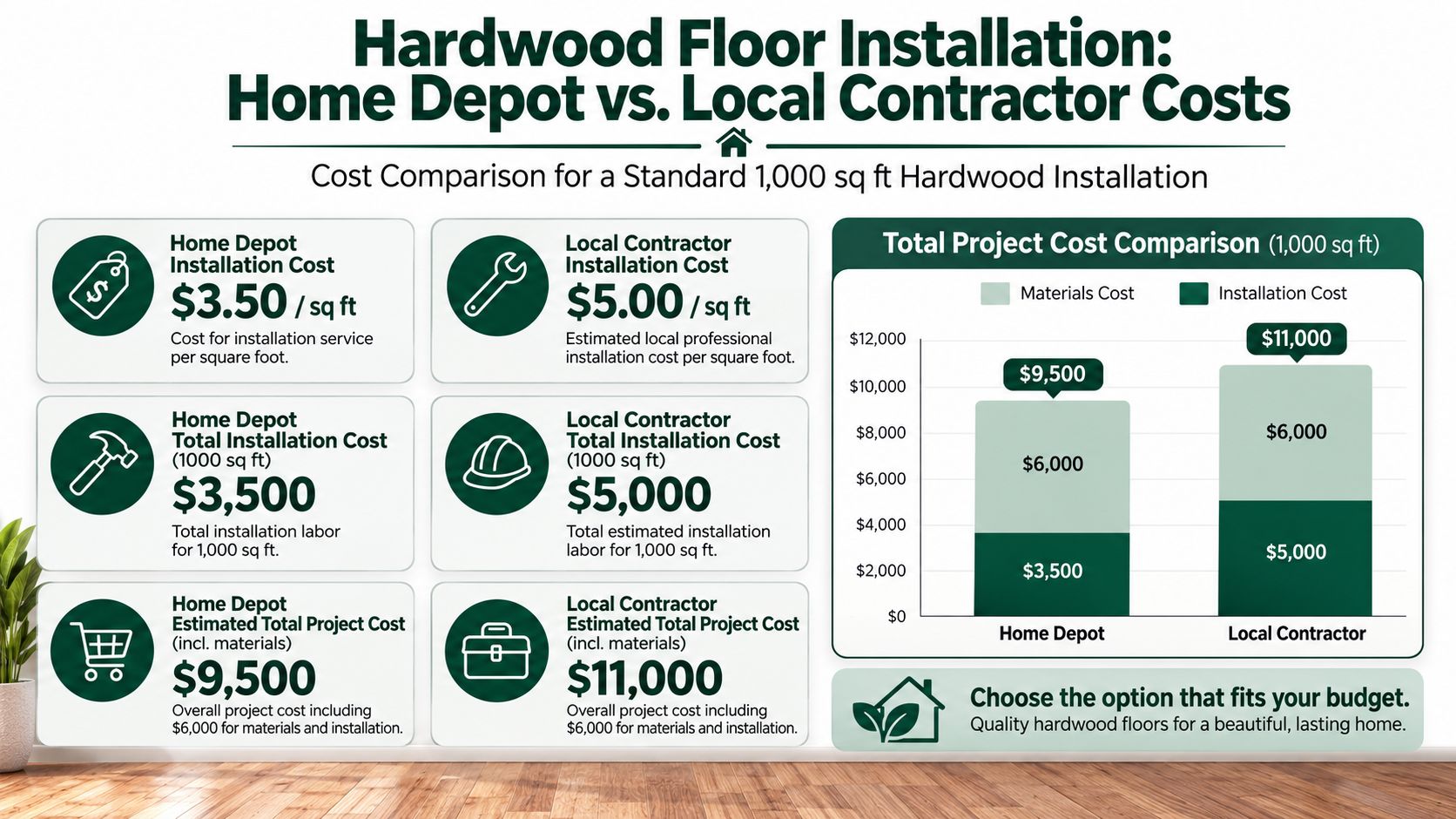
A Richmond homeowner can look at a retailer quote, see a clean per-square-foot number, and assume the comparison is finished. It rarely is. Hardwood installation costs turn on what the quote excludes, how the house handles moisture, and who owns the risk when site conditions change after materials arrive.
The baseline cost comparison
Home Depot often appeals to budget-focused shoppers because the labor benchmark is easy to understand. As noted earlier, the commonly cited average is about $3.50 per square foot, or roughly $3,500 for 1,000 square feet. That number is useful as a starting reference, but it does not answer the question Richmond homeowners need answered. What will the finished project cost once the installer sees the subfloor, moisture conditions, trim details, and transition points?
That is where value starts to separate from price.
| Cost question | Home Depot baseline | Local contractor reality |
|---|---|---|
| Labor benchmark | Broad average pricing reference | Usually quoted from site conditions and scope |
| Material shopping | Convenient retail purchasing | Contractor-supplied or owner-supplied, depending on the job |
| Scope customization | Depends on package details and change orders | Usually more specific to the job |
| Support after install | Split between retailer process and installer | Usually direct with the contractor |
| Ability to recommend partial repair or refinishing | Less central to the retail model | Often part of the inspection and quote |
Where value changes in real homes
A local bid can look higher because it often includes conditions a retailer-style estimate treats later as extras. That difference matters in older Richmond homes, where flatness issues, patched subfloors, and mixed-height adjoining floors are common.
The bigger point is diagnostic accuracy. If part of the floor can be kept and another section can be repaired, recoated, or refinished, full replacement may be the wrong purchase. For comparison, full hardwood floor refinishing in Richmond VA typically costs $3 to $8 per square foot, with 100 sq ft costing $300 to $800 and 1,000 sq ft costing $3,000 to $8,000, according to this Richmond refinishing cost guide. In some houses, the lower-cost decision is not the lower installation quote. It is the quote tied to the correct scope.
Homeowners comparing bids can use this guide to hardwood floor installation costs in Richmond to sort labor, prep work, and material-related charges before signing.
Hidden costs retailer guides often skip
Richmond adds two cost variables that generic flooring calculators tend to flatten out. The first is acclimatization risk. Wood brought from a warehouse into a house with high indoor humidity, recent HVAC changes, or a crawl-space moisture issue can move after installation if the moisture conditions were checked too loosely. The second is liability allocation. If the contract treats moisture, subfloor correction, furniture moving, or trim carpentry as exclusions, the low opening number can rise quickly once work starts.
These are the cost drivers that usually decide whether the “cheaper” quote stays cheaper:
- Subfloor leveling or stabilization when the existing floor is outside tolerance
- Moisture testing and mitigation for crawl spaces, slabs, or seasonally damp interiors
- Acclimatization delays if delivered wood is not ready for installation conditions
- Trim, shoe molding, and transitions around fireplaces, stairs, and adjacent rooms
- Occupied-home logistics such as furniture moving, phasing rooms, or return visits
- Responsibility for callbacks if boards gap, cup, or move after installation
One detail homeowners miss is who pays when site conditions interrupt the original plan. A direct local contractor relationship often makes that answer clearer because the same company inspected the house, wrote the scope, and handled the work. A retailer model can still work well, but homeowners should read the exclusions closely and ask who is responsible if moisture readings, delivery timing, or subfloor defects force a change.
Compare proposals line by line. In hardwood installation, the lower quote can carry the higher homeowner risk.
Installation Process and Timeline Comparison
The installation process tells you more about project quality than a showroom sample ever will. Hardwood success comes from sequencing. Materials, moisture, subfloor condition, layout, fastening method, and final spacing all need to line up.
What a technically sound install requires
For engineered click hardwood, industry standards require planks to run perpendicular to floor joists, call for a 3/8-inch underlayment in certain conditions, and require a 3/8-inch perimeter expansion gap to prevent buckling and deflection, according to these Home Depot Canada installation instructions reflecting NWFA-aligned guidance.
Those aren't cosmetic details. They affect whether the floor can move properly with seasonal change.
For solid hardwood, the technical sequence also gets more exacting. Home Depot's installation guidance specifies strips should run perpendicular to joists, use a 1/2 inch expansion gap at the starting wall, and follow fastening and layout procedures that reduce squeaks and movement, as described in Home Depot's hardwood installation guide.
How the workflows usually differ
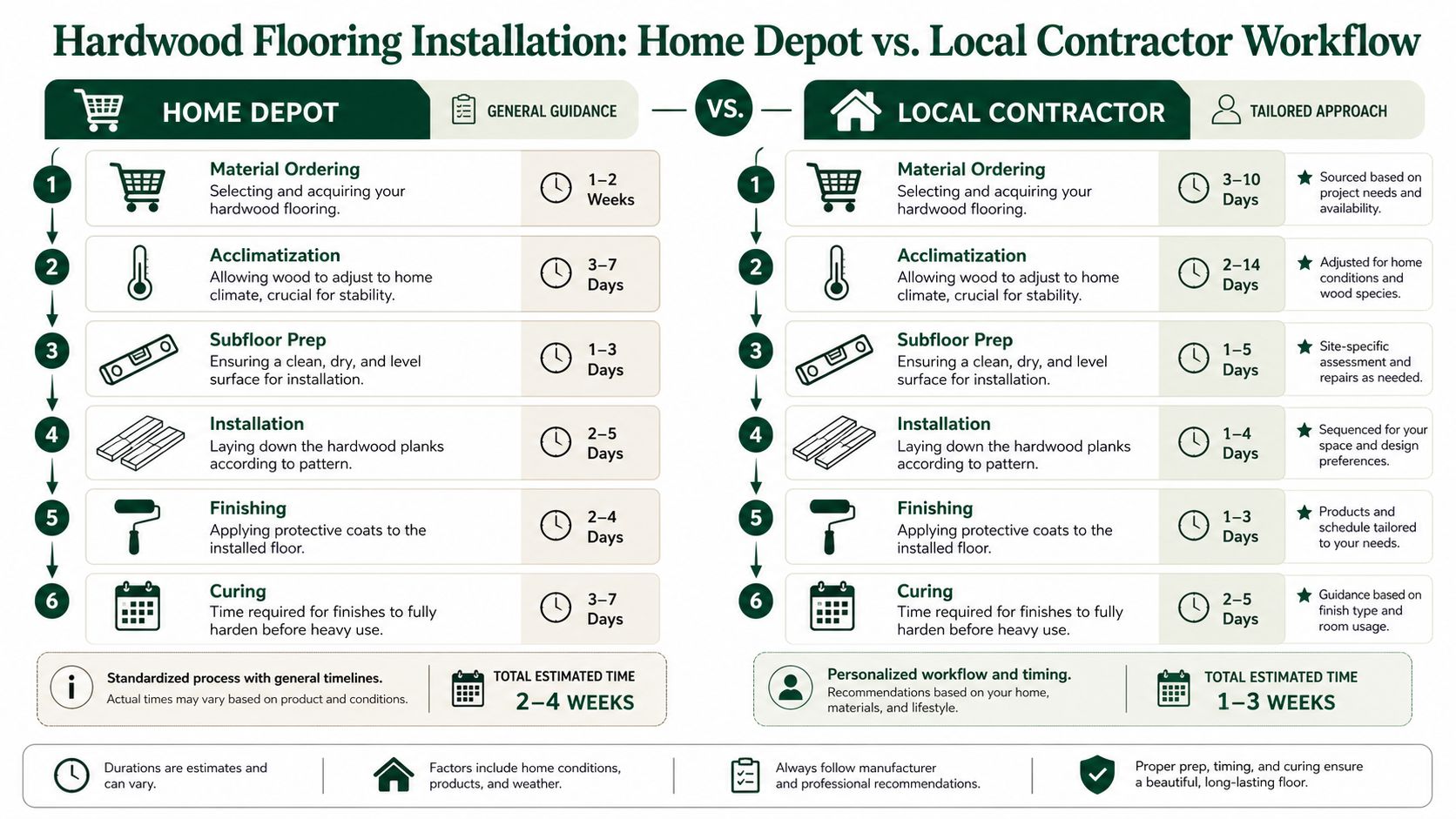
A retailer-led job can absolutely follow proper standards. The difference is that local contractors often spend more time adjusting the workflow to the house itself. In Richmond VA, that often means pausing for moisture stability, checking transitions more closely, and deciding whether old flooring below should stay, come out, or be isolated with the right underlayment.
Typical workflow differences look like this:
Material intake
Retail jobs often begin after product selection and scheduling lock in.
Local jobs often begin with a house-first site review before final product choice.Acclimatization planning
Retail guidance can feel generalized.
Local installers are more likely to tie acclimatization to the wood type and the room conditions.Subfloor prep
Both approaches should inspect and prep the subfloor.
The difference is often how much prep was anticipated before the crew arrived.Layout and installation
Retail jobs may follow a standard field process.
Local jobs often involve more discussion around direction changes, transitions, and room-by-room sequencing.Finishing and occupancy
Site-finished floors need curing awareness.
Pre-finished installs still require careful move-back timing and climate stability.
A more detailed walkthrough of field sequencing is in this article on the hardwood floor installation process.
If the installer can't explain layout direction, expansion space, and subfloor prep in plain language, the project isn't ready to start.
The timeline question homeowners should actually ask
Most homeowners ask, “How long does refinishing take?” or “How many days is installation?” Those are understandable questions, but they're incomplete. The better question is, “How many decision points could delay the job after materials arrive?”
That's where local reliability matters in Richmond VA. A project with fewer handoffs and clearer responsibility often feels faster even when the on-site labor time is similar, because fewer issues get stuck between departments.
Materials Quality and Warranty Comparison
Materials aren't just about species and color. They're about who stands behind the product, who stands behind the workmanship, and who pays attention when the two don't line up.
Retail sourcing versus project-specific selection
Home Depot gives homeowners broad access to solid and engineered wood lines, which is a real advantage if you want to compare styles quickly. The tradeoff is that product selection happens before anyone has fully evaluated whether that material is the smartest fit for your subfloor, moisture conditions, or room-to-room transitions.
A local contractor usually narrows choices after seeing the space. That can reduce mismatch between the product and the house, especially when the home has mixed elevations, older framing, or areas that may be better candidates for hardwood floor repair and refinishing instead of full replacement.
What warranty language often leaves out
Manufacturer warranties and installer warranties don't cover the same things. Homeowners should separate them clearly.
- Material warranty usually applies to the product itself under stated conditions
- Installation warranty applies to workmanship
- Moisture-related issues may fall outside coverage if site conditions weren't within requirements
- Normal wear often isn't treated the same as a finish defect
That creates a liability gap many homeowners don't see coming. If a board moves because humidity control was poor, the material maker may point to site conditions. The installer may point to product behavior. The homeowner gets stuck in the middle unless the site prep and climate discussion were documented well from the start.
Finish options and indoor comfort
For homeowners researching floor refinishing Richmond VA, finish selection matters almost as much as wood selection. Some local contractors offer VOC-free or low-odor finishes, dust-control methods, and room-by-room planning that help families stay in the house more comfortably during parts of the project.
That's especially relevant when the better decision isn't replacement at all, but hardwood floor scratch repair, recoating, or full sanding with a lower-dust process.
A warranty is only as useful as the paper trail behind the jobsite conditions.
If you're comparing proposals in Richmond VA, ask each company one direct question. “If there's a moisture-related problem later, who decides whether it was product, installation, or house conditions?” The answer tells you a lot.
Common Pitfalls and How to Avoid Them
The mistake many homeowners make is assuming hardwood projects fail because someone laid boards crooked. More often, the trouble starts before installation begins.
The acclimatization problem in Richmond
In humid climates such as Richmond VA, 31% of homeowners skip proper acclimatization, and 23% of DIY installations fail due to moisture-related gapping or crowning when guides conflate solid and engineered hardwood timelines, according to this article discussing Home Depot flooring guidance and acclimatization confusion.
That's one of the biggest hidden risks in hardwood floor installation Home Depot searches don't solve on their own. Homeowners read generic guidance, assume all wood behaves alike, and move too quickly.
Four avoidable mistakes
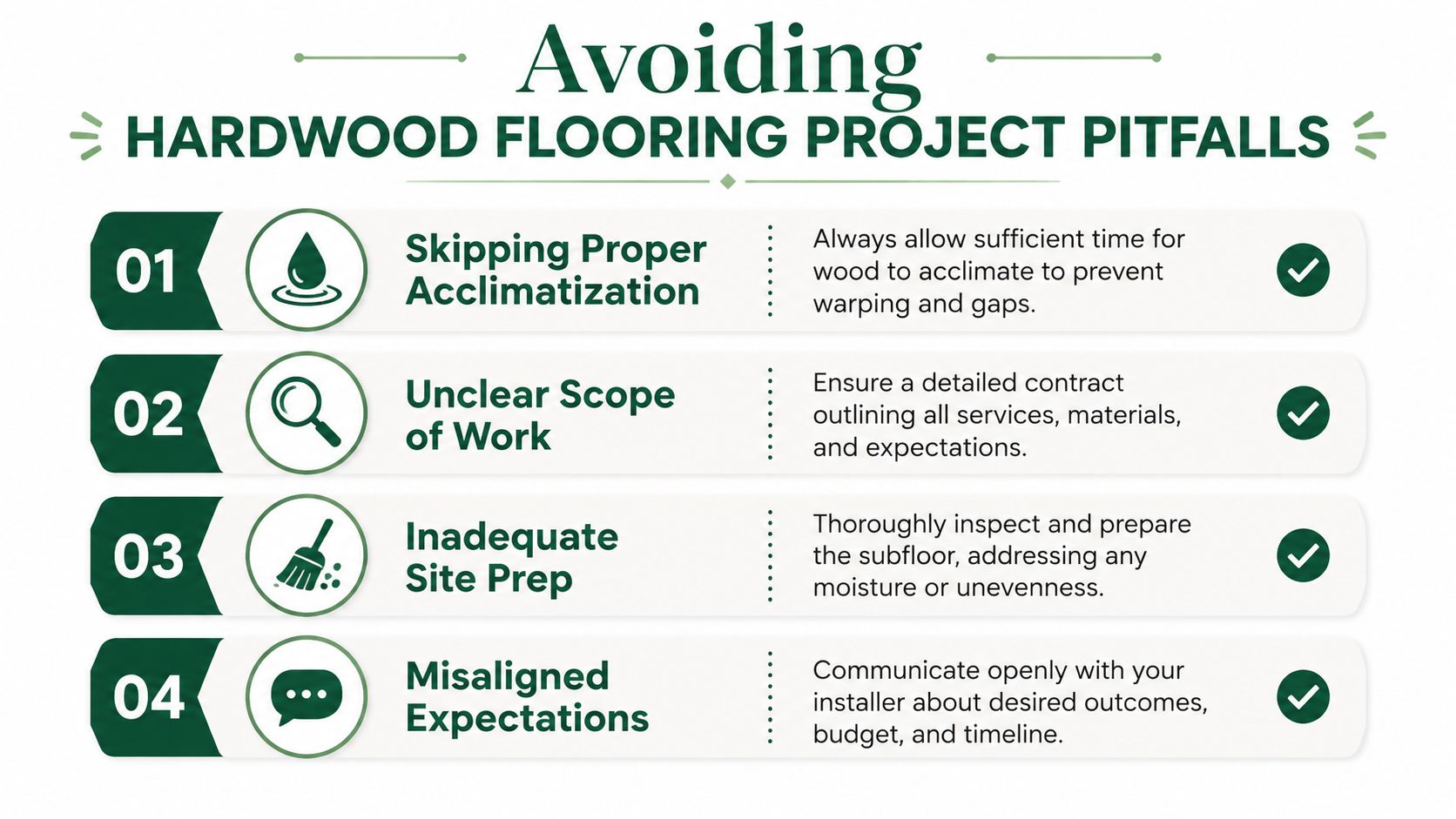
- Skipping climate prep. Solid and engineered floors don't behave the same way. Ask for the acclimatization plan in writing.
- Accepting a vague scope. If demo, trim removal, underlayment, moisture steps, or cleanup aren't listed, they may become disputes later.
- Overlooking site prep. A beautiful floor on a bad subfloor is still a bad project.
- Thinking the project ends at installation. Rugs, furniture return, and cleaning products affect the floor right away. Homeowners looking at choosing the best rugs for hardwoods can avoid scratching or trapping moisture after the install is finished.
Questions that prevent expensive surprises
Ask these before any contract is signed:
- What wood type am I buying, and how will you acclimate it in Richmond VA conditions?
- What happens if the subfloor isn't ready when the crew arrives?
- Who handles changes in scope, and how are they approved?
- What should I avoid placing on the new floor right after completion?
Those questions are simple. They also separate a routine sale from a well-managed flooring project.
Decision Checklist and Next Steps for Richmond
A good decision process is less about finding one perfect answer and more about ruling out bad fits. If you're comparing hardwood floor installation Home Depot against a local installer in Richmond VA, use a checklist that reflects the house, not just the ad.
Your decision checklist
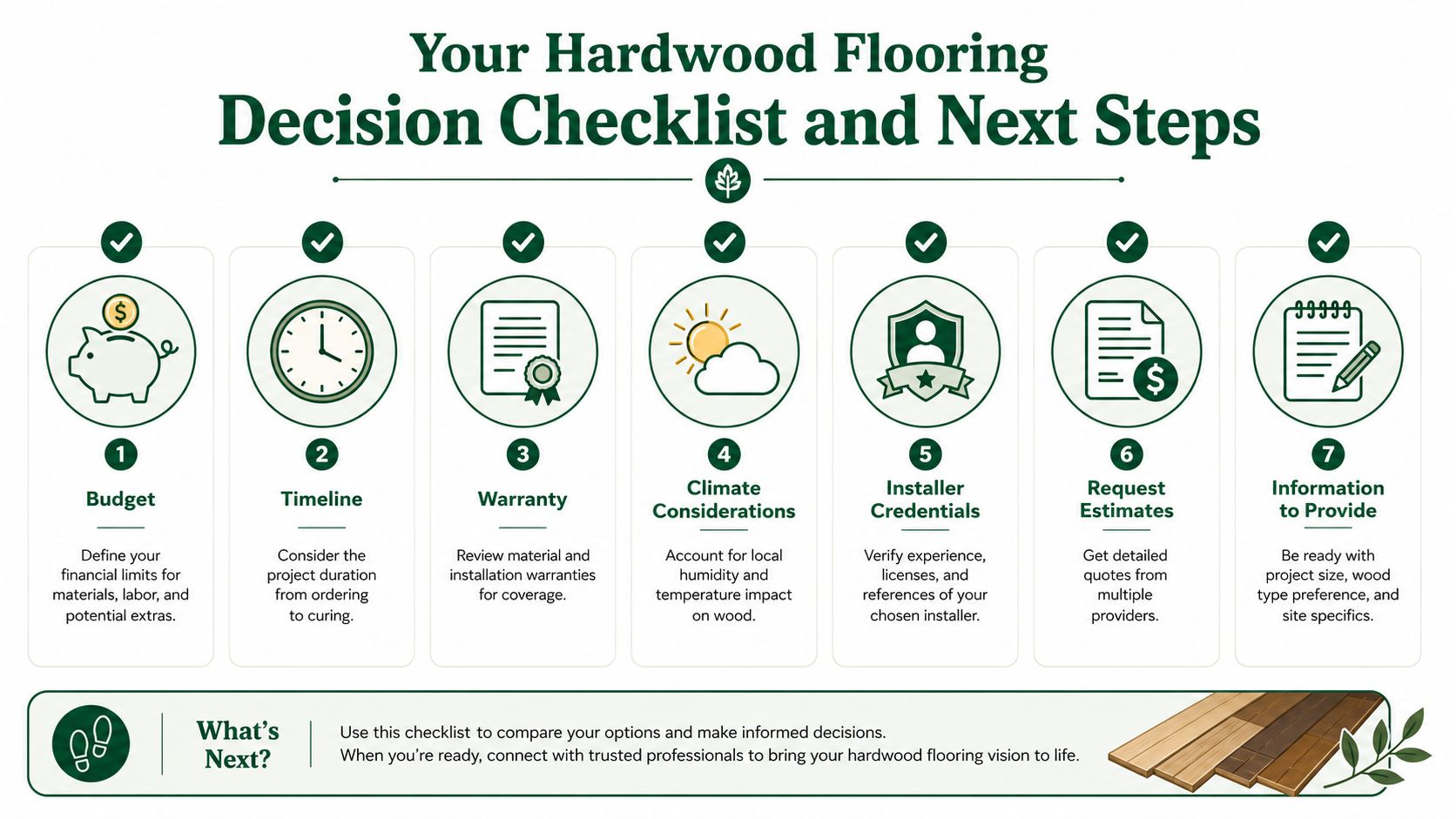
- Budget clarity. Decide whether you're comparing full replacement with full replacement, or whether refinishing and recoating should stay on the table.
- Timeline realism. Don't just ask how long the crew will be there. Ask what could delay the start or extend occupancy limits.
- Warranty logic. Separate product coverage from workmanship responsibility.
- Climate fit. In Richmond VA, moisture planning isn't optional.
- Installer credentials. Ask who will be in your home and who supervises the job.
- Scope detail. Compare prep, underlayment, trim, cleanup, and transition language line by line.
- Communication path. Know exactly who you call if something changes mid-project.
What to send when requesting estimates
You'll get better quotes if you provide useful information up front. Include room size, whether the home already has wood flooring, whether you're considering engineered hardwood refinishing or replacement, and any known issues like squeaks, pet damage, uneven spots, or moisture concerns.
If you want a local review of the project, this page on requesting a free floor estimate is a practical place to start.
For homeowners in Richmond, Midlothian, Chesterfield, Henrico, Glen Allen, Short Pump, Mechanicsville, and occasional projects in Charlottesville, Fredericksburg, and Virginia Beach, local scheduling and site review often make comparisons easier because the estimate can address your actual house conditions.
The right proposal should make the project feel clearer, not more confusing.
If you're unsure whether your hardwood floors need refinishing, Buff & Coat can take a look and give you honest recommendations. Call 804-392-1114 or request a free estimate today.
Why Richmond Homeowners Choose Buff & Coat
Richmond homeowners usually don't need a sales pitch. They need a flooring company that explains what the floor needs, does the work cleanly, and doesn't disappear when questions come up.
Buff & Coat Hardwood Floor Refinishing is a Richmond-based floor refinishing and installation company with 15+ years of experience. Services include dustless sanding, buffing and coating, hardwood floor installations, LVP/LVT installs, and repair work across Richmond, Midlothian, Chesterfield, Henrico, Glen Allen, Short Pump, Mechanicsville, and occasional jobs in Charlottesville, Fredericksburg, and Virginia Beach.
Why homeowners often choose a local, owner-operated company:
- 15 years in business
- Dustless sanding systems
- Local, owner-operated
- High-quality finishes
- Clear pricing and honest advice
- 5-star customer service
If you want a contractor who can compare replacement against refinishing, explain the refinishing timeline in plain language, and help you sort out refinishing cost versus installation cost in Richmond VA, local accountability matters. Richmond homeowners: get a fast quote for refinishing or recoating.
FAQ
Is hardwood floor installation through Home Depot cheaper than hiring a local contractor?
It can be cheaper at the baseline labor level. Home Depot's average hardwood installation price is $3.50 per square foot through its professional network, based on the earlier cited pricing source. But the better value depends on prep needs, moisture planning, scope detail, and post-job support.
Should I refinish old hardwood instead of replacing it?
Sometimes, yes. If the boards are structurally sound, refinishing or a buff and coat service may cost less and preserve the existing floor. That's why a site-specific inspection matters before you commit to replacement.
How long does refinishing take compared with installation?
The exact timing varies by floor condition, finish system, and project scope. For surface-level wear, a buff and coat can be a one-day renewal based on the service description cited earlier. Full refinishing or full installation usually involves more prep and recovery planning.
Is Richmond humidity really that big a deal for hardwood floors?
Yes. Richmond VA humidity affects wood movement, acclimatization, and long-term stability. That's why installation planning should address moisture and material type before work starts.
What should I ask before signing an installation contract?
Ask who installs the floor, what prep is included, how acclimatization will be handled, what happens if the subfloor needs more work, and who is responsible if product and site conditions conflict later.
Ready to restore your hardwood floors? Buff & Coat Hardwood Floor Refinishing makes the process fast, clean, and stress-free. Call 804-392-1114 or request your free estimate at buffandcoatvirginia.com.


