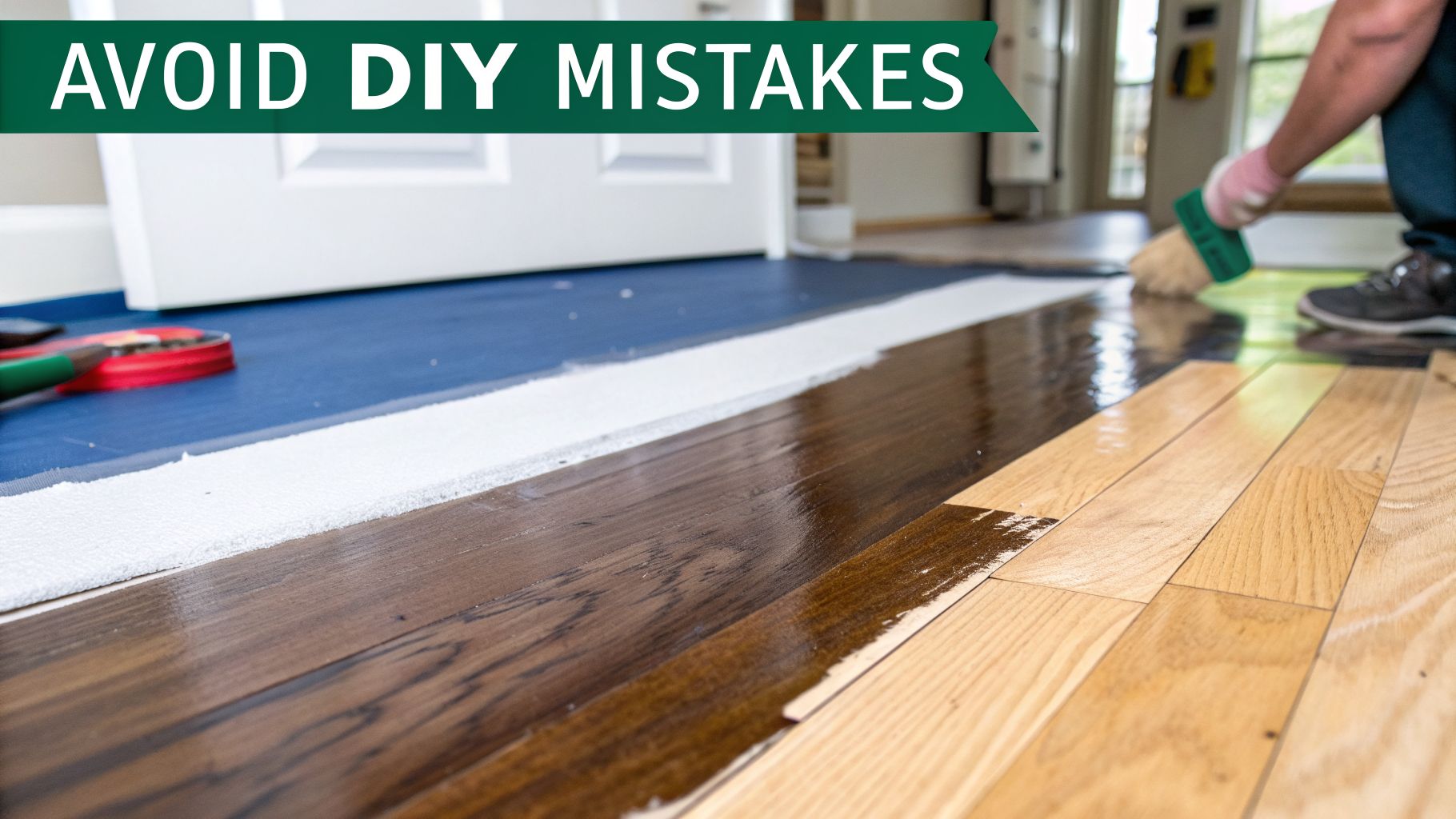
When considering Virginia flooring supply, you're probably already in the messy middle of a real project. You know you need flooring, but you're also trying to avoid the usual mistakes. Ordering the wrong amount, picking a material that doesn't fit your house, or finding out too late that the product you chose isn't available when your installer needs it.
For homeowners in Richmond VA, that supply side matters just as much as the installation. A good floor starts with clear planning, solid material choices, and a supplier who can support the job instead of slowing it down.
Start Here Assessing Your Project and Measuring Your Space
Most flooring problems start before anyone tears out a board or opens a box. They start with a rushed decision at home.
Before you visit a showroom or call around for Virginia flooring supply options, walk your house like a contractor would. Look at what you have now, how your family uses the space, and whether the existing floor should be refinished, repaired, or replaced.
Know whether you're restoring or starting over
If you already have hardwood, don't assume replacement is the only answer. In a lot of Richmond homes, especially older ones, the better move is hardwood floor refinishing, hardwood floor repair, or a buff and coat service instead of buying all new material.
A few signs usually point toward refinishing or recoating:
- Surface wear only. Light scratches, dull finish, traffic patterns, and minor scuffs often mean the wood itself is still in good shape.
- Localized damage. A few bad boards near a sink, pet bowl, or entry can sometimes be repaired without replacing the whole floor.
- Good existing wood. Older solid hardwood often deserves a second look before you cover it up.
Replacement starts making more sense when the floor has major movement, repeated water damage, soft spots, patchwork that won't blend, or a layout change that requires matching new material across several rooms.
Practical rule: If the issue is mostly in the finish, think refinishing. If the issue is in the structure of the floor or the layout of the house, think replacement.
Measure the right way
A lot of homeowners underestimate square footage by forgetting closets, alcoves, pantries, and transitions. Then the order comes up short, and the installer has to stop while everyone scrambles to track down matching material from the same run.
Use a simple process:
- Measure each room separately. Don't round up in your head. Write it down.
- Break odd-shaped rooms into rectangles. Measure each piece, then add them together.
- Include closets and short hallways if they'll get the same flooring.
- Note stair landings, thresholds, and direction changes because those details affect material use.
- Order extra material for cuts, waste, and future repairs.
If you want a cleaner measuring walkthrough, this guide on how to measure for hardwood flooring is worth keeping open while you sketch your rooms.

Match the product to the way you live
The right floor for a formal dining room isn't always the right floor for a kitchen with two dogs and kids running in from the yard. That's where homeowners get tripped up. They shop by color first and function second.
Think through these real-life questions:
- Do you have pets that slide, scratch, or spill water around bowls?
- Do you want repairability later, or are you fine with full replacement if a section gets damaged?
- Is this a forever-home decision or a practical update before selling?
- Will furniture stay put, or do you rearrange often? If you do, it's smart to review practical advice on preventing furniture scratches on floors before you settle on a finish or wear layer.
Homeowners in Richmond VA often do better when they slow this part down. The planning stage feels less exciting than picking samples, but it's what keeps the project from turning expensive and frustrating.
If you're not sure whether your floor needs refinishing, repair, or full replacement, Buff & Coat can take a look and give you honest recommendations.
How to Find Reputable Virginia Flooring Suppliers
Not every Virginia flooring supply business plays the same role. Some are retail showrooms built for homeowners. Some are contractor-focused distributors. Some do a little of both.
The mistake is treating all suppliers as interchangeable. They aren't.
Understand the three main supplier types
Big-box retailers are convenient. You can walk in, see a lot of options, and often leave with a basic idea of style and price range. The trade-off is that product knowledge varies, and you're usually buying from a broader retail system rather than a flooring-focused operation.
Independent showrooms tend to be better for homeowners who want guidance. You can compare finishes, widths, and textures in person, and the staff usually understands how products fit different homes and use cases.
Wholesale distributors are where many installers source material and accessories. Some sell only to trade professionals. Some will work with homeowners directly or through a contractor. If you're using an installer, this category matters because the installer may already know which distributors are dependable.
Look at how the Virginia market is structured
Virginia's flooring supply market isn't built around one single statewide center. Regional coverage matters.
For example, Southern Hardwood & Floor operates at least two Virginia locations, one in Richmond and one in Charlottesville, which shows how central Virginia supply and service are often organized around major population centers rather than one hub for the whole state, according to Southern Hardwood & Floor's location information.
That regional setup matters if you're in Richmond VA and trying to coordinate delivery, replacement boards, or last-minute trim. A supplier with nearby coverage can make a project smoother than one with a great showroom but weak logistics.
Another useful example is Virginia Tile Company. It was founded in 1928 by the Stephenson family and grew from a wholesale building supply business into a distributor of porcelain, ceramic, stone, glass, metal, and mosaic design solutions, with resilient flooring and woodworking products in select regions, according to Virginia Tile Company's company history. For a homeowner, the lesson is simple. Established supply businesses often expand because customers eventually want more than one material category under one roof.
A supplier isn't just selling boards. They're selling consistency, product knowledge, and fewer surprises when the job starts.
Questions worth asking before you buy
When I size up a supplier for a homeowner project, I care less about the sales pitch and more about these answers:
- What's in stock locally versus special order?
- Can I get matching trim and transitions from the same source?
- What's the return policy on unopened cartons?
- How are damaged boxes handled if they arrive chipped or crushed?
- Do they regularly work with installers who know the product?
A homeowner doesn't need to know every trade detail, but you do need enough information to avoid a bad handoff. If you want a Richmond-focused companion piece, this guide to hardwood floor supply in Richmond is a useful next read.
If you're gathering quotes for floor installation in Richmond, bring your supplier options into that conversation early. It saves time and usually leads to better decisions.
Choosing Your Materials Hardwood LVP and More
Material selection is where style and reality finally meet. This is also where many homeowners in Richmond VA get pulled in two directions. They want the look of real wood, the practicality of something tougher, and a budget that still leaves room for trim, prep, and labor.
No single floor wins every category. The right choice depends on your house, your tolerance for maintenance, and whether you value repairability over short-term convenience.
Solid hardwood
Solid hardwood still sets the bar for long-term character. It looks right in older Richmond homes, fits well with traditional millwork, and gives you the option of wood floor recoating or full hardwood floor refinishing later instead of replacing the whole floor.
That said, it asks more from the house and the homeowner. Wood moves with seasonal conditions, and it can show dents and scratches more easily than synthetic products. In high-traffic family spaces, that trade-off needs to be accepted upfront.
Engineered hardwood
Engineered hardwood is often the middle path. You still get real wood on top, but the construction is built for better dimensional stability than traditional solid planks in a lot of settings.
For many homes in Richmond VA, especially where humidity swings are part of the conversation, engineered wood makes practical sense. It can fit basements, slab areas, and mixed-condition spaces better than some homeowners expect. The catch is that not every engineered product has the same wear layer or long-term refinishing potential, so the label alone doesn't tell the full story.
LVP and LVT
Luxury Vinyl Plank and Luxury Vinyl Tile have earned their place. They handle busy households well, clean up easily, and give homeowners a broad style range without the maintenance demands of wood.
This is one area where a professional installer also watches the prep very closely. Virginia Flooring Supply's technical guidance for installing vinyl, LVT, and laminate includes verifying pH between 6.5 and 8.0, moisture content below 4.5%, and using vapor retarders where soil moisture exceeds 3.0%, with adhesive failures in commercial installs tied in part to substrate mistakes. Their guidance also notes an adhesion benchmark of 92% when substrate treatment follows manufacturer specs, according to the neutral expert data provided in the brief. For a homeowner, the practical takeaway is simpler. LVP is forgiving in daily life, but it still punishes poor prep.
Cheap-looking LVP usually isn't the fault of LVP. It's often the result of rushed subfloor prep, weak layout planning, or mixing a decent product with bad installation habits.
A lot of homeowners also ask about peel-and-stick products for small rooms or temporary updates. If you're comparing lighter-duty options for a utility space or quick cosmetic change, this ultimate peel and stick flooring guide gives a helpful overview of where those products fit and where they don't.
Here's a quick side-by-side view.
| Feature | Solid Hardwood | Engineered Hardwood | Luxury Vinyl Plank (LVP) |
|---|---|---|---|
| Appearance | Natural wood throughout | Real wood surface | Wood-look visual layer |
| Refinishing potential | Usually the strongest option | Depends on wear layer | Not refinishable |
| Moisture tolerance | Lower | Better than solid in many settings | Strong practical choice for spill-prone areas |
| Repair approach | Board replacement or refinishing | Board replacement, sometimes limited refinishing | Plank replacement |
| Best fit | Main living areas, classic homes | Whole-home updates, mixed conditions | Busy households, kitchens, lower-level spaces |
Some homeowners like seeing installation visuals before they decide. This short video is a good starting point.
What I usually tell Richmond homeowners
If you want a floor that can age with the house, hardwood is hard to beat. If you want a real-wood look with more flexibility, engineered hardwood often lands in the sweet spot. If your top priorities are durability, simpler maintenance, and fewer worries around spills, LVP belongs in the conversation.
For homeowners comparing resilient products more closely, Buff & Coat also installs LVP flooring, which can help when you're weighing appearance against day-to-day wear.
Budgeting Samples and Making the Final Decision
The final decision usually falls apart in one of two ways. Either the homeowner focuses only on the flooring price and forgets the surrounding costs, or they fall in love with a sample that looked one way in the store and completely different at home.
Both are avoidable.
Build the budget around the full job
A flooring budget needs to include more than the material itself. The quote should reflect what it takes to finish the room properly.
That often means accounting for:
- Trim and transitions that match the floor height and doorway conditions
- Underlayment or moisture control layers where the product requires them
- Delivery and staging if the material isn't being picked up locally
- Subfloor prep such as leveling, patching, or moisture-related correction
- Furniture moving and disposal if old flooring has to come out first
If you're planning around rental turnover or a property update, this guide to the best flooring for rental properties is a useful outside perspective because it frames the decision around wear, replacement, and upkeep instead of just showroom appeal.
Take samples home and test them honestly
A flooring sample under store lights doesn't tell you much about how it'll look in your own house. Richmond homes can have warm paint, old trim, shaded porches, or strong afternoon sun that changes a color completely.
Set the sample in three places if you can:
- Near a window with daylight
- Under your evening lighting
- Next to cabinets, trim, or brick features that aren't changing
Then leave it there for a couple of days. Quick decisions tend to favor dramatic color. Lived-in decisions usually favor something more balanced.

Confirm availability before you commit
This is the question too many homeowners ask too late. Is it in stock, and can it get to the jobsite when the installer needs it?
Public information for Virginia Flooring Supply points to a Manassas wholesale distributor with listed business hours, but public content often doesn't explain inventory depth, lead times, or delivery radius, which leaves a real gap for buyers trying to secure same-week, jobsite-ready materials, as noted on the Virginia Flooring Supply website. That's not a criticism of one business. It's a reminder that many supply listings answer "where" without answering "how fast."
Don't treat "available" and "available for your install date" as the same thing. They often aren't.
Ask the supplier these questions in plain terms:
- Is this color and width physically in stock now?
- How many cartons are available today?
- If something arrives damaged, how quickly can you replace it?
- Can matching trim ship with the main order?
- Will delivery go to the house, garage, or installer's location?
If you're unsure whether your chosen material fits your budget and install plan, call 804-392-1114 or request a free estimate. A job makes a lot more sense once the product, prep, and labor are looked at together.
Coordinating the Supply Drop with Your Floor Installer
The material order isn't the finish line. It's the handoff point.
A homeowner can pick a good product from a respectable Virginia flooring supply source and still end up with problems if the delivery shows up damaged, the wrong cartons get mixed in, or the material is installed before the home conditions are right.
What a professional checks before installation starts
An installer should verify the shipment before the first plank goes down. That includes checking product labels, color, run consistency, trim pieces, and visible damage.
Then the installer needs to evaluate the house itself. Technical specifications for engineered hardwood and LVT installation require subfloor flatness within 3mm over 10ft and humidity control at 45 to 55%, and those conditions are tied to 32% of gapping and buckling issues in commercial flooring when overlooked, according to the neutral expert data in the brief. That's why a professional's verification process matters so much.

Why homeowners shouldn't rush this part
Acclimation, staging, and inspection aren't delays. They're quality control.
If a floor is installed over a subfloor that's out of tolerance, or if the material hasn't adjusted to indoor conditions, the homeowner usually doesn't see the problem on day one. It shows up later as movement, noise, separation, or edge issues. By then, the room is full of furniture and nobody wants to hear that the problem started before installation ever began.
A careful installer acts as the last filter between a boxed product and a finished floor. That's a big part of protecting your investment in floor installation in Richmond.
Frequently Asked Questions About Flooring Supply
Can I buy flooring myself and then hire an installer?
Yes, but it works best when the installer is involved before you place the order. That helps avoid problems with product type, trim compatibility, layout concerns, and missing accessories.
Is local Virginia flooring supply always better than ordering online?
Not always. Online buying can work for simple projects. Local or regional supply tends to be stronger when you need samples fast, replacement cartons, matching trim, or real answers about delivery timing.
Should I refinish hardwood or replace it with LVP?
That depends on the condition of the wood, your lifestyle, and your goals. If the existing hardwood is structurally sound, hardwood floor refinishing in Richmond VA can be a better long-term move than covering it. If moisture, pets, or heavy wear are bigger concerns, LVP may be the more practical fit.
How do I know if engineered hardwood is a good choice for my house?
Look at where it's going, what the subfloor is, and how stable your indoor conditions are. Engineered wood often makes sense when you want a real wood surface with more flexibility than solid hardwood.
What's the biggest mistake homeowners make when sourcing flooring?
They choose the product before confirming the full picture. That means quantity, trim, delivery plan, subfloor condition, and installation requirements all need to line up before anyone schedules the job.
Do I need to keep leftover flooring?
Yes. If you have the space, keep clearly labeled extra material for future repairs. It can save a lot of frustration if a board gets damaged later and the original product is no longer easy to match.
Ready to restore your hardwood floors? Buff & Coat Hardwood Floor Refinishing makes the process fast, clean, and stress-free. Richmond homeowners choose them for practical guidance, dustless sanding systems, clear pricing, and honest recommendations built on years of local flooring work. Call 804-392-1114 or request your free estimate today.