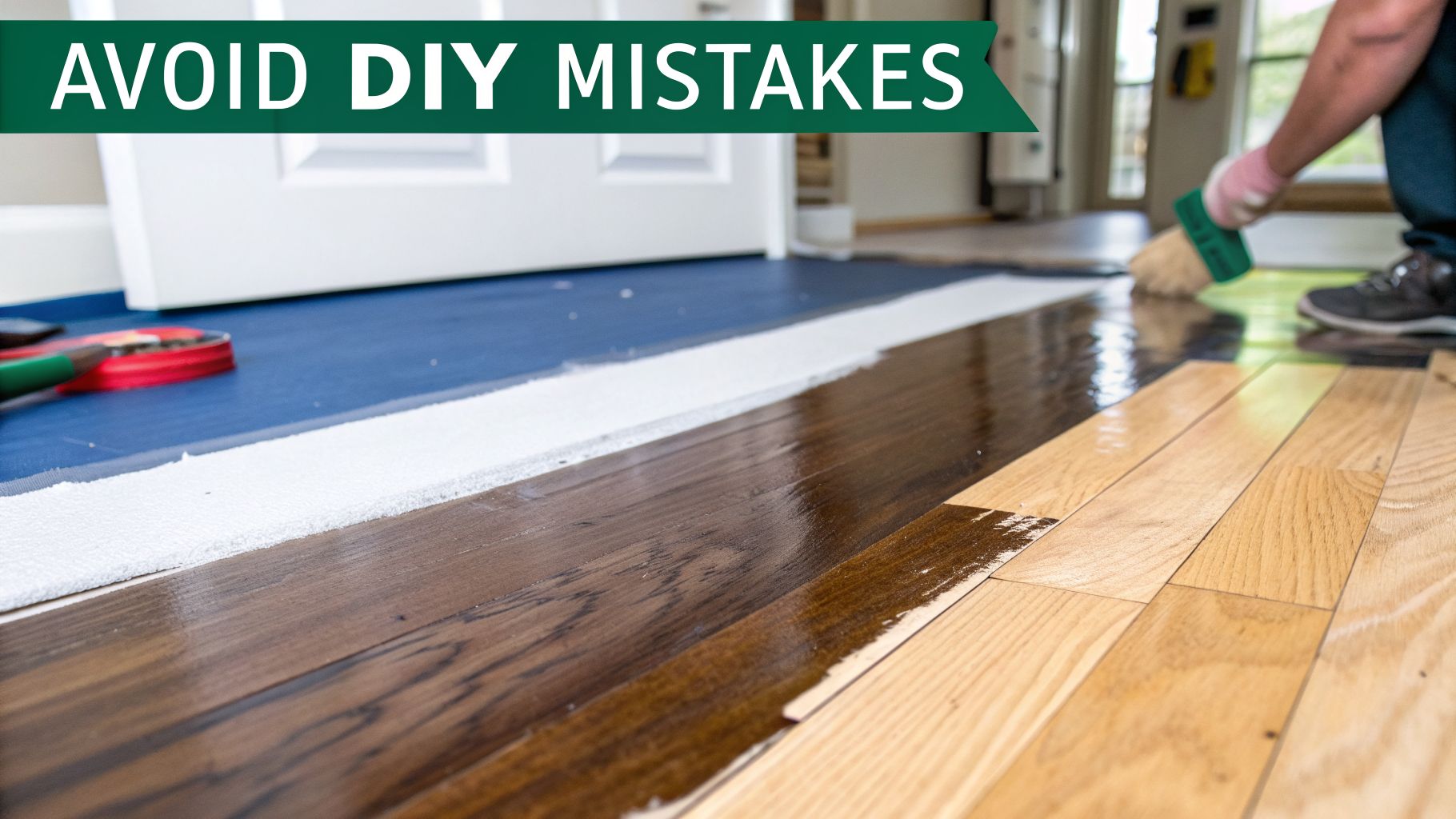
Richmond homeowners usually reach the hard part of an LVT project after they’ve already picked the color, plank width, and finish. The product looks great in the sample box. The risk starts when you hire the wrong crew to put it in.
Good lvt flooring installers don’t just click planks together. They evaluate the whole floor system, especially the subfloor, moisture conditions, room transitions, and how the material will behave once it lives in a Richmond house through humid summers and dry winter heat.
Your Guide to Hiring LVT Flooring Installers in Richmond
If you’re in Richmond VA, Midlothian, Chesterfield, or Henrico, you’ve probably noticed how many flooring companies say they install LVT. That doesn’t tell you much. Some are careful mechanics. Some are product sellers with an install crew. Some are handymen taking on flooring because the material looks simple.
That difference matters because LVT rewards precision and punishes shortcuts. A floor can look fine on day one and still fail early if the prep work was rushed. The average homeowner won’t spot that during an estimate unless they know what questions to ask.
A smart hiring process starts with work history, but it shouldn’t end there. Look for installers who can talk clearly about transitions, flatness, moisture, and the difference between floating and glue-down systems. If a contractor’s online presence feels polished, that can help, but marketing alone doesn’t prove field quality. If you’re curious how strong contractors build visibility online, the broader world of home services digital marketing is useful background, especially for understanding why some companies show up everywhere in search.
For homeowners comparing products, it also helps to understand the overlap between plank and tile-style vinyl systems. This guide to LVP flooring gives good context if you’re still narrowing down what fits your home best.
A clean estimate is nice. A detailed explanation of prep is better.
Why Professional LVT Installation Is a Non-Negotiable Investment
Luxury vinyl has become a major category for a reason. Resilient flooring, led by LVT, generated $9.522 billion in U.S. sales in 2022, surpassing carpet for the first time, and residential LVT accounted for $6.585 billion of that total, according to Floor Covering News industry reporting. Big demand is good news for homeowners because there are more products and styles than ever. It also means more people are offering installation, not all with the same level of skill.

What goes wrong with a bad install
Most failed LVT jobs don’t fail because the homeowner picked the wrong color. They fail because somebody skipped steps that aren’t visible once the furniture goes back in.
Common problems include:
- Seam gaps: Planks separate because the floor moved, the subfloor wasn’t flat enough, or the locking joints were stressed during installation.
- Lifting edges: This often shows up near walls, doorways, or sun-exposed sections where movement wasn’t planned for properly.
- Buckling or peaking: The floor has nowhere to move, so pressure forces it upward.
- Telegraphing: Imperfections underneath print through the finished floor and become visible over time.
- Warranty trouble: Manufacturers usually expect the installer to follow preparation and installation requirements. If those basics were ignored, the claim can get messy fast.
What a professional crew actually protects
A professional installation protects more than appearance. It protects the money you spent on material, trim work, furniture moving, and downtime in the room. It also protects the finish details most homeowners care about after the job is done, like quiet foot traffic, smooth transitions, tight cuts at jambs, and a floor that still looks right months later.
In Richmond VA, that matters because homes vary a lot. A newer slab in Short Pump presents different challenges than an older wood-framed floor in the Fan or a settled subfloor in Midlothian. The installer has to read the house correctly before they ever open a box of flooring.
Practical rule: If an installer talks mostly about laying planks and barely mentions prep, keep looking.
If you’re comparing options for floor installation in Richmond, ask for an estimate that breaks out prep, not one that hides everything inside a single vague line item. If your project needs a second set of eyes, Buff & Coat Hardwood Floor Refinishing can review the job and give you a straight answer on what the floor needs before installation starts. Call 804-392-1114 or request a free estimate.
How to Find and Vet LVT Installers in the Richmond Area
The U.S. flooring installers industry reached $33.8 billion in 2025 with about 110,000 businesses, according to IBISWorld’s flooring installers industry data. That tells you two things. First, flooring is a serious trade. Second, there’s a huge range in quality.
In Richmond VA, that means you need a filtering process, not just a few phone calls.
What to look for before you contact anyone
Start with signs of real trade experience, not just polished branding.
- Project photos that show details: Look for transitions, stair noses, doorway cuts, and room edges. Wide room shots are fine, but close detail shots tell you more.
- Reviews that mention process: The useful reviews talk about prep, communication, dust control, punctuality, and whether the finished floor stayed solid.
- Consistency across service areas: If a company says it works in Richmond VA, Midlothian, Chesterfield, and Glen Allen, you want proof they’ve worked in homes like yours.
- Education in their content: Contractors who explain process usually understand it better. If you want to see how good companies use search visibility to educate local homeowners, this guide to local SEO for contractors gives useful perspective.
A helpful local reference point is this article on choosing a flooring contractor in Richmond, which outlines what homeowners should ask before signing a proposal.
Essential Questions to Ask Your LVT Flooring Installer
| Category | Question to Ask | Why It Matters |
|---|---|---|
| Experience | What kinds of LVT systems do you install most often? | Some installers are comfortable with click-lock only, while others are stronger with glue-down work and more demanding prep. |
| Experience | Have you installed over both wood subfloors and concrete slabs? | The prep process changes depending on the substrate. |
| Process | How do you check the subfloor before quoting the job? | A serious installer doesn’t guess from photos alone. |
| Process | What do you do if you find dips, high spots, cracks, or movement? | You want a clear plan, not vague reassurance. |
| Process | Do you moisture test concrete or suspect subfloors before installing? | Moisture problems can ruin an otherwise good installation. |
| Materials | Do you follow the product’s acclimation and installation requirements? | Manufacturer instructions affect performance and warranty support. |
| Layout | How do you handle transitions, door jambs, and room direction? | The floor needs to look intentional, not patched together. |
| Pricing | Does your estimate separate installation from prep and trim work? | Clear pricing helps you compare bids honestly. |
| Warranty | What part of the installation do you stand behind? | You want accountability if workmanship causes a problem. |
| Logistics | Who is actually doing the work in my home? | Some companies sell the job and subcontract everything. |
Red flags homeowners in Richmond VA should take seriously
Low bids aren’t always a bargain. Sometimes they’re just missing the expensive part of the job, which is prep.
Watch for these warning signs:
- No questions about the existing floor
- No mention of moisture, flatness, or acclimation
- Pressure to book immediately
- A quote given without seeing the space
- Dismissive answers like “underlayment will take care of it”
- No explanation of how trim, appliances, or transitions will be handled
The best installers usually sound calm, specific, and a little picky. That’s a good sign.
If you’re hiring for floor installation in Richmond or nearby, don’t ask only whether they can install LVT. Ask how they prevent failure.
The Unseen Foundation The Critical Role of Subfloor Preparation
The part of an LVT job most homeowners never see is usually the part that determines whether the floor lasts. Not the carton. Not the wear layer brochure. The subfloor.

Why prep matters more than most people realize
LVT is thin enough to reflect what’s underneath it. If the floor below has dips, ridges, cracks, movement, or leftover adhesive buildup, the finished surface can show it sooner or later. Click systems may flex. Glue-down products may lose bond or show imperfections. Either way, the problem usually starts below the plank.
Subfloor prep starts with identifying the substrate. Wood and concrete behave differently. So do older patched floors, existing hardwood, and rooms with multiple transitions. A qualified installer checks the surface, maps problem areas, and decides whether the job needs sanding, patching, skim coating, leveling compound, moisture work, or a combination.
According to this pre-installation checklist for LVT flooring, proper LVT installation requires a mandatory 48-hour acclimation period on-site, and failure to acclimate is a leading cause of post-installation buckling and gapping, as well as a significant source of warranty claims. That matters in Richmond VA because houses can swing through humidity and temperature changes fast, especially during shoulder seasons when HVAC use is inconsistent.
What careful installers check before day one
A good installer should be doing more than sweeping.
- Flatness: They use long levels or straightedges to find low spots and high spots.
- Moisture conditions: On concrete, moisture testing matters before adhesive or flooring goes down.
- Surface integrity: Loose patches, flaking material, or old residues can compromise the install.
- Movement: On wood subfloors, squeaks and flex need attention before the finish floor is installed.
- Adhesive planning: For glue-down work, spread rate and coverage have to be right. Too little or inconsistent application creates trouble later.
If the subfloor is wrong, the finished floor is borrowing time.
This visual gives homeowners a good sense of how installers inspect and think through the base before they start cutting material.
The Richmond angle homeowners shouldn’t overlook
In Richmond VA, older houses often have settled framing, patched underlayments, or transitions that were built around older flooring heights. Newer homes can still have slab moisture issues or builder-grade surfaces that are flatter in some rooms than others. That’s why one room can be simple and the next one turns into a prep-heavy install.
What works is straightforward, even if it isn’t glamorous:
- Test first
- Level what needs leveling
- Let the product acclimate
- Use the right installation method for the room
- Don’t rush the prep to save a day
If you’re evaluating lvt flooring installers in Richmond VA, ask them to describe prep in plain English. The good ones can.
LVT Installation Methods and How to Avoid Common Pitfalls
Not every LVT floor goes in the same way. The two methods most homeowners hear about are floating click-lock and glue-down. Both can perform well. Neither one forgives lazy prep.

Floating and glue-down are not interchangeable
Floating click-lock systems are common in residential work because installation is cleaner and often faster. They can be a good fit for many bedrooms, living spaces, and renovation projects where minimizing disruption matters.
Glue-down LVT asks more of the installer and the subfloor, but it offers a more anchored feel and can be the better choice in spaces that need added stability.
Here’s the practical comparison:
Floating click-lock
- Better when the project calls for speed and flexibility
- More sensitive to subfloor irregularities than many homeowners realize
- Depends heavily on sound locking joints and proper expansion planning
Glue-down
- Better when permanence and stability matter most
- Demands tighter prep and correct adhesive use
- Usually leaves less room for installer error because every prep mistake can print through
The DIY mistakes that show up later
A lot of bad LVT jobs don’t look bad until furniture comes back in and the room starts living like a real room. The most common mistakes are usually avoidable.
According to Timeless Designs installation guidance referenced in the verified material, roughly 25-30% of DIY LVT installation failures stem from undetected subfloor dips over 1/8 inch in 10 feet. That lines up with what installers see in the field. Homeowners often assume underlayment can hide those issues. It usually can’t.
Other pitfalls include:
- No expansion gap at walls and fixed objects
- Poor seam staggering that creates visible pattern repetition
- Cuts that are too tight at jambs or cabinets
- Installing over a dirty or unstable surface
- Using underlayment as a cure for structural or flatness problems
A clean click-lock seam doesn’t prove the floor is ready. It only proves the last plank clicked in.
Which method is better for your home
That answer depends on the room, subfloor, and how permanent you want the floor to be. In Richmond VA homes, floating systems often make sense in standard residential layouts. Glue-down can make more sense where the floor needs a firmer feel or where product specs call for it.
The mistake is choosing the method first and asking questions second. The better approach is to inspect the room first, then match the method to the conditions.
LVT Installation Costs and Timelines in the Richmond Market
Homeowners in Richmond VA usually want one simple number. Real estimates don’t work that way, because the visible floor is only one part of the job.
Verified pricing guidance in the provided source puts LVT at $3-7 per square foot installed, while noting that lifespan can fall from 20-30 years to 10-15 years on imperfect subfloors. The same source notes that hardwood renewal can extend a floor’s life by 25+ years, which is why some homeowners should compare installation against restoration before replacing a wood floor outright, as discussed in this flooring installation cost guide.
What your estimate is really paying for
A professional LVT quote in Richmond VA may include several layers of work:
- Removal of existing flooring
- Subfloor prep, which may involve patching, leveling, sanding, or moisture-related steps
- Material handling and layout
- Installation labor
- Trim, quarter round, reducers, or transitions
- Cuts around door jambs, cabinets, and obstacles
- Cleanup and final walkthrough
The reason one quote is much lower than another is often simple. One contractor priced only the visible installation. The other priced the conditions required for the floor to last.
What affects the timeline
A straightforward room can move quickly. A room with repairs, slab concerns, multiple transitions, or furniture coordination takes longer. The timeline is often driven less by plank installation and more by what has to happen before the first row starts.
A realistic schedule often depends on:
- How much prep the subfloor needs
- Whether old flooring has to come out
- Whether the product needs to acclimate on-site
- How many cuts and transitions the room layout creates
- Whether trim or molding work is part of the scope
LVT versus renewing hardwood
Homeowners in Richmond VA can avoid making an incorrect project choice. If you already have hardwood underfoot, replacement isn’t always the best value. Sometimes a buff and coat service, wood floor recoating, or full hardwood floor refinishing gives you more long-term value than covering the floor up.
LVT can be a smart option when the existing surface is beyond practical repair, the room needs a different performance profile, or the project budget favors vinyl. Hardwood renewal can be the smarter route when the wood is structurally sound and worth preserving.
If you’re deciding between new vinyl and restoring existing wood, Buff & Coat Hardwood Floor Refinishing can give you an honest comparison based on the actual condition of the floor. For homeowners researching floor refinishing Richmond VA, hardwood floor repair, or floor installation Richmond, that kind of side-by-side guidance is often what prevents an expensive mistake. Call 804-392-1114 or request a free estimate.
Why Richmond Homeowners Choose Buff & Coat
Homeowners in Richmond VA, Glen Allen, Midlothian, and Short Pump usually want the same thing from a flooring company. Clear answers, careful workmanship, and no surprises once the job starts.

Buff & Coat stands out because the company works from the floor up, not just from the product box down.
- 15 years in business
- Dustless sanding systems
- Local, owner-operated
- High-quality finishes
- Clear pricing and honest advice
- 5-star customer service
That matters whether you need LVT installation, hardwood floor restoration, engineered hardwood refinishing, scratch repair, or a practical answer on whether your floor should be renewed instead of replaced. Homeowners looking for the best hardwood floor contractor Richmond usually aren’t looking for the flashiest pitch. They want a crew that understands prep, communicates clearly, and respects the house.
Frequently Asked Questions about LVT Installation
| Question | Answer |
|---|---|
| Can LVT be installed over existing hardwood? | Sometimes, but only when the existing floor is stable, properly prepared, and flat enough for the product requirements. If the old wood has movement, cupping, height issues, or uneven transitions, installing over it can create trouble later. |
| How do I know if I need glue-down or floating LVT? | The room, subfloor, and product specs should decide that. A good installer will inspect first and explain why one method fits the job better. |
| Does LVT need time to sit in the house before installation? | Yes. The verified guidance requires a 48-hour on-site acclimation period before installation. Skipping that step raises the risk of buckling and gapping. |
| Is LVT a better option than hardwood floor refinishing? | It depends on what’s already in the home. If you have repairable hardwood, hardwood floor refinishing or a buff and coat service may deliver better long-term value. If the existing floor is too damaged or the room calls for a vinyl product, LVT can make more sense. |
| How long does refinishing take compared with LVT installation? | The answer depends on room count, floor condition, and prep. LVT installation can be quick in a simple space, but major prep changes the timeline. Hardwood projects vary too, especially if the floor needs full sanding instead of a lighter recoating. |
| What’s the biggest mistake homeowners make when hiring lvt flooring installers? | Choosing based on price alone. If the estimate doesn’t explain prep, moisture checks, transitions, and installation method, you may be comparing an incomplete bid to a complete one. |
| Can you help if I’m not sure whether I need new flooring or hardwood floor repair? | Yes. That’s one of the most useful conversations to have before spending money. Some floors need replacement. Others need repair, recoating, or full restoration. |
| Is LVT a good fit for Richmond VA homes? | Often, yes. It can work well in many homes in Richmond VA, especially when the installer accounts for local humidity, substrate conditions, and room layout. The fit depends more on prep and product choice than on trend alone. |
Ready to restore your hardwood floors or install new flooring with confidence? Buff & Coat Hardwood Floor Refinishing makes the process fast, clean, and stress-free. If you need help with LVT, hardwood floor repair, wood floor recoating, dustless sanding, or floor refinishing in Richmond VA, call 804-392-1114 or request your free estimate today.