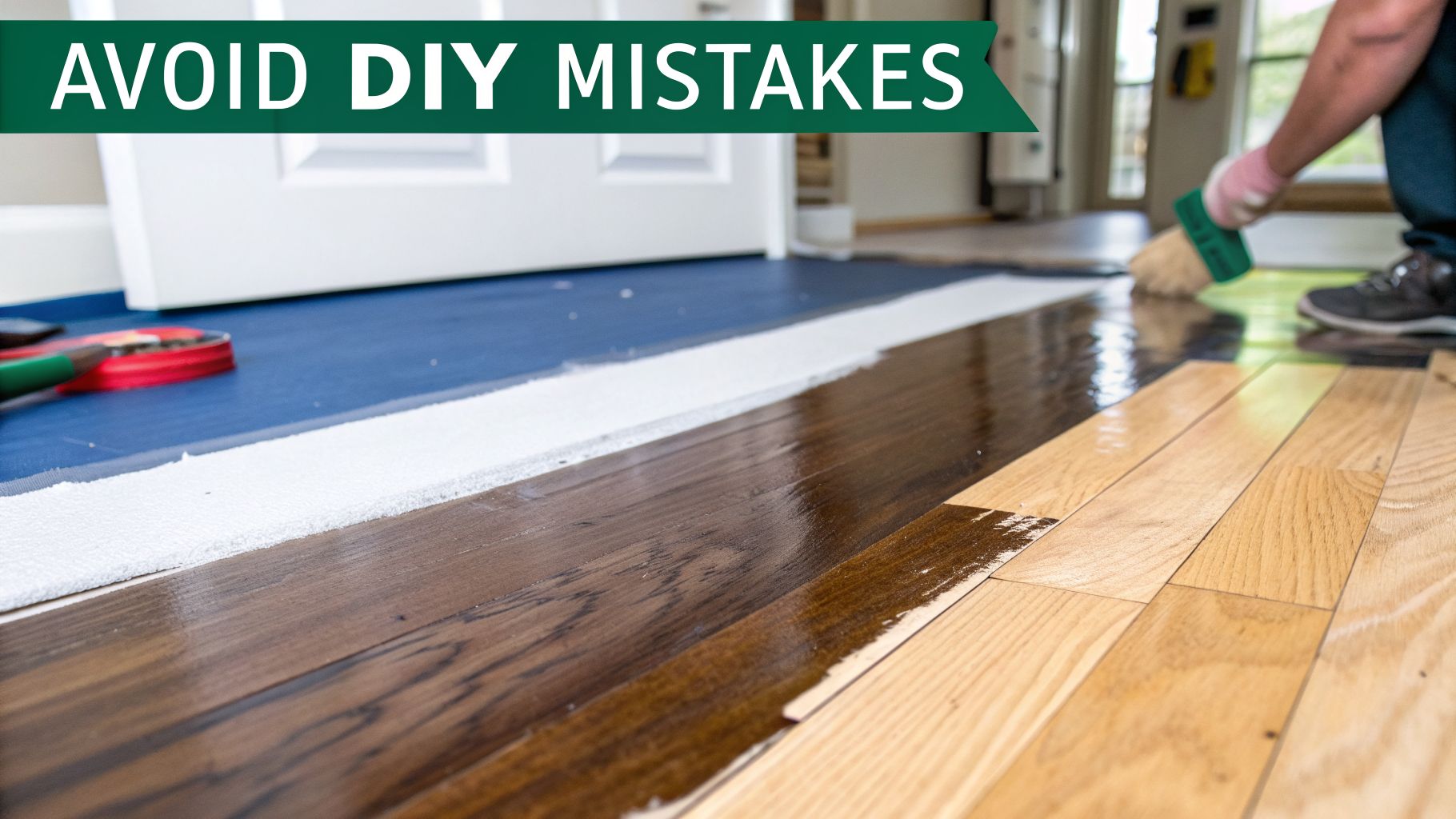
Richmond homeowners usually start in the same place. The floors look tired, traffic paths are dull, a few scratches catch the light, and now you're trying to figure out who the best hardwood floor refinisher is and whether you need a simple refresh or a full restoration.
That decision matters more than is commonly appreciated. The right approach can save money, reduce disruption, and protect the life of your wood floor. The wrong one can leave you paying for work your floors didn't need, or worse, a finish that fails because the prep was wrong.
Do Your Floors Need a Refresh or a Full Refinish
A lot of confusion around hardwood floor refinishing comes from one basic problem. Homeowners are often told about sanding, stain colors, and fillers before anyone helps them identify what kind of wear they have.
Start with what you can see and feel.

Signs the finish is worn but the wood is still in good shape
If the floor looks cloudy, lightly scratched, or dull in the main walking lanes, that often points to wear in the finish layer, not damage deep in the wood.
Look for these clues:
- Light scuffs only in the topcoat. You can see them in reflected light, but they don't read as dark lines.
- Traffic lanes near kitchens, hallways, and entry points. The finish loses its sheen first where people walk every day.
- No exposed bare wood. The color still looks mostly even.
- You can't catch the scratch with a fingernail. That's a quick field test many pros use.
When a floor fits that description, a buff and coat service or wood floor recoating may be the better move than full sanding.
A guide on when to refinish hardwood floors can help you sort out the timing if you're still unsure.
Signs your floors need full sanding
Some floors have gone past maintenance and into restoration.
Watch for issues like these:
Deep scratches you can feel
If your fingernail drops into the mark, it has likely cut through the finish and into the wood.Black staining or water marks
Surface haze is one thing. Dark discoloration usually means moisture got below the finish.Peeling, flaking, or patchy finish
Once adhesion fails, adding another coat on top usually won't solve the root problem.Uneven color from old spot repairs
This happens a lot in older Richmond homes where one board was touched up years ago and now stands out.You want a color change
A buff and coat doesn't remove stain. Full sanding does.
Practical rule: If the problem is in the finish, recoat may work. If the problem is in the wood, sanding is usually the right path.
Why this matters in Richmond VA
In Richmond VA, seasonal humidity can make normal movement more noticeable. Boards expand and contract, small gaps show up and shrink back, and older finishes can look rough sooner in entryways and kitchens.
That's one reason the low-dust option gets so much attention. According to a cited summary discussing an NWFA report, 68% of U.S. homeowners prefer low-dust refinishing, and buff-and-coat can extend floor life by 5 to 10 years without sanding to bare wood (Panel Town summary).
That doesn't mean every floor qualifies. It means many homeowners in Richmond VA should at least ask whether a non-invasive renewal makes more sense before committing to full sanding.
If you're shopping for the best hardwood floor refinisher, this is the first question to ask: Are they diagnosing the floor accurately, or selling the biggest job?
Buff and Coat Service vs Full Sanding
A lot of Richmond homeowners call after getting two completely different recommendations. One contractor says, "Just recoat it." Another says, "It all needs to be sanded." The floor is the same. The advice is not.
That usually means the issue has not been diagnosed clearly. The better question is not which service sounds more thorough. It is which service matches the condition of the floor.

What a buff and coat does
A buff and coat service, often called a screen and recoat, scuffs the existing finish so a new topcoat can bond to it. It does not cut down to bare wood. That distinction matters because this service is maintenance, not restoration.
It is a smart choice when the floor still has a sound finish layer and the problems are mostly cosmetic:
- Light surface scratching
- Dull traffic lanes
- Minor wear in the topcoat
- A floor that looks tired but is still structurally healthy
For the right floor, this is the smarter move. You keep more of the original floor, create less disruption, and avoid paying for work the wood does not need.
If you want a closer look at how this maintenance service works, our guide to buff and coat hardwood floors breaks it down in plain language.
What full sanding does differently
Full sanding removes the old finish and sands the surface back to bare wood. That gives the contractor a clean slate to correct deeper wear, remove many stains, flatten uneven areas, and apply a new stain color or clear finish.
This is usually the better path when the issue goes below the finish layer:
- Deep scratch patterns
- Dark water marks or pet stains
- Finish failure across larger areas
- Visible repair patches
- A planned color change
A simple way to judge it is this. A buff and coat improves the protection layer. Full sanding addresses the wood and the finish system together.
The trade-off homeowners should focus on
The decision is not just about how worn the floor looks today. It is also about what problem you are trying to solve.
If the finish is dull but still intact, full sanding can be more work than the floor needs. If the wood is stained, exposed, or uneven, a buff and coat can leave you paying for a short-term improvement that does not fix the underlying issue.
That is why I tell homeowners to stop asking only, "Which one lasts longer?" Ask this instead. "Is my problem in the topcoat, or in the wood?"
Side by side trade-offs
| Decision factor | Buff and coat | Full sanding |
|---|---|---|
| Best for | Light wear and dull finish | Deep wear, stains, major scratches |
| Wood removal | Minimal surface abrasion only | Sands to bare wood |
| Color change | No | Yes |
| Disruption | Lower | Higher |
| Dust level | Lower, especially with dust-controlled equipment | Depends heavily on equipment and process |
| Result | Refreshes and protects | Restores and transforms |
Where homeowners get tripped up
A buff and coat only works if the new finish can bond well. Floors that have been treated with waxy products, polish-heavy cleaners, or the wrong maintenance products often fail this test. So do floors with worn-through spots where bare wood is already exposed in patches.
Full sanding has its own trade-offs. It gives the contractor far more correction power, but it also demands good technique. Poor sanding leaves chatter, edge marks, uneven stain absorption, and visible wave patterns. The service is more involved, so the skill gap matters more.
The better decision is usually the less invasive one, if the floor qualifies
Homeowners sometimes assume the bigger job is the safer job. In hardwood refinishing, that is not always true.
Sanding removes material. A buff and coat preserves the floor while renewing the finish. If the existing floor only needs a fresh protective layer, preserving that wear layer is often the better long-term call.
The best hardwood floor refinisher is usually the contractor who can explain why your floor does or does not qualify for the less-invasive option, and who is willing to recommend the smaller job when it is the right one.
The Professional Dustless Sanding Process Explained
A good sanding job looks simple when it's finished. It isn't simple while it's happening.
The difference between a clean, flat, durable floor and one with chatter marks, edge scars, or uneven stain usually comes down to process. That's why dustless sanding matters, but it's not the only thing that matters.

Dustless sanding is about more than cleanliness
Homeowners usually ask for dustless sanding because they don't want fine dust drifting through vents, settling on shelves, or hanging in the air after the crew leaves.
That's a good reason. It's also a quality issue.
When a contractor controls dust well, the work area stays cleaner between steps. That helps with inspection, prep, and final coat quality. If you're comparing contractors, this guide to a dustless floor sander helps explain what to ask about.
The sanding sequence that separates pros from shortcuts
Professional sanding follows a progression. According to this hardwood sanding guide, the standard sequence is 40 → 60 → 80 → 120 grit, with each pass doing a different job (Big Bro Hardwood sanding guide).
In practice, this means:
- 40 grit removes old finish and flattens high spots.
- 60 grit takes out the scratches left by the coarse first cut.
- 80 grit prepares the floor for stain or natural finish.
- 120 grit smooths the surface before sealer.
That sequence isn't optional just because a contractor is in a hurry.
Trade insight: Fine paper doesn't magically fix coarse scratches. It only removes the scratches from the grit before it.
If someone skips a step, the floor may look passable from the doorway and terrible once light hits across it in the afternoon.
The vacuuming step people never notice
Between grit changes, the floor needs to be vacuumed thoroughly. If stray abrasive from a coarser pass stays on the floor, it can gouge the wood during the next finer pass.
That one mistake can follow the project all the way to the final coat.
The same source notes that for heavily damaged floors or old shellac and lacquer finishes, pros may need to start even more aggressively before moving into the normal progression. That decision takes judgment, not guesswork.
Here's a short visual that shows the equipment in action and why technique matters.
Where bad sanding jobs usually go wrong
Most failed refinishing jobs don't fail because the finish can was wrong. They fail because prep was sloppy.
Common problems include:
- Skipped grits
- Poor edge blending
- Inconsistent machine pace
- Dirty surface before coating
- Worn abrasive that should've been changed out
The same sanding guide notes that abrasive belts on drum sanders should be replaced every 250 square feet to keep cutting consistent. That's the kind of detail homeowners never see, but it shows up in the result.
If you're looking for the best hardwood floor refinisher in Richmond VA, ask them to explain their sanding sequence in plain language. A pro should be able to do that without hiding behind jargon.
Refinishing Cost and Timelines in the Richmond Area
You look at the floor and see surface wear, a few dull traffic lanes, and maybe one rough patch by the back door. Then the quotes start coming in, and the range is wide enough to make anyone pause. That usually means the underlying question is not just price. It is whether your floor needs a lighter buff and coat or a full sand-and-refinish.

What the price range usually looks like
National trade guidance puts a screen and recoat at the low end and full refinishing several steps higher, with labor making up most of the bill, as noted earlier. In plain English, the difference comes down to time, floor condition, and how much material has to be removed before a new finish can go down.
For Richmond homeowners, a buff and coat usually makes sense when the finish is worn but the wood itself is still in good shape. That cuts labor, shortens downtime, and avoids taking off more wood than necessary. A full refinish costs more because it includes sanding to bare wood, edge work, stain work if requested, and multiple finish stages.
A simple budgeting view looks like this:
| Project type | Typical cost direction |
|---|---|
| Screen and recoat | Lower-cost option |
| Full refinishing | Higher-cost option |
| Repairs before refinishing | Adds to the total |
That is why two homes with similar square footage can land at very different numbers.
What affects your quote in Richmond VA
Square footage matters, but it is rarely the whole story.
I see the biggest quote swings come from five things:
- Wear depth. Light finish wear is one job. Pet stains, black water marks, and deep gouges are another.
- Wood species. Some floors cut fast and finish cleanly. Others take more passes and more care.
- Room layout. Narrow halls, tight closets, stair landings, and lots of edges slow the work down.
- Repairs. Board replacement, patching around old walls, and leveling proud boards all add labor.
- Finish system. Faster-curing and lower-odor finishes can be worth the money, especially if you are living in the home during the project.
Older Richmond homes add another layer. Fan District, Museum District, and Near West End floors often have patches from old remodels, mixed board widths, or transitions into newer additions. Those details do not always show up in an online estimate, but they show up on the job.
How long does refinishing take
A full refinish usually takes several days because each step depends on the one before it. Sanding has to be completed cleanly. Repairs need to be blended. Finish coats need proper dry time before the next coat or before foot traffic returns.
A buff and coat is usually much faster.
That is the part many homeowners miss. If the floor qualifies for recoating, you can often get the look and protection you want with less disruption, lower cost, and a quicker return to normal use. That decision is where good judgment saves money.
Timing also depends on the finish you choose, humidity inside the house, and whether furniture has to be moved in stages. A rushed schedule can create adhesion problems, soft finish, or visible debris in the coat. No one wants to pay for speed and then pay again to fix the result.
If you are moving in, listing soon, or trying to keep a rental turn tight, the smartest choice is often the least invasive method the floor will honestly allow.
What to expect during the job
Most Richmond refinishing projects follow a practical sequence:
- Site visit and floor evaluation
- Moisture check, prep planning, and repair review
- Buff and coat or full sanding based on floor condition
- Finish application and cure time
- Staged return for socks, furniture, and rugs
Homeowners also tend to judge the experience by communication, cleanliness, and whether the schedule stays believable. That is one reason the role of Google reviews in a contractor's reputation and online visibility matters so much when you are comparing floor pros. Reviews often reveal whether a company shows up on time, explains trade-offs clearly, and handles surprises well once the work starts.
If a quote sounds unusually cheap, ask what process is being skipped. On wood floors, low prices often mean less prep, weaker dust control, thinner coating work, or a recommendation for full sanding when a buff and coat would have been the better call.
How to Choose the Best Hardwood Floor Contractor
Choosing a refinisher isn't just about who can sand a floor. It's about who can read the floor, recommend the right system, and execute without cutting corners.
That matters because hardwood refinishing isn't a cosmetic splurge with little upside. According to the National Association of REALTORS®, hardwood floor refinishing delivers an average 118% return on investment at resale (NAR coverage of the Remodeling Impact Report). If the work affects value that directly, the contractor choice matters just as much.
Questions worth asking before you hire anyone
A strong estimate appointment should feel like a conversation, not a pitch.
Ask questions like these:
Do these floors need recoating or full sanding
If the answer is always "full sand," be careful.
What dust containment system do you use
"Dustless" shouldn't mean "we'll try to keep it tidy." Ask how they capture dust at the machine and how they protect adjacent spaces.
What finish system do you prefer and why
A good contractor should explain the trade-offs clearly, including low-odor or low-VOC options if that's important in your home.
Have you worked on this type of floor before
Oak, maple, engineered hardwood, old patched floors, and newer site-finished wood can all behave differently.
What prep steps happen before the final coats
Experienced contractors set themselves apart from low bidders.
Will you provide a written scope
You want to know what is included, what is excluded, and what could change if hidden issues appear.
What good answers sound like
The best hardwood floor contractor in Richmond usually doesn't rush this part. They look at wear patterns. They ask what bothers you most. They explain what can improve and what won't disappear completely.
They also won't promise perfection on every old floor. Some character is part of the floor. Honest pros know the difference between restoration and overpromising.
A trustworthy refinisher will tell you where your money helps, and where it doesn't.
Red flags that should slow you down
Some warning signs are obvious. Others are easy to miss.
Watch for these:
- Vague phone-only pricing without seeing the floors
- Pressure to book immediately
- No clear explanation of process
- No recent project photos
- No discussion of finish options
- No mention of cleanup, curing, or re-entry expectations
Online reputation matters too, but it helps to know how to read it. This overview of the role of Google reviews in a contractor's reputation and online visibility gives useful context on why reviews matter and how they shape trust before a homeowner ever makes the first call.
The contractor should fit the house, not just the job
A condo with light wear, a rental turnover in Henrico, and a century-old Richmond VA home with patched oak strips are not the same assignment.
The right contractor understands the house style, the existing floor, and your goal. Some homeowners want resale prep. Others want a healthier, lower-disruption process while they stay in the home. Others need hardwood floor repair before any finish work begins.
The best hardwood floor refinisher is usually the contractor who makes the decision feel clearer, not more confusing.
The Buff & Coat Promise Our Process and Local Service
A good flooring company should make the process feel organized from the first visit. Homeowners don't need a lecture. They need a clear recommendation, a realistic schedule, and work that respects the house.
In the Richmond area, that usually starts with an in-home look at the floor itself. Photos help, but they don't always show finish failure, board movement, old patching, or whether a scratch is just in the coating or down into the wood.
What the process should feel like
The best experience is straightforward.
A typical job flow looks like this:
In-home estimate
The floor is inspected in person, the wear is identified, and the homeowner gets a plain-language recommendation.
Right-sized scope
If a buff and coat service will solve the issue, that should be the recommendation. If the floor needs full sanding or hardwood floor repair, that should be explained clearly.
Scheduling with real expectations
Homeowners should know what rooms are affected, how to prepare, and when they can plan to move back into those spaces.
Final walkthrough
Before a project wraps, someone should review the result with you and answer care questions.
Why local experience matters in Richmond VA
Richmond homes are a mix. You see older strip oak, newer prefinished material, engineered hardwood, patched transitions from additions, and entryway wear from daily use and wet weather.
Local experience helps with things like:
- Reading seasonal movement
- Matching repairs in older neighborhoods
- Choosing practical finish systems for occupied homes
- Working around tight schedules for listings and rental turns
A contractor serving Richmond, Midlothian, Chesterfield, Henrico, Glen Allen, Short Pump, and Mechanicsville regularly will usually spot these issues faster than someone treating every floor the same way.
What homeowners should expect from a reputable local company
The baseline should be simple:
| What to expect | Why it matters |
|---|---|
| Honest recommendations | Prevents overselling |
| Dust-controlled methods | Keeps the house cleaner and more comfortable |
| Clear communication | Reduces surprises |
| Responsive scheduling | Helps with move-ins, listings, and tenant turns |
| Quality finishes | Protects the result over time |
In practical terms, homeowners in Richmond VA share common expectations. A crew that shows up, protects the home, does the prep right, and recommends the least invasive option that will hold up.
If you're unsure whether your hardwood floors need refinishing, Buff & Coat can take a look and give you honest recommendations. Call 804-392-1114 or request a free estimate today.
Why Richmond Homeowners Choose Buff & Coat
Homeowners looking for floor refinishing Richmond VA usually want more than a nice before-and-after. They want a company that gives straight answers and does careful work.
Here are the reasons Buff & Coat stands out in the Richmond area:
| Feature | Benefit |
|---|---|
| 15 years in business | Experienced judgment on what to recoat, repair, or fully refinish |
| Dustless sanding systems | Cleaner process with less disruption in the home |
| Local, owner-operated | Direct communication and local accountability |
| High-quality finishes | Better-looking results and durable protection |
| Clear pricing and honest advice | Easier decisions without pressure |
| 5-star customer service | A smoother experience from estimate to walkthrough |
That combination matters whether you're planning hardwood floor restoration, engineered hardwood refinishing, a listing refresh, or a full sanding project after years of wear.
Richmond homeowners choose Buff & Coat because the company keeps the process practical:
- It recommends the right service, not just the biggest one
- It uses dustless sanding systems for a cleaner jobsite
- It handles repairs, recoating, and full refinishing
- It serves Richmond and surrounding communities with local knowledge
Ready to restore your hardwood floors? Buff & Coat makes the process fast, clean, and stress-free. Call 804-392-1114 or request your free estimate at buffandcoatvirginia.com.
Frequently Asked Questions About Hardwood Refinishing
Can all hardwood floors be recoated instead of fully sanded
No. A recoat works best when wear is limited to the finish layer. If the floor has deep scratches, water staining, peeling finish, or bare wood in heavy traffic areas, full sanding is often the better choice.
Is dustless sanding really dust free
No sanding method is absolutely perfect, but professional dustless sanding is far better than old-style open sanding. The goal is strong dust capture at the machine and cleaner containment through the job.
Can engineered hardwood be refinished
Sometimes, yes. It depends on the thickness of the wood wear layer on top. Some engineered floors can handle refinishing. Others are better candidates for recoating only. This is one of those areas where an in-person evaluation matters.
What about hardwood floor scratch repair
Light scratches in the finish can often be improved with recoating. Deep scratches that cut into the wood usually need sanding, board repair, or a more targeted restoration plan.
Should I choose low-odor or low-VOC finishes
Many homeowners do, especially if they have kids, pets, or plan to stay in the home during parts of the project. The right contractor should explain finish options in plain language and match them to your schedule and comfort level.
Will refinishing fix gaps between boards
Not always. Some gaps are seasonal and move with humidity. Filling the wrong gaps can create cracking problems later. That's why gap issues need to be evaluated case by case, especially in older Richmond homes.
How do I know I'm hiring the best hardwood floor refinisher
Look for clear diagnosis, written scope, good communication, strong reviews, dust-control answers, and realistic expectations. The best contractor usually sounds calm, specific, and honest about trade-offs.
If you're comparing options for Buff & Coat Hardwood Floor Refinishing, the easiest next step is to get an in-home assessment and a clear recommendation. Call 804-392-1114 or request a free estimate to find out whether your floors need a buff and coat, repair, or full refinishing.