

Home Blog Cost of Solid Hardwood vs Engineered Flooring in 2026
Cost of Solid Hardwood vs Engineered Flooring in 2026

If you're standing in your living room comparing samples and trying to figure out the cost of solid hardwood vs engineered, you're not alone. Richmond homeowners usually start with the sticker price, then realize pretty quickly that installation method, moisture conditions, and refinishing potential matter just as much as the board itself.
That's where this decision gets easier. Once you understand how each floor is built, what drives the upfront bill, and what happens years down the road, you can choose the right floor for your home instead of just the cheapest number on a quote.
Understanding the Core Difference in Hardwood Floors
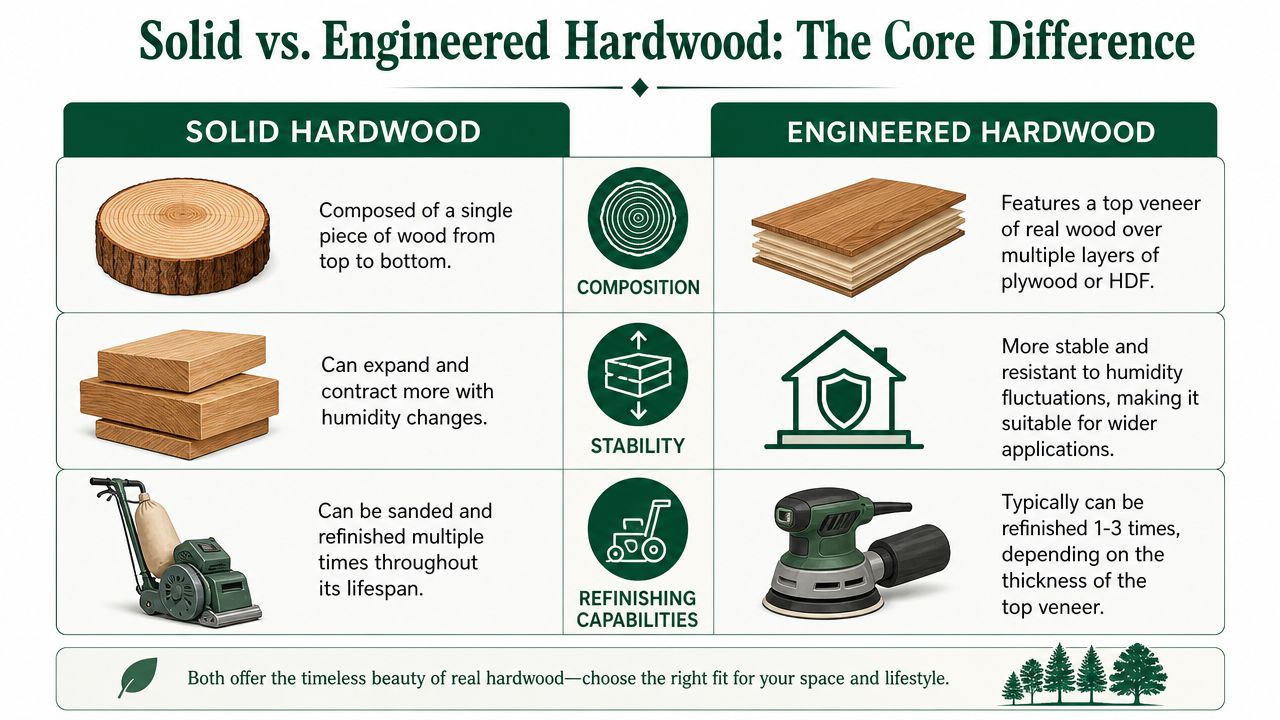
The biggest difference between solid and engineered hardwood isn't the finish color or plank width. It's the way the board is built.
Solid hardwood is exactly what it sounds like. Each plank is milled from a single piece of wood from top to bottom. That construction gives it depth, which is why it can be sanded and refinished multiple times over its life.
Engineered hardwood uses a real wood veneer on top, bonded over layers of plywood or a similar core. A simple way to think about it is this: solid hardwood is one thick slice of wood, while engineered hardwood is more like a layered panel with real hardwood on the surface.
Why the construction matters
That layered build changes how the floor behaves in a real house.
Solid hardwood tends to move more with humidity. In Richmond VA, that matters because summer moisture and winter dry heat can both affect wood movement. Installed correctly, solid performs beautifully, but it wants a stable environment.
Engineered hardwood is generally more dimensionally stable because the layers help control expansion and contraction. That makes it useful in places where solid wood may be a riskier choice, such as lower levels, homes over concrete, or rooms with more seasonal moisture fluctuation.
Practical rule: If the room has a stable, above-grade environment and you're thinking long term, solid deserves a serious look. If the room has more moisture risk or a tricky subfloor, engineered often makes more sense.
What homeowners often misunderstand
A lot of people hear "engineered" and assume it isn't real wood. It is real wood. The top layer is hardwood. The question isn't whether it's real. The question is how much hardwood is there, and what that means for future sanding, repair, and lifespan.
That distinction matters if you're also researching engineered hardwood refinishing or trying to decide between restoration and replacement. A floor with a thin wear layer doesn't give you the same options later that a solid plank does.
If you want a deeper side-by-side breakdown of construction and use cases, this guide on solid vs engineered hardwood flooring is a good next read.
How this affects refinishing and repair
From a contractor's standpoint, the structure of the board decides what can be done later.
- Surface wear on solid hardwood: scratches, finish loss, and traffic patterns are usually repairable through buff and coat service, full hardwood floor refinishing, or board replacement if needed.
- Surface wear on engineered hardwood: the answer depends on veneer thickness and installation method. Some engineered floors handle recoating well. Some can take a careful sanding. Some are replacement-only once the top layer is spent.
- Subfloor and room conditions: they often matter more than homeowners expect. A great product installed in the wrong environment still causes problems.
That's why the best hardwood floor contractor in Richmond won't just hand you a sample board and a price. They'll ask where it's going, what's underneath it, and how long you plan to stay in the home.
A Direct Comparison of Upfront Installation Costs
Most homeowners want the simple answer first. What costs more on day one?
Here's the baseline. Solid hardwood flooring typically costs $8 to $15 per square foot for material, with installed costs of $8 to $25 per square foot. Engineered hardwood typically costs $4 to $7 per square foot for material, with installed costs of $6 to $20 per square foot, making solid hardwood about 50% more expensive initially, according to Bruce Hardwood Flooring's comparison of engineered and solid wood flooring.
| Flooring type | Material cost per sq. ft. | Installed cost per sq. ft. | General upfront takeaway |
|---|---|---|---|
| Solid hardwood | $8 to $15 | $8 to $25 | Higher upfront cost |
| Engineered hardwood | $4 to $7 | $6 to $20 | Lower upfront cost in many projects |
Why solid usually costs more at installation
There are two main reasons.
First, the product itself is typically more expensive because you're buying a full-thickness hardwood plank rather than a thinner hardwood surface over a layered core. Second, installation tends to be more labor-intensive. Solid hardwood often calls for a nail-down process, and that means more setup, more subfloor requirements, and less flexibility.
In practical terms, this matters for floor installation in Richmond because labor isn't just about time. It's about the right subfloor, the right moisture conditions, and the right installation method for that particular house.
Why engineered can lower the first bill
Engineered flooring often gives installers more options. Depending on the product, it may be floated, glued, or fastened. Some click-lock systems move faster than a traditional nail-down solid floor, which can reduce labor costs and simplify the job.
For homeowners in Richmond VA, Glen Allen, Midlothian, or Henrico, that can make engineered attractive when the project needs to stay within a tighter immediate budget. It's also a common choice when the subfloor or room location limits what solid can reasonably do.
The lower upfront number is real. The mistake is assuming it automatically means lower cost overall.
What to expect from a real estimate
An actual quote for hardwood floor installation should separate three things:
- Material selection: entry-level and premium products can both fall under the same category, but they don't price the same.
- Installation method: floating, glue-down, and nail-down are not equal in labor.
- Prep work: removal, subfloor correction, trim work, and transitions can change the final number fast.
If you're trying to budget a project in Richmond VA, this breakdown of new hardwood floor installation cost helps put the line items in plain English.
For homeowners comparing quotes, this is where experience matters. One contractor may price only the floor. Another may include the prep that keeps the floor from failing later. The cheaper quote isn't always the cheaper job.
Call 804-392-1114 or request a free estimate today if you want help comparing installation options with integrity.
Key Factors That Influence Your Total Project Price
The per-square-foot range gets you in the ballpark. It doesn't tell you what your house will cost.
A real hardwood quote changes based on the product you choose, the shape of the rooms, and the condition of what's underneath. In Richmond-area homes, that can vary a lot. A newer house in Short Pump presents different challenges than an older house in The Fan or a lower-level space in Chesterfield.
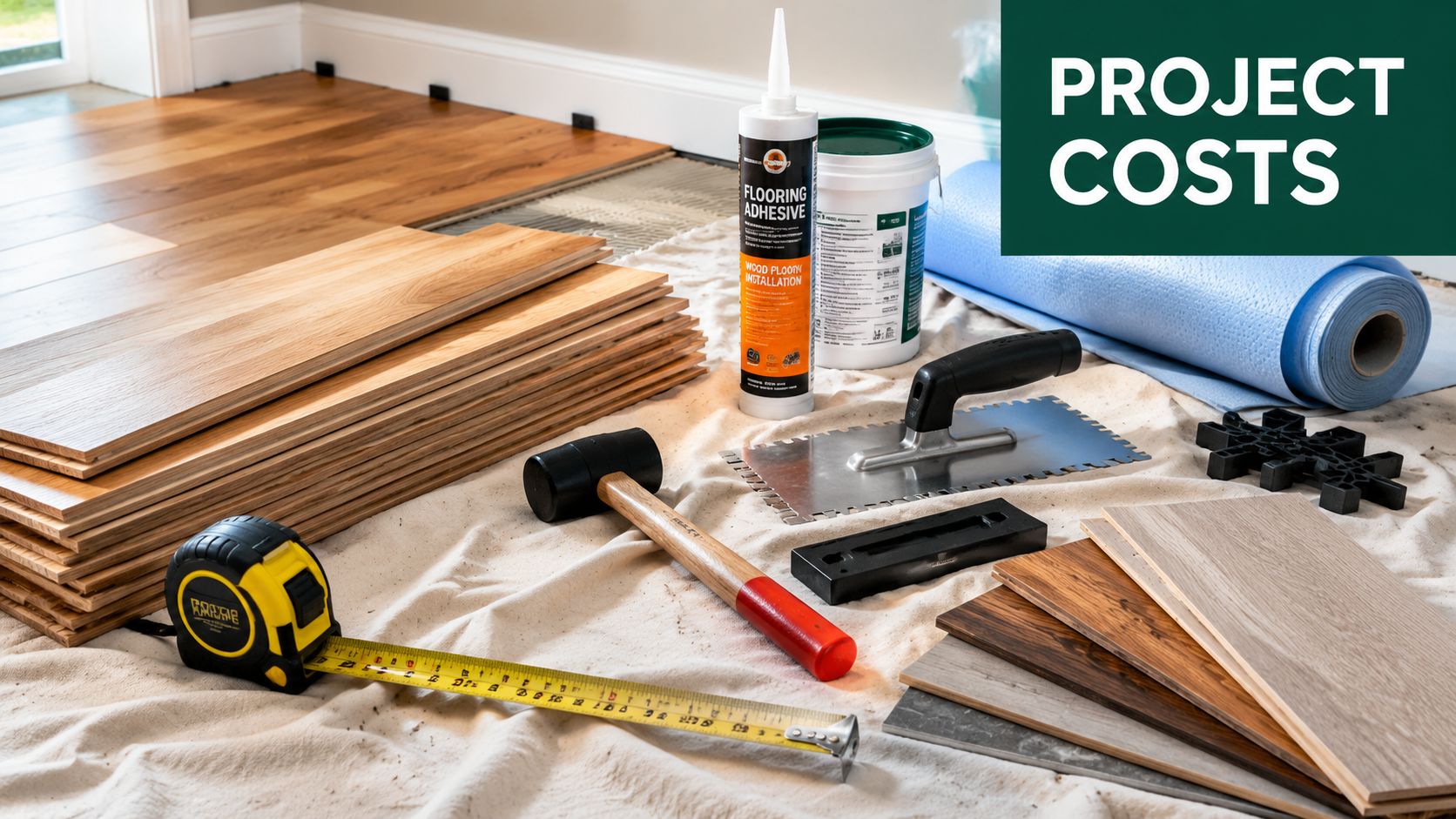
Material choices can flip the price logic
Not all engineered flooring is budget flooring. Some engineered products are built and priced as premium finishes, especially when they come in wider planks, specialty textures, or higher-end factory finishes. At that point, the usual assumption that engineered is the cheaper path can break down.
There's also a nuance most cost guides miss. In specific regional markets or with certain brands, solid hardwood can sometimes be $3 to $5 per square foot cheaper than engineered options, potentially saving a homeowner around $1,650 on a typical 500 sq ft installation, based on this discussion of real-world flooring pricing examples.
That's not the norm, but it happens. In practice, I've seen homeowners assume engineered was the automatic value choice and skip over solid too early.
Other costs that move the number
Some price drivers have nothing to do with whether the floor is solid or engineered.
- Old flooring removal: pulling out existing material adds labor and disposal.
- Subfloor prep: if the base isn't flat, dry, or structurally sound, the new floor won't perform the way it should.
- Room layout: stairs, closets, odd angles, kitchen tie-ins, and transition details take more time than an open rectangular room.
- Finish coordination: if you're matching existing hardwood floor restoration work, product selection can narrow fast.
A flooring quote gets expensive when the room fights the installation, not just when the wood costs more.
What works and what doesn't
What works is comparing full project scope. That means asking what kind of prep is included, whether trim and transitions are in the quote, and whether the product suits the room.
What doesn't work is comparing a premium engineered sample to a standard solid product and assuming the category alone tells you the budget. It doesn't. Product tier matters. Site conditions matter more than most homeowners expect.
This comes up often in floor refinishing Richmond VA conversations too. Homeowners ask whether replacement is the only path, when in fact a wood floor recoating, hardwood floor repair, or buff and coat service may be the smarter move if the existing floor still has life left.
If you're unsure whether your hardwood floors need refinishing, Buff & Coat can take a look and give you honest recommendations.
The True Cost Over Time Lifecycle and Refinishing Value
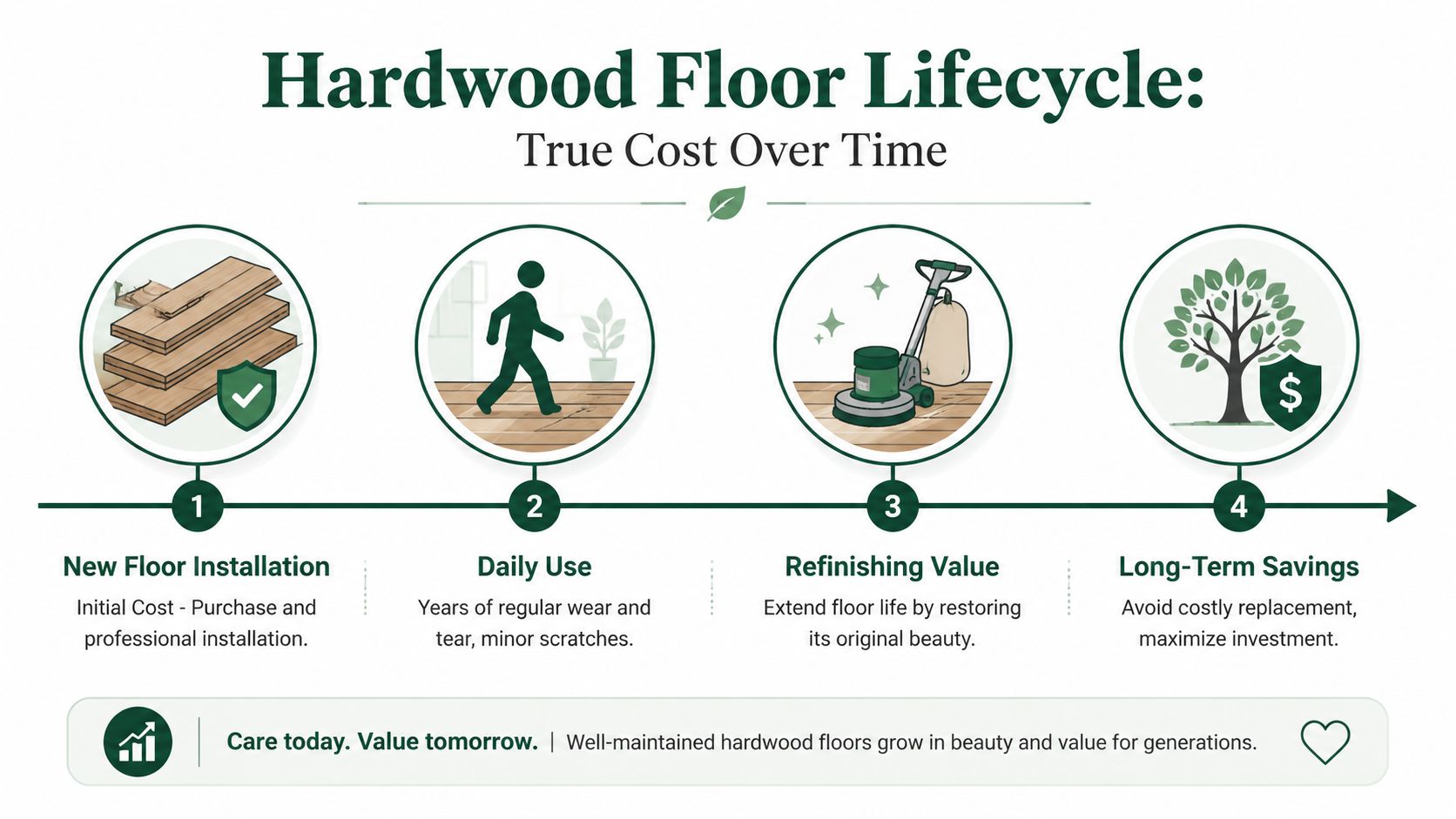
The installation bill matters, but it isn't the whole story. Flooring is one of those home decisions where the long-term cost can reverse the short-term math.
A floor that costs less now may cost more later if it can't be restored when wear shows up. That's why homeowners who plan to stay put, and landlords thinking beyond one turnover cycle, should look hard at lifecycle value instead of only the opening quote.
Lifespan changes the entire calculation
Solid hardwood can last up to 100+ years and be refinished 4 to 6 times. Engineered hardwood typically lasts 25 to 40 years and can be refinished only 1 to 2 times, if at all, depending on veneer thickness, according to Robbins' solid vs engineered hardwood guide.
That's the piece many homeowners don't hear in the showroom.
With solid hardwood, wear doesn't automatically mean replacement. Scratches, traffic lanes, dull finish, and color changes can often be corrected through hardwood floor refinishing. With engineered, the answer depends on how much real wood sits on top of the core. Some engineered floors allow limited refinishing. Others reach a point where replacement is the only clean option.
Why refinishing value matters in Richmond homes
In Richmond VA, especially in neighborhoods with older housing stock, the ability to restore a floor matters a lot. Many homes were built with wood floors meant to be lived on, repaired, and refinished over time. That mindset still holds up.
If a homeowner has children, pets, moving furniture, or years of ordinary wear, a restorable floor gives you another option besides tearing everything out. Dustless sanding, low-odor finishes, and a careful recoating plan can extend the life of a wood floor without changing the whole room.
If you're trying to understand where engineered fits into that picture, this article on whether engineered hardwood can be refinished is worth reviewing before you buy.
Jobsite reality: Homeowners rarely regret having the option to refinish. They do regret finding out too late that their floor doesn't have enough wear layer left to save.
Here's a quick way to think about lifecycle value:
- Solid hardwood works best when you want a floor you can maintain over decades instead of replace when it ages.
- Engineered hardwood works best when the room conditions make stability the higher priority.
- Refinishing creates value when the floor has enough material to restore instead of remove.
For rental owners, this choice can depend on hold time and turnover strategy. If you're comparing surfaces across investment properties, this guide to cost-effective landlord flooring options gives useful broader context on balancing durability, maintenance, and replacement planning.
A short visual walkthrough can help if you're comparing maintenance paths and restoration potential:
What usually saves money over time
In a stable main-floor living area, solid hardwood often wins the long game because it can be renewed again and again. In a moisture-prone or below-grade space, engineered may still be the better financial decision because it fits the environment better from the start.
That's the practical answer. The cheapest floor is the one that fits the room and gives you a workable maintenance path later.
Richmond homeowners: get a fast quote for refinishing or recoating.
Making the Right Choice for Your Richmond Home
Most flooring decisions get easier once you stop asking which product is better in general and start asking which one fits your specific house.
Richmond homes vary a lot. A historic row house near the Museum District, a colonial in Henrico, and a newer build in Chesterfield don't present the same moisture conditions, subfloors, or design priorities. The right choice depends on where the floor is going and what you need it to do.
When solid hardwood makes more sense
Solid is often the better fit for above-grade living spaces where the home stays reasonably stable year-round. In Richmond VA, that usually means main floors, bedrooms, dining rooms, and older homes where preserving traditional character matters.
If you own a classic home in The Fan, West End, or parts of Mechanicsville with an existing wood floor layout, solid hardwood usually feels more in line with the structure of the house. It also leaves the door open for future hardwood floor restoration and hardwood floor scratch repair instead of full replacement.
When engineered is the smarter call
Engineered hardwood is often the safer option in rooms with more environmental stress. Finished basements, slab areas, and spaces with seasonal moisture changes are common examples.
For a Chesterfield basement conversion or certain lower-level rooms in Richmond VA, engineered can be the practical winner because it handles humidity shifts better. The same goes for homes where the subfloor setup limits a traditional solid installation.
A simple decision filter
Ask these questions before you choose:
- Is the room above grade and climate-controlled? If yes, solid deserves a close look.
- Is there concrete underneath or more moisture risk? Engineered often makes more sense.
- Are you planning to stay long term? If yes, refinishing potential matters more.
- Do you care about matching older hardwood in the home? Solid is often easier to blend into that kind of project.
In Richmond VA, the right flooring choice usually comes down to the room first, not the catalog first.
What local homeowners should watch
Richmond summers bring humidity. Winters bring dry indoor heat. Both matter. Good acclimation, moisture testing, and correct installation details are what keep a floor stable over time.
That's also why homeowners researching dustless sanding, wood floor recoating, or how long does refinishing take should look at the full floor system, not just the visible wear. Sometimes the best move is a new installation. Sometimes the smarter move is keeping what you have and restoring it properly.
If you're weighing the options for your own home in Richmond VA, Midlothian, Glen Allen, or Short Pump, getting eyes on the space beats guessing from showroom samples.
Your Hardwood Flooring Questions Answered
Is engineered hardwood easier to install than solid hardwood
Usually, yes. Many engineered products offer more installation flexibility, which can simplify the job in the right setting. Solid hardwood tends to be less forgiving and usually calls for a more traditional installation approach.
That doesn't mean engineered is always the better buy. Easier installation and better long-term value aren't the same thing.
Which one is better for pets and everyday wear
The finish matters more than the category alone. Dogs, chairs, grit, and daily traffic can mark up both solid and engineered floors.
The important difference comes later. If wear becomes heavy enough, a solid floor usually gives you more recovery options through hardwood floor refinishing or hardwood floor repair.
Can engineered hardwood be repaired
Sometimes. Small issues may be manageable, but repair options depend on the product, the wear layer, and how the floor was installed. Some boards can be replaced individually. Some scratches can be improved with surface work. Some damage means replacement is the cleanest answer.
Solid hardwood usually offers more flexibility for both localized repairs and full restoration.
Is solid hardwood always worth the extra money
Not always. In a dry, stable main-floor space where you want a long-term floor, solid can be an excellent investment. In a lower-level room or a space with more moisture movement, engineered may be the better decision even if it has less refinishing potential.
The room decides a lot.
What about allergies and indoor air concerns
Both solid and engineered can work well in a home where air quality matters, especially compared with flooring that traps more dust and debris. The bigger factor is product selection and finish system. Homeowners who want VOC-free or low-odor finishes should ask about those options during the estimate, especially for refinishing and recoating work.
Can you use either one with an older Richmond home
Yes, but older homes need careful evaluation. Subfloor condition, existing floor height, transitions, and moisture patterns all matter. In many older Richmond VA homes, keeping and restoring existing wood is often worth discussing before replacing it.
Why Richmond Homeowners Choose Buff & Coat
Buff & Coat Hardwood Floor Refinishing is a Richmond-based floor refinishing and installation company with 15+ years of experience serving homeowners who want straight answers and quality workmanship. The team works throughout Richmond, Midlothian, Chesterfield, Henrico, Glen Allen, Short Pump, and Mechanicsville, with occasional jobs in Charlottesville, Fredericksburg, and Virginia Beach.
Homeowners choose Buff & Coat because they offer the services people need, not a one-size-fits-all answer:
- 15 years in business
- Dustless sanding systems
- Local, owner-operated
- High-quality finishes
- Clear pricing and honest advice
- 5-star customer service
Whether the job calls for dustless sanding, a buff and coat service, full hardwood floor refinishing, hardwood floor repair, solid or engineered floor installation, or LVP/LVT installs, the focus stays the same. Give the homeowner a floor that fits the house, the budget, and the long-term plan.
If you're unsure whether your floors need a full refinish, a wood floor recoating, or replacement, that's the kind of question a local contractor should answer clearly. No jargon. No pressure. Just practical advice for your home in Richmond VA.
Ready to restore your hardwood floors? Buff & Coat Hardwood Floor Refinishing makes the process fast, clean, and stress-free. Call 804-392-1114 or request your free estimate at buffandcoatvirginia.com.


